
India's Delhi-Patna Bullet Train Corridor: 58-Minute Agra and 3.5-Hour Varanasi Journeys by 2026
India's proposed high-speed rail corridor linking Delhi to Patna aims to slash travel times, reducing the Delhi-Agra trip to 58 minutes and Delhi-Varanasi to 3.5 hours.

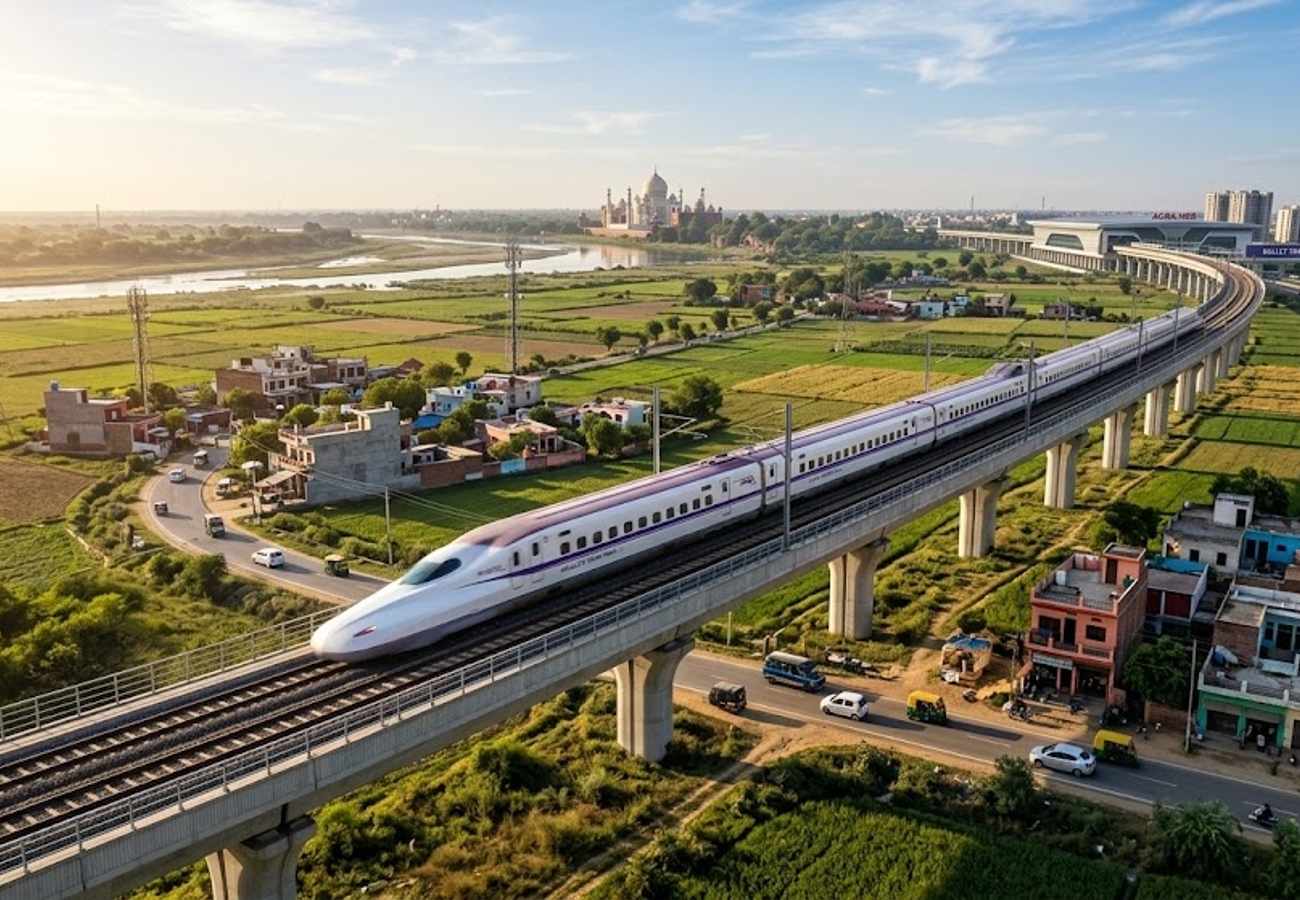
Image generated by AI
India is planning a massive high-speed rail expansion across North India, potentially reducing the trip from Delhi to Agra to under an hour and cutting the journey to Varanasi to approximately 3.5 hours.
The proposed bullet train corridor is designed to link the national capital, Delhi, with primary urban centers across Uttar Pradesh and Bihar. This infrastructure project targets a strategic alignment including Agra, Kanpur, Lucknow, Prayagraj, Varanasi, and Patna. By integrating these political, industrial, and spiritual hubs, the network aims to replace slower conventional transport with a high-capacity, rapid-transit alternative.
Strategic Route Alignment and Travel Time Reductions
The core of the proposal is a dramatic shift in regional mobility. Current transit between these cities relies on a mix of road, air, and standard rail, often plagued by congestion. The proposed high-speed rail (HSR) system would fundamentally alter the logistics of North Indian travel.
The most immediate impact is seen in the short-haul corridor between Delhi and Agra. Covering roughly 200 kilometers, the journey is expected to drop to just 58 minutes. This shift effectively turns Agra into a satellite destination for business and weekend tourism from Delhi.
Further east, the corridor connects critical administrative and industrial hubs:
- Delhi to Kanpur: Estimated travel time of 1 hour and 50 minutes.
- Delhi to Lucknow: Estimated travel time of 2 hours and 12 minutes.
Long-Distance Connectivity: Varanasi and Patna
The project extends its reach into eastern Uttar Pradesh and Bihar, targeting some of India's most visited cultural sites. The Delhi-Varanasi route, which spans nearly 945 kilometers, is projected to take approximately 3 hours and 33 minutes. Given Varanasi's status as a global spiritual destination, this reduction is expected to increase international tourist throughput.
The corridor terminates in Patna, the capital of Bihar. The proposed travel time from Delhi to Patna is estimated at 4.5 hours, a move that could integrate the regional economies of Bihar and Delhi more tightly than ever before.
Comparative High-Speed Rail Metrics
While the Delhi-Patna corridor is in the proposal phase, it builds on the technical foundation of the Mumbai–Ahmedabad High Speed Rail corridor. That project sets the benchmark for India's HSR ambitions.
| Route/Metric | Projected Travel Time / Speed | Key Detail |
|---|---|---|
| Delhi $\rightarrow$ Agra | 58 Minutes | ~200 km distance |
| Delhi $\rightarrow$ Kanpur | 1 Hour 50 Minutes | Industrial hub link |
| Delhi $\rightarrow$ Lucknow | 2 Hours 12 Minutes | Admin center link |
| Delhi $\rightarrow$ Prayagraj | ~3 Hours | Eastern UP link |
| Delhi $\rightarrow$ Varanasi | 3 Hours 33 Minutes | ~945 km distance |
| Delhi $\rightarrow$ Patna | 4.5 Hours | Bihar capital link |
| Mumbai-Ahmedabad (Max Speed) | 350 km/h | Operational speed ~320 km/h |
Why This Matters: Industry Analysis
From a logistical perspective, this corridor is not just about speed; it is about "de-bottlenecking" the North Indian transport grid. Our analysis of the route map suggests a strategic move to shift mid-distance passenger traffic away from saturated highways and overcrowded conventional rail lines.
For travelers and businesses, the real impact is the creation of a "mega-region." When a 945 km journey to Varanasi takes only 3.5 hours, the city becomes viable for a single-day business trip or a highly condensed tourist itinerary. This will likely trigger a surge in hospitality investment in secondary cities like Prayagraj and Kanpur.
Furthermore, this project marks a clear distinction between "semi-high-speed" and "true high-speed" rail. While the Vande Bharat trains have improved speeds on existing tracks, the bullet train corridor requires dedicated tracks to achieve 300+ km/h. This removes the conflict between freight trains and passenger expresses, which is the primary cause of delays in the current Indian rail system.
Forward Outlook
The immediate focus for Indian rail infrastructure remains the Mumbai–Ahmedabad corridor, specifically the initial operational section between Surat and Vapi. The success of this first phase will dictate the funding and timeline for the Delhi-Patna proposal.
If the North India corridor moves from planning to construction, expect a massive reallocation of tourism capital toward the "Golden Triangle" extensions. The integration of Patna and Varanasi into a high-speed loop with Delhi will likely catalyze a new wave of economic development in Bihar and Eastern Uttar Pradesh.
The transition from semi-high-speed to dedicated HSR corridors represents the most significant leap in Indian mobility since the introduction of the broad gauge.
Related Travel Guides
Disclaimer
This article is for informational and educational purposes only. It does not constitute legal, financial, or professional advice. While we strive to provide accurate and up-to-date information, travel policies, regulations, and conditions change rapidly. Always verify information with official sources before making travel decisions. Nomad Lawyer makes no representations about the accuracy, reliability, completeness, or suitability of the information provided. Readers should consult qualified professionals for advice specific to their circumstances. The views expressed in this article are those of the author and do not necessarily reflect the views of Nomad Lawyer.
Preeti Gunjan
Contributor & Community Manager
A passionate traveller and community builder. Preeti helps grow the Nomad Lawyer community, fostering engagement and bringing the reader experience to life.
Learn more about our team →