
Iceland Lead Europe’s Off Site Modular Eco-Resort Revolution, Transforming Wilderness Tourism With Sustainable Design
Iceland Lead Europe’s Off Site Modular Eco-Resort Revolution, Transforming Wilderness Tourism With Sustainable Design

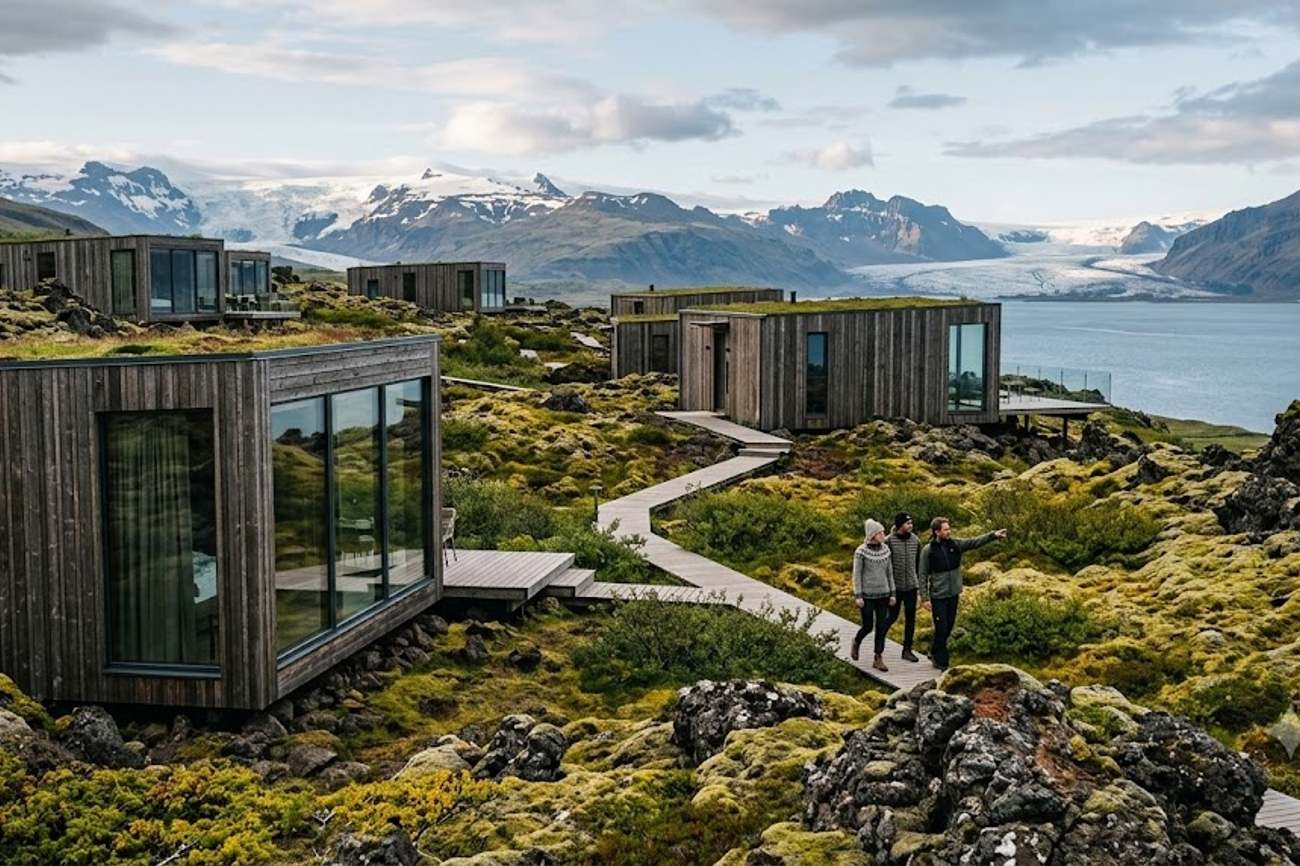
Image generated by AI
3.02 billion nights spent in tourist accommodations across the European Union serves as the stark baseline for a continent currently grappling with the physical limits of its own popularity. This volume of travel, compounded by a 9.7% surge in short-term platform bookings during the first quarter of 2026, has pushed Europe's most prized wilderness areas toward a state of regulatory and ecological saturation.
The Sub-Gateway Pivot and the Death of the Gateway Strip
The traditional model of nature tourism relied on "gateway strips"—dense corridors of hotels and services located immediately adjacent to national park entrances. However, these zones have become operational bottlenecks characterized by vehicular gridlock, pedestrian congestion, and intense civic resistance from local populations. In response, institutional developers are migrating toward a "sub-gateway" strategy, positioning low-density, high-end assets 15 to 30 minutes outside the primary access points.
This spatial shift is not merely a preference for tranquility; it is a survival mechanism for the hospitality industry. By moving away from the saturated primary hubs, developers can avoid the moratoriums on new construction that plague high-density tourist zones. This model was previously validated in the United States, specifically in Tennessee, where the developer Ofland deployed 75 modular cabins, each measuring 345 square feet, manufactured by Wind River Built. These units were strategically placed five minutes from the Cades Cove entrance of the Great Smoky Mountains National Park, proving that guests are willing to trade immediate proximity for an immersive, "peaceful" experience.
In Europe, however, the transition to sub-gateway sites is complicated by a rigid legal framework. Unlike the more permissive zoning laws of North America, European rural corridors are governed by strict municipal land classifications and international conservation treaties. To operate within these sensitive buffer zones, the industry has moved away from "wet construction"—traditional on-site building involving concrete and heavy machinery—in favor of off-site modular prefabrication.
The Technical Shift: From Concrete to Precision Engineering
The move toward modularity is driven by the impossibility of managing traditional construction in remote, ecologically sensitive areas. Traditional building sites in the Julian Alps or the North Atlantic coast face narrow weather windows, chronic labor shortages, and the risk of permanent environmental degradation. Prefabricated suites are instead engineered in ISO-certified industrial environments, where precision is guaranteed and waste is minimized.
The following data outlines the operational divergence between the failing gateway model and the emerging sub-gateway modular approach:
| Spatial Planning Parameter | Overcrowded Primary Gateway Strips | Sub-Gateway Modular Nature Escapes | Strategic Operating Impact |
|---|---|---|---|
| Location Profile | Direct park entry highway strips | 15–30 minute perimeter buffer communities | Eliminates traffic friction; enhances immersion |
| Asset Density | High-density concrete (100–300 keys) | Dispersed modular pavilions (20–75 keys) | Superior acoustic and spatial privacy |
| Permitting Risk | Infrastructure moratoriums | Support for rural economic dispersion | Alignment with EU carrying-capacity mandates |
| Guest Profile | Mass tours, budget segments | High-net-worth, eco-tourists | Increased pricing power and higher ADR |
| Eco-Impact | Heavy surface sealing, high grid load | Reversible foundations, micro-utilities | Preservation of topsoil and hydrology |
Expert Analysis: The Regulatory Pincer Movement
For the modern developer and the luxury traveler, the shift to modular sub-gateways is the result of a "regulatory pincer movement" created by three distinct European Union mandates.
First, the European Commission manages the Natura 2000 network, which protects over 18% of the EU's terrestrial land. Under the 1992 Habitats Directive (Directive 92/43/EEC), specifically Article 6, any project likely to affect a protected site must undergo an "Appropriate Assessment." Traditional construction—which involves heavy excavation and aquifer disruption—almost always fails this assessment. Modular units, often placed on reversible screw-piles, leave the topsoil intact, allowing developers to bypass the "net deterioration" trigger that kills most traditional permits.
Second, the recast Energy Performance of Buildings Directive (Directive (EU) 2024/1275) has mandated a Zero-Emission Building (ZEB) standard. This requires new structures to produce zero on-site greenhouse gas emissions from fossil fuels. Achieving these thermal metrics in a remote mountain microclimate using local subcontractors is a logistical nightmare. By shifting the building envelope assembly to a factory, developers can ensure airtightness and thermal efficiency that meet the ZEB standard before the unit even reaches the site.
Iceland's shift toward modular eco-resorts aligns with national goals to balance luxury tourism with strict environmental preservation. Travelers can coordinate their arrivals through Visit Iceland, the official tourism portal, to discover sustainable lodging options across the island's remote wilderness.
Finally, there is the financial pressure of the EU Sustainable Finance Taxonomy (Regulation (EU) 2020/852). To secure institutional funding, a project's Primary Energy Demand (PED) must be at least 10% lower than national Nearly Zero-Energy Building (nZEB) thresholds. This creates a direct cause-and-effect relationship: if a developer wants low-cost institutional capital, they must use high-precision modular construction.
For the traveler, the direct consequence is a shift in the "luxury" definition. Luxury is no longer about the size of the hotel or the proximity to the park gate; it is about the exclusivity of a low-impact, thermally perfect pavilion located in a zone that was previously legally untouchable.
Key Takeaways
- Spatial Migration: Hospitality is moving 15–30 minutes away from primary park entrances to avoid "gateway" congestion and regulatory moratoriums.
- Modular Mandate: Off-site prefabrication is no longer a choice but a requirement to meet the EU's Zero-Emission Building (ZEB) and Natura 2000 standards.
- Financial Incentives: Access to institutional funding now requires compliance with the EU Sustainable Finance Taxonomy, favoring factory-built precision over on-site construction.
- Environmental Preservation: The use of reversible foundations and closed-loop utilities is replacing heavy surface sealing to protect critical European aquifers and topsoil.
- Market Pivot: There is a clear transition from mass-market "bus tour" infrastructure to low-density, high-ADR (Average Daily Rate) experiential eco-tourism.
FAQ: European Nature Tourism 2026
Will these new modular hotels be more expensive for travelers? Yes. Because these assets target high-net-worth individuals and operate with lower key counts (20–75 keys), they command premium pricing. The cost is justified by increased privacy and the exclusivity of the sub-gateway location.
How do "reversible foundations" work in these wilderness areas? Instead of pouring concrete slabs, developers use screw-piles—large steel screws bored into the ground. This prevents "surface sealing," allows water to flow naturally, and means the structure can be removed without leaving a permanent scar on the land.
Does the Natura 2000 network ban all new hotels in protected areas? Not entirely, but it mandates a strict "Appropriate Assessment" under Article 6 of the Habitats Directive. Only projects that prove zero net deterioration of the habitat are approved, which is why modular, low-impact designs are now the industry standard.
What is a "sub-gateway" site? A sub-gateway is a location situated 15 to 30 minutes outside the main entrance of a national park or nature reserve. It provides a buffer from the traffic and crowds of the primary entry point while remaining accessible.
The era of the concrete hotel at the park gate is ending; the era of the invisible, engineered pavilion has begun.
Tags: Natura 2000, EU Habitats Directive, Modular Hospitality 2026, Zero-Emission Buildings, Sub-Gateway Tourism, EU Sustainable Finance Taxonomy
Related Travel Guides
- Mumbai’s Grounded Reinvents Classic Toast Experience With The Toast Takeover Featuring Bold New Flavours
- UAE Pairs With Saudi Arabia, Morocco, South Africa and India To Lead Historic Michelin Distinction Drive As Michelin Guide Honors Exceptional Luxury Stays
- Thailand Draws Food Travellers With Exclusive Torino Inspired Menu at Four Seasons Hotel Bangkok
Disclaimer
This article is for informational and educational purposes only. It does not constitute legal, financial, or professional advice. While we strive to provide accurate and up-to-date information, travel policies, regulations, and conditions change rapidly. Always verify information with official sources before making travel decisions. Nomad Lawyer makes no representations about the accuracy, reliability, completeness, or suitability of the information provided. Readers should consult qualified professionals for advice specific to their circumstances. The views expressed in this article are those of the author and do not necessarily reflect the views of Nomad Lawyer.
Kunal K Choudhary
Co-Founder & Contributor
A passionate traveller and tech enthusiast. Kunal contributes to the vision and growth of Nomad Lawyer, bringing fresh perspectives and driving the community forward.
Learn more about our team →