
China Completes the World's Tallest Bridge: The Huajiang Grand Canyon Megastructure Opens
Suspended a terrifying 2,050 feet above the Beipan River, the Huajiang Grand Canyon Bridge has officially opened in Guizhou, transforming a two-hour trek into a two-minute glide.

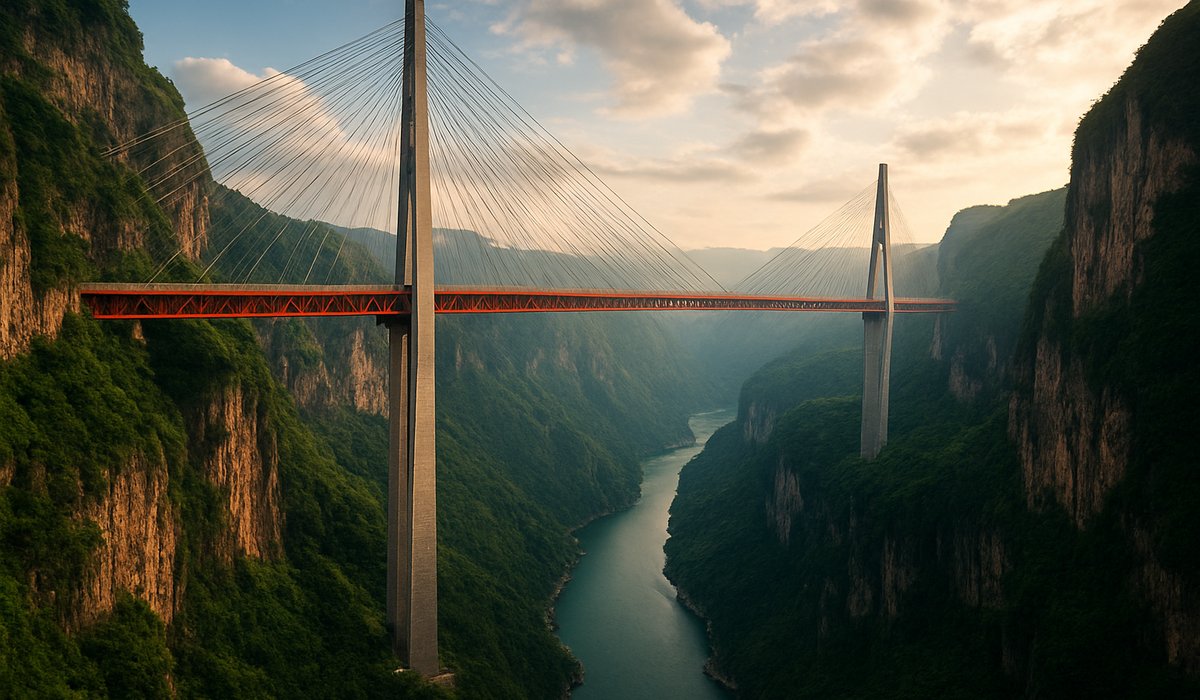
Image generated by AI
A Masterpiece of Vertical Engineering
Shattering all mathematical limits of structural engineering, China has officially opened the Huajiang Grand Canyon Bridge in the dense, mountainous terrain of Guizhou province, formally claiming the title of the world's tallest bridge. Suspended an absolutely terrifying 625 meters (roughly 2,050 feet) above the violently rushing Beipan River, this sweeping suspension megastructure completely eclipses the previous record-holder (the nearby Duge Beipanjiang Bridge) and stands as an unrivaled testament to modern infrastructure.
For centuries, navigating the jagged limestone cliffs of the Huajiang Grand Canyon required a grueling, highly treacherous two-hour journey through hairpin mountain switchbacks. As of early 2026, that punishing geographic chasm has been entirely negated. Vehicles can now effortlessly glide across the canyon in exactly two minutes. However, the impact of this structure extends far beyond regional commuting; it represents a massive pivot in global "Infrastructure Tourism," with severe thrill-seekers and architectural historians rushing to Guizhou specifically to witness this vertical anomaly.
Infrastructure as a Prime Tourist Destination
The sheer scale of the Huajiang Grand Canyon Bridge has instantly placed it on highly prestigious "Greatest Places of 2026" lists globally.
China's southwestern provinces are increasingly treating these massive infrastructural hubs not just as roads, but as highly monetized tourism ecosystems. The bridge incorporates heavily fortified pedestrian viewing platforms and localized visitor centers engineered directly into the cliff-faces, allowing luxury tourists to safely photograph the terrifying drop into the gorge below. For the global adventurer, this structure serves as the ultimate anchor point for exploring the broader, highly dramatic karst landscapes of Guizhou.
Global Tallest Bridge Rankings (2026)
| Rank | Bridge Name | Location | Height from River Deck |
|---|---|---|---|
| 1st | Huajiang Grand Canyon Bridge | Guizhou, China | 625 meters (2,050 ft) |
| 2nd | Duge Beipanjiang Bridge | Guizhou/Yunnan, China | 565 meters (1,854 ft) |
| 3rd | Puli Bridge | Yunnan, China | 485 meters (1,591 ft) |
What Guests Get
- Redefining fear of heights — realizing that looking down from the Huajiang bridge is mathematically equivalent to looking off the roof of a 200-story skyscraper.
- Micro-economic accessibility — grasping that this infrastructure finally connects hyper-remote, localized indigenous villages directly to major Chinese economic hubs.
- Aesthetic dominance — witnessing the sheer contrast between ancient, jagged limestone geology and hyper-modern, red-painted suspension cables cutting through the clouds.
What This Means for Travelers
If you are planning an itinerary to Southwest China in 2026: You must heavily recalibrate your understanding of regional driving times. Previous guidebooks from 2024 and 2025 are completely obsolete; what used to be a full-day, exhausting transit between isolated canyon villages is now a fast, multi-lane highway connection. If you plan to self-drive or hire a private vehicle to cross the Huajiang bridge, ensure you check local weather advisories. The canyon frequently produces highly aggressive crosswinds and sudden heavy fog, which can legally force local authorities to temporarily close the span to high-profile vehicles.
Integrating with Guizhou Tourism: Do not solely cross the bridge and leave. Guizhou province is currently one of China's most heavily promoted ecological zones. Use the time saved by the bridge to aggressively explore the region's massive underground cave systems (such as Zhijin Cave) or the ancient, culturally rich Miao and Dong ethnic minority villages that form the cultural backbone of the province.
FAQ: The Huajiang Grand Canyon Bridge
Is the Huajiang Bridge the longest or the tallest? It is strictly the tallest bridge in the world, measuring the absolute vertical distance from the bridge deck directly down to the surface of the river below. It is not the longest continuously spanning bridge in the world.
Can pedestrians walk on the bridge? While the primary span is heavily dedicated to high-speed vehicular traffic, the architectural integration features specific, highly engineered viewing zones on the canyon rims specifically designed for pedestrian tourists and photography.
Where exactly is Guizhou? Guizhou is a heavily mountainous, landlocked province situated in the southwestern region of China, bordering the better-known provinces of Sichuan to the north and Yunnan to the west.
External Resources
- China Ministry of Transport Official Data
- Guizhou Province Tourism Bureau
- Huajiang Bridge Engineering Documentation
Related Travel Guides
The Ultimate Southwest China Road Trip Itinerary 2026
Disclaimer
This article is for informational and educational purposes only. It does not constitute legal, financial, or professional advice. While we strive to provide accurate and up-to-date information, travel policies, regulations, and conditions change rapidly. Always verify information with official sources before making travel decisions. Nomad Lawyer makes no representations about the accuracy, reliability, completeness, or suitability of the information provided. Readers should consult qualified professionals for advice specific to their circumstances. The views expressed in this article are those of the author and do not necessarily reflect the views of Nomad Lawyer.
Raushan Kumar
Founder & Lead Developer
Full-stack developer with 11+ years of experience and a passionate traveller. Raushan built Nomad Lawyer from the ground up with a vision to create the best travel and law experience on the web.
Learn more about our team →