
How Nationwide Maritime Injury Lawyers Protect Injured Seamen
Commercial fishing and maritime work are among the most dangerous jobs. Learn how nationwide maritime injury lawyers protect injured seamen under the Jones Act.

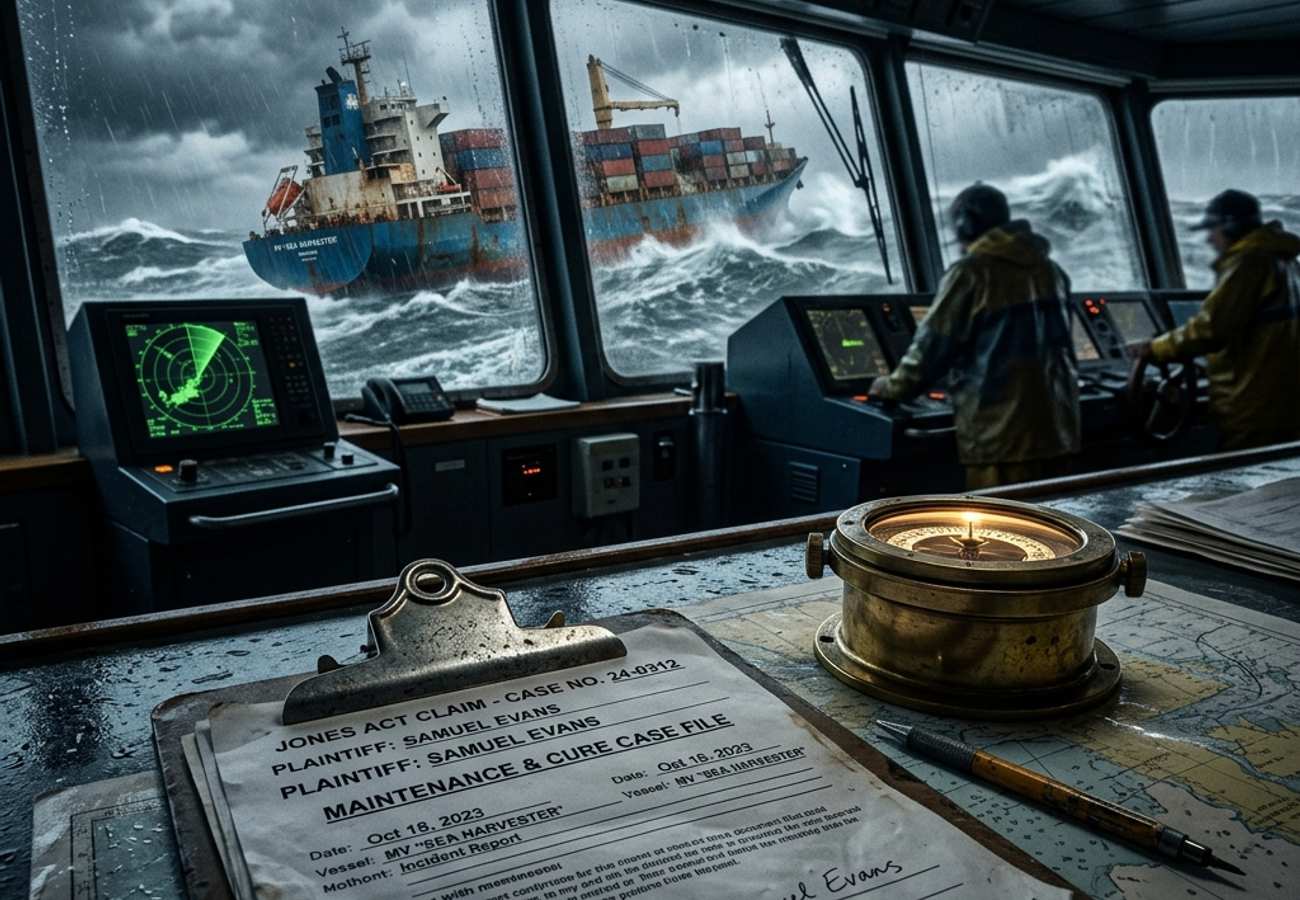
Image generated by AI
Commercial fishing consistently ranks among the most dangerous occupations in the United States — the Bureau of Labor Statistics' 2022 occupational fatality data lists fishing workers at a fatality rate more than 20 times the national average for all occupations. Yet the legal protections available to injured seamen remain among the most misunderstood in American law, layered with federal statutes, admiralty jurisdiction, and doctrines that have no equivalent on land. When a deckhand suffers a back injury hauling gear 60 miles offshore, or a merchant mariner is burned in an engine room fire, the legal path forward looks nothing like a standard workers' compensation claim.
That disconnect creates serious consequences. Maritime workers often don't realize their rights differ fundamentally from those of land-based employees, and employers — along with their insurers — routinely exploit that gap. As offshore energy development expands along the Gulf Coast and shipping traffic through major ports continues climbing, the volume of maritime injury claims is growing alongside increasingly sophisticated defense tactics by vessel operators and P&I clubs.
What actually separates injured seamen who secure meaningful compensation from those who don't is rarely the severity of their injuries. More often, it's the quality and specialization of legal representation they access from the start. This article examines how nationwide maritime injury lawyers work, what makes these cases uniquely complex, and what effective representation actually looks like for workers navigating these high-stakes claims.
Why Nationwide Maritime Injury Legal Representation Matters Now
Maritime work doesn't confine itself to a single jurisdiction — and neither do the injuries that come with it. A tugboat crew member injured in Houston may need representation that spans Texas state courts, federal admiralty jurisdiction, and potentially international law if the vessel operated under a foreign flag. A commercial diver hurt on an offshore platform off Louisiana might have overlapping claims under the Jones Act, the Outer Congressional Shelf Lands Act, and general maritime law simultaneously. Local attorneys without dedicated maritime experience frequently miss these intersecting frameworks, sometimes fatally undermining a client's case.
The current legal environment makes specialized representation even more consequential. Vessel operators and their insurers have grown increasingly aggressive in disputing the seaman status of injured workers — a threshold determination that controls whether the powerful protections of the Jones Act even apply. Employers argue that platform workers, harbor employees, or workers on vessels in dry dock aren't "seamen" under the legal definition, stripping those individuals of their strongest legal remedies before a claim even gets started. Challenging these determinations requires attorneys who track evolving case law from the Fifth, Ninth, and Eleventh Circuits, where the majority of maritime injury litigation is concentrated.
Consider a realistic scenario: a crane operator working aboard a derrick vessel for an offshore construction contractor is injured when equipment fails. His employer immediately classifies him as a "land-based" worker and directs him to a standard workers' compensation adjuster. Without counsel who understands how courts have defined vessel-based work, that operator might accept a fraction of what he'd recover under Jones Act negligence — not because his claim was weak, but because no one identified it correctly in the first place.
The expansion of the offshore wind industry along the Atlantic Coast is also generating new categories of maritime workers whose legal status remains actively contested in courts. Nationwide representation matters precisely because the attorneys handling these emerging fact patterns are concentrated in a handful of specialist firms, not in every coastal city where workers might live.
How Maritime Injury Lawyers Prepare and Handle Cases
The work maritime injury lawyers do before a case is ever filed often determines its outcome. Because injuries happen at sea, on platforms, or aboard vessels that continue operating after an accident, the evidence landscape deteriorates quickly. Experienced practitioners understand that the first 72 hours after an injury are as legally significant as anything that happens in a courtroom.
Investigative Methods and Expert Witness Use
Maritime injury investigations are categorically different from land-based accident work. Attorneys coordinate with marine surveyors, naval architects, and Coast Guard accident report specialists to reconstruct what happened aboard a vessel — often before the ship returns to port and before the employer's own investigation can shape the narrative. Maintenance records, vessel logs, safety inspection reports, and crew manifests are subject to spoliation if not preserved through formal legal holds early in the process.
Expert witnesses play an outsized role in maritime cases. A claim involving an unseaworthy vessel requires testimony from maritime safety engineers who can speak to industry standards under the International Safety Management Code. A Jones Act negligence case might call for a maritime medicine specialist to address the long-term consequences of an injury sustained far from shore, where delays in medical treatment often compound the harm. These aren't generic expert witnesses — they're specialists whose credibility with admiralty judges and juries requires extensive vetting.
Negotiation and Litigation Tactics
Maritime cases rarely begin with a straightforward negotiation. Vessel operators almost always tender an immediate offer of maintenance and cure — a no-fault obligation to cover a seaman's basic living expenses and medical treatment — while simultaneously building a defense against the larger negligence or unseaworthiness claims. Experienced maritime injury lawyers recognize this dynamic and structure early negotiations to avoid waiving larger claims in exchange for prompt but inadequate maintenance payments.
When cases proceed to litigation, admiralty courts operate under procedural rules distinct from standard civil practice. Attorneys experienced in this forum understand how to use Rule B maritime attachments, how to navigate forum selection clauses in employment agreements, and when to push for jury trials versus bench trials in front of admiralty judges. These tactical decisions can meaningfully shift case outcomes — and they require practitioners who litigate in these courts regularly, not occasionally.
Unique Challenges and Complexities in Maritime Injury Law
Maritime law occupies a distinct constitutional and statutory space that regularly surprises even experienced general practice attorneys. The Jones Act (46 U.S.C. § 30104) provides qualified seamen with a negligence remedy against their employers, but "seaman" status is a contested legal question with an extensive body of federal case law defining it. The Longshore and Harbor Harbor Workers' Compensation Act (LHWCA) covers a different class of maritime workers — dock workers, shipbuilders, and certain harbor employees — under an administrative compensation scheme rather than the tort system. Misidentifying which statute governs a claim can mean pursuing the wrong legal theory entirely.
Unseaworthiness claims add another layer. A vessel owner's duty to provide a seaworthy ship is absolute — it doesn't require proving negligence — but courts have developed nuanced doctrine around what "unseaworthy" means, distinguishing transient conditions from permanent defects, and addressing how third-party contractor equipment aboard a vessel can trigger the shipowner's liability. These distinctions aren't academic; they determine whether a case survives summary judgment.
The statute of limitations adds further complexity. Jones Act claims carry a three-year limitations period, but general maritime law claims and LHWCA administrative claims run on different timelines. Cruise ship passenger injury claims — governed by the Athens Convention and typically subject to contractual limitations clauses buried in ticket fine print — may require notice and suit within as little as one year. Missing these deadlines ends the case permanently, regardless of its merits.
One persistent misconception worth addressing: many maritime workers believe that accepting maintenance and cure payments means they've resolved all claims against their employer. It doesn't. Maintenance and cure is a separate obligation from Jones Act negligence damages, and accepting one doesn't extinguish the other — though employers frequently imply otherwise during the early stages of a claim.
Success Rates, Best Practices, and Industry Trends Among Maritime Injury Lawyers
Evaluating maritime injury lawyer performance requires looking beyond simple win/loss ratios, which are rarely published and often misleading in a field where most cases settle. What distinguishes highly effective practitioners is a combination of jurisdictional depth, case volume in specific practice areas, and demonstrated familiarity with the defense firms and insurers they routinely face.
The most consistently effective maritime injury attorneys maintain active relationships with maritime medicine specialists, vocational rehabilitation experts, and actuarial professionals who can model lifetime earnings loss for workers injured at the height of their careers. A 35-year-old able seaman with a career-ending back injury has a dramatically different damages calculation than what a standard personal injury framework would generate — accounting for the wage premium that experienced mariners earn, their advancement trajectory, and the specific physical demands that prevent return to sea.
An emerging trend reshaping maritime injury litigation is the increasing use of vessel-based digital evidence. Modern commercial vessels generate enormous volumes of electronically stored information — voyage data recorders, GPS tracking, engine performance logs, and crew communication records — that can either establish or undermine an employer's account of how an accident occurred. Attorneys who build digital evidence protocols into their early case strategy are increasingly separating themselves from practitioners who rely primarily on witness testimony in disputes where the employer controls the narrative.
The broader industry trend toward remote inspection and virtual court proceedings, accelerated during the pandemic and now embedded in admiralty practice, has also changed the calculus on geographic representation. Attorneys operating from established maritime law hubs — Houston, New Orleans, Seattle, Miami — can now effectively handle cases arising in regions where no local specialist exists, which is partly what makes nationwide practice more viable and meaningful than it was a decade ago.
How Nationwide Maritime Injury Lawyers Support Injured Seamen Beyond Litigation
Effective maritime legal representation extends well beyond the courtroom, and for many injured seamen, the non-litigation aspects of their lawyer's role are equally consequential. Ensuring that an employer fulfills its maintenance and cure obligations is often the most immediate practical priority after an injury — because without steady maintenance payments and covered medical treatment, a seaman can face severe financial pressure that pushes them toward premature settlement.
Lawyers experienced in this area monitor maintenance payments actively, identify when employers are improperly terminating cure before a seaman reaches maximum medical improvement, and pursue enhanced penalties available when employers act in bad faith. Courts have recognized an employer's obligation to act promptly and in good faith in handling maintenance and cure — and the consequences for willful failure include punitive damages that create real deterrence.
Client counseling around recorded statements and independent medical examinations is another area where early intervention matters enormously. Employers and their insurers routinely request recorded statements from injured seamen in the days following an accident, and the answers given during those conversations can be used to undercut a claim years later. Similarly, IME physicians retained by shipowners frequently apply evaluation frameworks designed to minimize injury severity — understanding how to contest those findings requires both legal and medical sophistication.
The long-term advocacy role is perhaps most visible in wrongful death claims, where maritime lawyers guide surviving families through the overlapping remedies available under the Death on the High Seas Act, general maritime law, and state law — each with different damage structures and beneficiary eligibilities. For families who've lost a spouse or parent to a maritime accident, navigating that complexity without specialized counsel rarely ends well. The question worth asking before any maritime injury claim proceeds: does the attorney handling this case litigate in admiralty courts regularly, or does maritime law represent a small fraction of a general practice?
Related Travel Guides
Who Pays After an Uber or Lyft Accident?
Relocating to Houston? Immigration Issues Every Family Should Understand
Maritime Injury Settlements & Jones Act Litigation, According to Reddit
Disclaimer
This article is for informational and educational purposes only. It does not constitute legal, financial, or professional advice. While we strive to provide accurate and up-to-date information, travel policies, regulations, and conditions change rapidly. Always verify information with official sources before making travel decisions. Nomad Lawyer makes no representations about the accuracy, reliability, completeness, or suitability of the information provided. Readers should consult qualified professionals for advice specific to their circumstances. The views expressed in this article are those of the author and do not necessarily reflect the views of Nomad Lawyer.
Preeti Gunjan
Contributor & Community Manager
A passionate traveller and community builder. Preeti helps grow the Nomad Lawyer community, fostering engagement and bringing the reader experience to life.
Learn more about our team →