
Hidden Above the Clouds: Inside the Airbus A380's Secret Crew Rest Quarters
Breaking airline news and aviation industry updates for 2026.

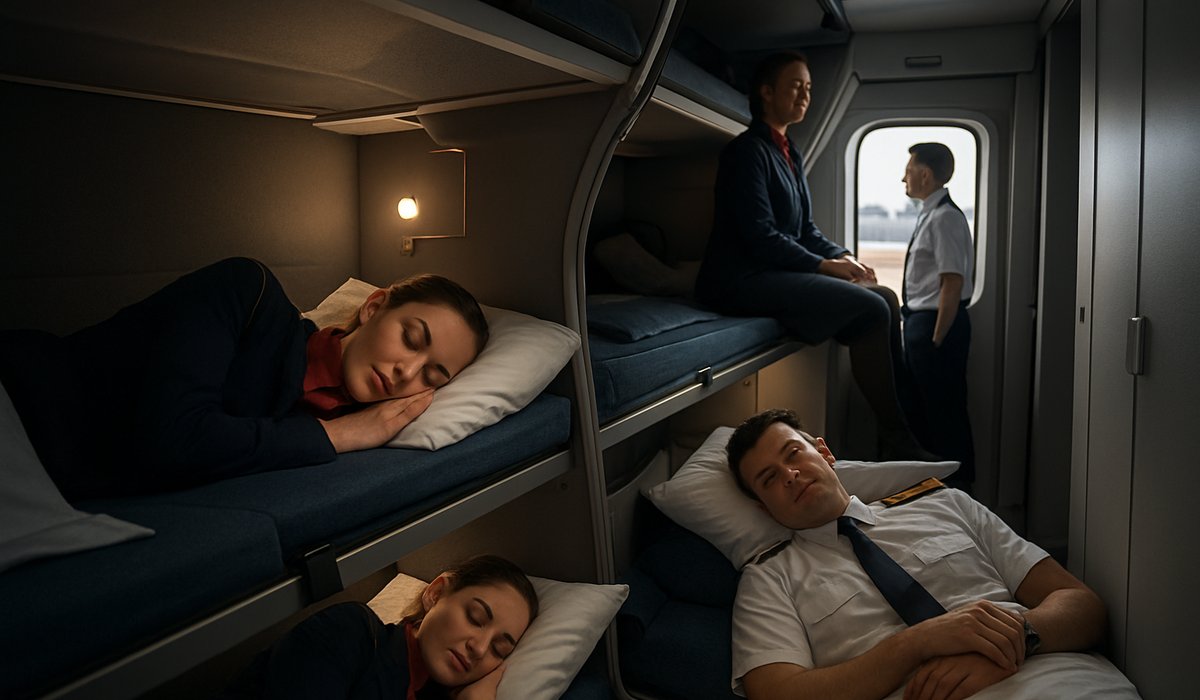
Image generated by AI
Hidden Above the Clouds: Inside the Airbus A380's Secret Crew Rest Quarters
How the world's largest passenger aircraft keeps flight attendants alert during marathon transpacific routes
The A380's Purpose-Built Sanctuary
The Airbus A380 operates fundamentally differently from conventional wide-body aircraft when it comes to crew management on ultra-long-haul flights. Rather than relying on improvised rest solutions—such as flight attendants rotating through cramped jump seats or makeshift napping areas—the double-deck superjumbo features a dedicated, enclosed crew rest compartment engineered directly into the aircraft's structural design. This specialized facility represents a significant operational advantage for airlines operating the world's most demanding transpacific and intercontinental routes.
Strategic Crew Rotation Maintains Service Standards
Airlines deploying the A380 on extended international routes implement carefully coordinated rest schedules, cycling flight attendants through mandatory breaks during flight operations. This systematic rotation accomplishes two critical objectives: maintaining consistent passenger service quality throughout multi-hour flights while simultaneously ensuring crew members remain cognitively sharp for emergency situations that demand immediate, precise responses.
The stakes are particularly high during prolonged flights. Fatigue-related degradation in crew alertness can compromise response times during turbulence encounters, in-flight medical emergencies, aircraft diversions, or—most critically—evacuation procedures. By providing legitimate rest facilities rather than forcing crew into suboptimal sleeping conditions, the A380 addresses a fundamental aviation safety and crew welfare concern.
A Departure from Industry Standard
Competing wide-body aircraft including the Boeing 777, Airbus A350, and A330 rely on less formal crew rest arrangements, often utilizing crew lounges or designated seating areas. The A380's integrated compartment marks a technological step forward, acknowledging that long-haul aviation demands thoughtful infrastructure investment.
This design philosophy reflects broader industry recognition that crew fatigue represents a measurable safety variable. Regulatory bodies including the FAA and EASA have increasingly scrutinized flight time and rest period regulations, implementing stricter limitations on consecutive flight hours to combat pilot and cabin crew exhaustion.
Operational Implications for Global Airlines
Major A380 operators including Emirates, Singapore Airlines, Lufthansa, and Air France have optimized their crew scheduling protocols around these built-in rest facilities. The aircraft's configuration allows these carriers to maintain competitive service standards on routes stretching 15+ hours while simultaneously adhering to international crew welfare standards—a balance that translates directly to passenger safety and satisfaction.
As aviation continues evolving toward longer ultra-long-haul routes, the A380's crew rest infrastructure increasingly represents an industry benchmark for balancing operational efficiency with human factors considerations.
FAQ: A380 Crew Rest & Long-Haul Aviation
Q: Where is the A380 crew rest compartment located? A: The dedicated rest quarters are built into the aircraft's upper deck structure, separate from main passenger seating areas.
Q: How many crew members can use the rest facility simultaneously? A: The compartment accommodates multiple flight attendants in rotation, though exact capacity varies by airline configuration.
Q: Do other aircraft have crew rest facilities? A: Some wide-bodies offer informal rest areas, but the A380's purpose-built compartment is uniquely integrated into the aircraft's design.
Q: Why is crew rest important for flight safety? A: Fatigue impairs crew response times during emergencies including medical situations, turbulence, and evacuations—making rest critical for passenger safety.
Q: Which airlines operate A380s with crew rest facilities? A: Emirates, Singapore Airlines, Lufthansa, Air France, and several other international carriers utilize A380 crew rest capabilities on their longest routes.
Related Travel Guides
Disclaimer
This article is for informational and educational purposes only. It does not constitute legal, financial, or professional advice. While we strive to provide accurate and up-to-date information, travel policies, regulations, and conditions change rapidly. Always verify information with official sources before making travel decisions. Nomad Lawyer makes no representations about the accuracy, reliability, completeness, or suitability of the information provided. Readers should consult qualified professionals for advice specific to their circumstances. The views expressed in this article are those of the author and do not necessarily reflect the views of Nomad Lawyer.
Preeti Gunjan
Contributor & Community Manager
A passionate traveller and community builder. Preeti helps grow the Nomad Lawyer community, fostering engagement and bringing the reader experience to life.
Learn more about our team →