
Carved from River Ice: Inside Harbin’s Record-Breaking Winter Tourism Phenomenon and China’s Frozen Frontier

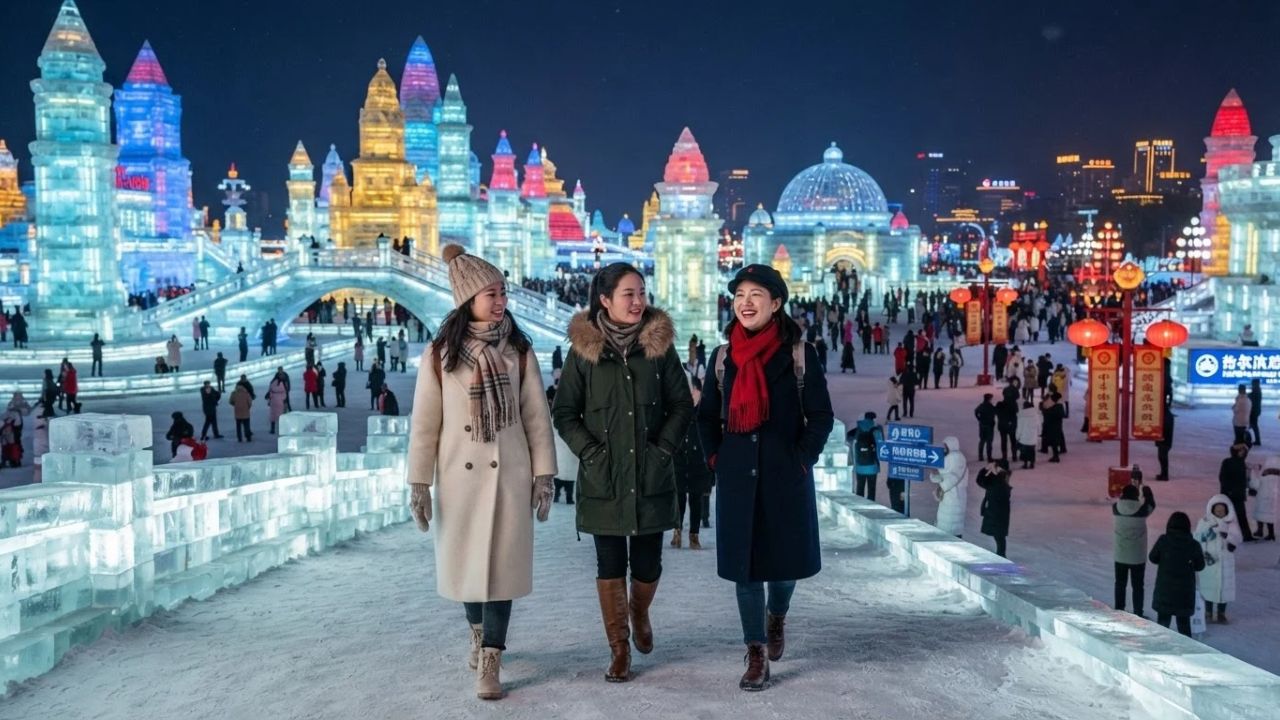
When winter temperatures plunge past minus thirty degrees Celsius across northeastern China, life does not retreat indoors; instead, armies of ice carvers harvest hundreds of thousands of cubic meters of crystalline blocks from the frozen Songhua River to erect monumental glowing pagodas, palaces, and super-slides. Driving an extraordinary national economic phenomenon that generated an estimated CNY 450 billion across 360 million projected ice-and-snow leisure visits during the 2025–26 season, Harbin set an all-time benchmark when a record-shattering single-day crowd of over 120,000 visitors entered Harbin Ice-Snow World on 19 February 2026.
For international travelers accustomed to viewing northern China through the lens of Beijing's historic imperial monuments or Shanghai's glass skylines, the frozen northeast (Dongbei) represents a completely distinct cultural realm. Anchored by the capital of Heilongjiang province, this frost-bound territory blends Russian neoclassical architecture, hearty borderland cuisine, and cutting-edge ice engineering. Now, bolstered by expanding inbound border exemptions and high-speed rail corridors, China's ice capital has evolved from a regional winter novelty into one of the world's most astonishing seasonal travel spectacles.
The Frozen Metamorphosis: Inside China’s CNY 450 Billion Ice Economy
The sheer magnitude of China’s winter tourism boom was unveiled at the 2026 Ice and Snow Tourism Development Conference in Harbin. According to the comprehensive development report issued by the China Tourism Academy, approximately 220 million of the 360 million projected seasonal visits were motivated primarily by ice and snow experiences, establishing cold-weather recreation as a premier driver of domestic and international consumer spending.
This seasonal momentum culminated in the 42nd China Harbin International Ice and Snow Festival, which officially opened its doors on 5 January 2026 at Harbin Ice-Snow World. Spanning ten thematic winter tourism corridors and more than 200 cultural, athletic, and trade programs, the festival transformed the provincial capital into an illuminated ice kingdom. Beyond the glowing towers of Ice-Snow World, visitors engaged with the colossal snow carvings of the Sun Island Snow Expo, evening ice lantern celebrations in Zhaolin Park, and world-class ski slopes across the region.
The economic power of this frozen sector was demonstrated during the nine-day national Spring Festival holiday, held from 15 to 23 February 2026. Across China, domestic journeys reached an unprecedented 596 million trips, generating CNY 803.5 billion in nationwide tourism spending. Heilongjiang province alone captured 30.094 million tourist visits during the holiday window—a 14.6% increase compared to the prior year—generating approximately CNY 38.79 billion in visitor spending, up 15.3%.
Beyond Harbin's urban core, the travel boom rippled across the province:
- Yabuli Ski Resort: Hosted more than 200,000 winter sports enthusiasts across the Spring Festival period, serving as China’s premier alpine training ground.
- China Snow Town (Zhongguo Xuexiang): Welcomed approximately 170,000 travelers, captivated by traditional timber cottages adorned with pillowy "snow mushrooms" formed by prevailing Siberian winds.
- Cross-Border Travel Surges: China logged 17.796 million total cross-border entries and exits during the holiday, with foreign nationals accounting for 1.313 million border crossings—representing a daily average rise of 21.8% year on year. Approximately 460,000 international visitors entered under expanding visa-free frameworks, marking a 28.5% daily average jump.
Decoding China's Inbound Travel Framework for the Americas
A significant catalyst behind this international influx is China’s calibrated entry policies, which provide varied travel pathways for visitors across the Americas:
- Unilateral Visa-Free Access: Passport holders from Canada, Brazil, Argentina, Chile, Peru, and Uruguay can enter China without an advance visa for tourism, business, and family visits under prevailing bilateral and unilateral accords.
- 240-Hour Visa-Free Transit: Travelers holding United States or Mexican citizenship do not have unilateral visa-free entry, but can leverage the 240-hour (10-day) visa-free transit facility when transiting through designated international gateways to a third country or territory, provided strict ticketing and itinerary criteria are fulfilled.
Because immigration protocols require documented forward travel and specific municipal registration, travelers must verify real-time entry guidelines through official consular platforms before embarking on their journey.
What Makes Harbin and Heilongjiang Unique
Harbin’s character is distinct from any other Chinese metropolis. Established in 1898 during the construction of the Russian-built Chinese Eastern Railway, the city developed as an international railway boomtown where Russian engineers, Jewish merchants, and European architects settled beside native Manchu and Han communities.
This cross-cultural legacy is preserved along Zhongyang Pedestrian Street (Central Avenue), a cobblestone promenade lined with Baroque, Renaissance, and Eclecticist facades that look as though they were lifted directly from 19th-century Saint Petersburg. Dominating the nearby urban square is the Saint Sophia Cathedral, an iconic Russian Orthodox sanctuary featuring dark-green Byzantine onion domes and rich red-brick arches.
The winter environment itself is a masterclass in thermal adaptation. Rather than resisting the sub-zero chill, Harbin embraces it as an artistic medium. The water drawn from the Songhua River freezes into flawless, translucent ice blocks devoid of trapped air bubbles, allowing master sculptors to construct translucent replicas of ancient Buddhist pagodas, gothic bell towers, and towering dragons illuminated from within by programmable computer-controlled LED arrays.
Visitor Insider Tips: Surviving and Thriving in Sub-Zero Harbin
Experiencing the ice capital without freezing requires hyper-local knowledge and specialized winter preparation. As highlighted by China Highlights and transit updates via China Railway, strategic planning makes the difference between misery and wonder.
- Master the Three-Layer Extreme-Cold Armor: Normal winter attire will fail in Harbin. Dress using a moisture-wicking synthetic or merino wool base layer, a heavy fleece or down mid-layer, and a windproof, waterproof outer down parka rated to -30°C. Wear thick felt insoles inside waterproof snow boots, wool mittens (which keep fingers warmer than separated gloves), and a wind-blocking balaclava. Exposed facial skin freezes within minutes during river breezes.
- Combat Sudden Smartphone Battery Shutdown: Extreme sub-zero temperatures cause lithium-ion smartphone batteries to drop from 80% to zero instantly. Keep your phone in an insulated interior coat pocket close to your body heat. Adhere a chemical hand warmer packet directly to the back of your phone case, and carry a reliable high-capacity portable power bank stored inside your inner jacket.
- Time Your Ice-Snow World Arrival for Blue Hour: Never arrive at Ice-Snow World after dark unless you enjoy standing in multi-hour entry lines. Enter the park around 3:00 PM. This timing allows you to photograph the massive ice monuments in the pale natural daylight, watch the sun set over the frozen Songhua River, and stand in awe at 4:30 PM when the entire illuminated ice metropolis flickers to life in incandescent neon colors.
- Feast on Hearty Dongbei Specialties: Stay energized against the cold by indulging in northeastern Chinese comfort food. Walk along Central Street eating a sweet Madieer (Modern) dairy ice cream pop—a beloved local tradition—before settling into a neighborhood dining hall for guobaorou (crispy double-fried pork coated in a sweet-and-sour ginger vinegar glaze), steaming copper hot pots filled with preserved sour cabbage and pork belly, and skewers of sugar-glazed hawthorn berries (tanghulu).
- Ride Harbin Metro Line 2 for Stress-Free Transit: Skip long taxi queues in sub-zero winds. Harbin Metro Line 2 connects Harbin Main Railway Station directly to Ice-Snow World Station and Sun Island Station in under twenty minutes, offering a warm, hyper-efficient subterranean transit link.
Cultural and Environmental Context: Sustainable Stewardship on the Songhua River
The rapid expansion of Harbin’s ice economy brings significant environmental responsibilities. Building Harbin Ice-Snow World requires extracting over 250,000 cubic meters of natural river ice each December. Municipal environmental monitors work closely with hydrologists to ensure that ice harvesting does not compromise the river’s aquatic ecosystems, fish wintering grounds, or seasonal riverbed flow.
When the spring thaw arrives in early March, the entire temporary city melts naturally back into the Songhua River watershed. Park authorities systematically dismantle electrical wiring, steel structural armatures, and LED arrays before melting begins, preventing toxic runoff from entering the waterway.
Furthermore, tourism expansion has provided a vital green economic transition for Heilongjiang's historic timber and coal regions. Towns like China Snow Town, which once relied on intensive timber logging, have transitioned into protected forest parks where local families earn sustainable livelihoods by hosting nature lovers, photographers, and winter hikers. By turning bitter winter freezes into an enduring source of civic pride, Harbin demonstrates how extreme climatic realities can inspire sustainable cultural wonder.
FAQ: Visiting Harbin and China's Ice Belt 2026
What are the official dates for the Harbin International Ice and Snow Festival? The 42nd edition officially opened on 5 January 2026, with major attractions like Harbin Ice-Snow World operating from late December through late February, depending on weather and ice conditions.
Can American travelers visit Harbin visa-free? While United States passport holders do not receive unilateral visa-free access, eligible travelers can utilize China's 240-hour visa-free transit facility when transiting through international ports like Beijing or Harbin onward to a third international destination.
How do travelers get from Harbin to Yabuli Ski Resort and China Snow Town? High-speed trains connect Harbin Railway Station to Yabuli West Station in just over an hour. Dedicated tourist shuttle buses and arranged private transfers connect Yabuli and Harbin directly to China Snow Town in Mudanjiang.
What is the single coldest month to visit Harbin? January is typically the coldest month, with daytime temperatures averaging around -18°C and night temperatures regularly dropping below -30°C.
Where Siberian gales sculpt the frozen rivers into palaces of light, Harbin reminds us that human creativity burns brightest against the deepest winter cold.
Related Travel Guides
- Cosmic Frontier at 4,500 Metres: How Women Stargazers Are Transforming Ladakh’s Hanle Dark Sky Reserve
- China Tightens Outbound Travel Rules: State Council Decree 841 and the New Reality for International Tourism
- Navigating China’s Evolving Travel Rules: Exit Bans, Visa Regulations, and Practical Realities for 2026
Disclaimer
This article is for informational and educational purposes only. It does not constitute legal, financial, or professional advice. While we strive to provide accurate and up-to-date information, travel policies, regulations, and conditions change rapidly. Always verify information with official sources before making travel decisions. Nomad Lawyer makes no representations about the accuracy, reliability, completeness, or suitability of the information provided. Readers should consult qualified professionals for advice specific to their circumstances. The views expressed in this article are those of the author and do not necessarily reflect the views of Nomad Lawyer.
Raushan Kumar
Founder & Lead Developer
Full-stack developer with 11+ years of experience and a passionate traveller. Raushan built Nomad Lawyer from the ground up with a vision to create the best travel and law experience on the web.
Learn more about our team →