
Greece Cruise Travel Safety: Rhodes Port Mooring Incident and Ship Clearance Standards 2026

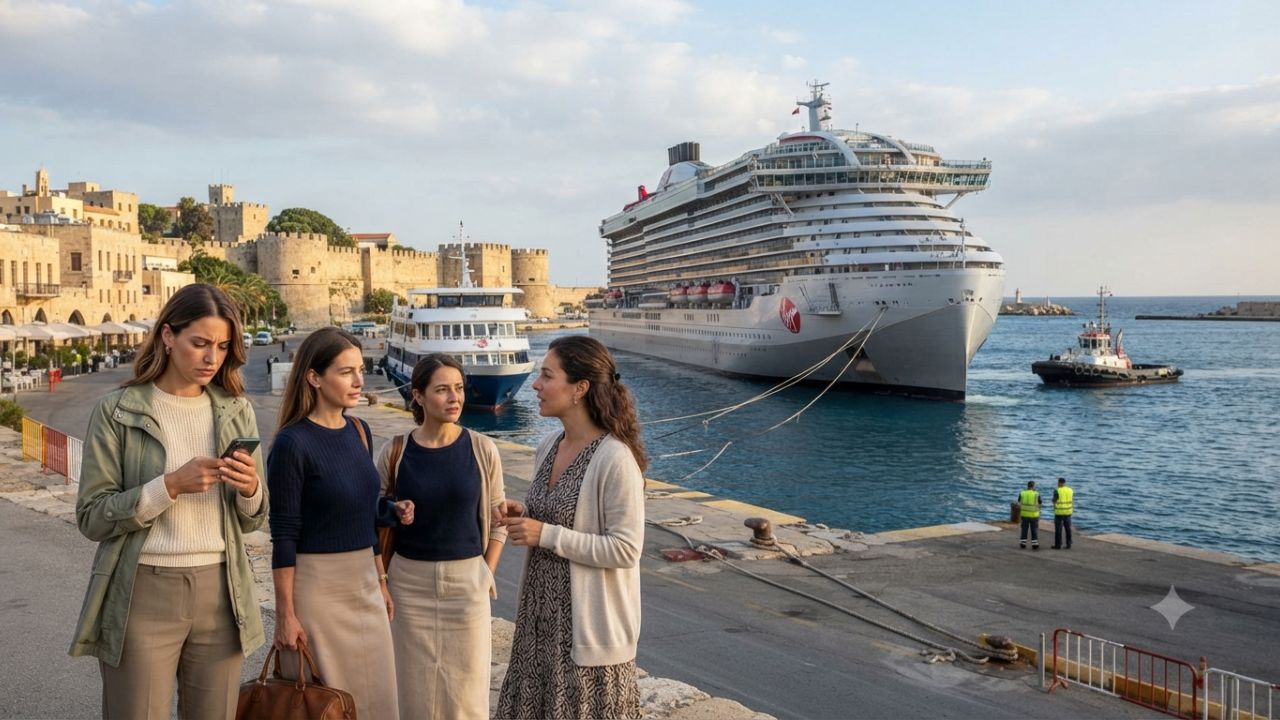
Maritime safety authorities in Rhodes enforced mandatory seaworthiness inspections following a mooring line break incident at the island's tourist port.
Greece cruise operations came under regulatory review following a maritime incident at the Rhodes tourist port on September 30, 2026. Official bulletins confirmed by the Hellenic Coast Guard state that a cruise ship lost its mooring lines alongside the pier and contacted another berthed passenger vessel, triggering emergency safety protocols and temporary departure restrictions.
Hellenic Coast Guard Incident Report: Mooring Break at Rhodes Tourist Port
[RHODES, October 4, 2026] — A maritime incident occurred on the evening of September 30, 2026, when a Bahamas-flagged cruise vessel berthed at Rhodes tourist port experienced a mooring line break during docking operations. The vessel shifted from its berth and made contact with a Palau-flagged passenger ship berthed directly ahead.
The Hellenic Coast Guard immediately activated an emergency search-and-rescue response and alerted port safety tugs. Both vessels utilized their propulsion systems to re-secure their berths safely under tug supervision.
| Incident Parameter | Officially Established Finding | Regulatory & Operational Status |
|---|---|---|
| Incident Date & Time | Evening of September 30, 2026 | Event confirmed by maritime authorities |
| Location | Rhodes Tourist Port, Dodecanese, Greece | Port traffic monitored under emergency protocols |
| Primary Failure | Mooring lines parted on Bahamas-flagged cruise ship | Subject to preliminary safety investigation |
| Vessel Contact | Shifted into Palau-flagged passenger vessel berthed ahead | Hull inspection performed alongside berth |
| Casualties & Injuries | Zero (0) injuries reported among passengers or crew | Verified by port emergency medical personnel |
| Environmental Impact | Zero (0) marine pollution or fuel spill observed | Confirmed by Hellenic Coast Guard environmental units |
| Vessel Hull Integrity | Zero (0) water ingress or hull breach reported | Structural integrity verified by onboard engineers |
| Regulatory Action | Departure prohibition issued by Rhodes Central Port Authority | Clearance contingent on classification society certification |
Seaworthiness Certification and Port Authority Clearance Protocols
Under Greek maritime law and international safety regulations, returning to a secure berth does not permit a vessel to resume its itinerary immediately. The Rhodes Central Port Authority issued a formal departure prohibition against both involved vessels pending mandatory inspection requirements.
Before receiving sailing clearance, each vessel must fulfill specific regulatory steps:
- Classification Society Inspection: Independent marine surveyors from recognized classification societies must conduct full hull, propeller, and mooring gear structural audits.
- Issuance of Seaworthiness Certificates: Surveyors must issue formal documentation certifying that no hidden structural damage or mechanical impairment exists.
- Port Authority Clearance: The preliminary investigation team at Rhodes Central Port Authority must review surveyor findings before lifting departure holds.
Maritime law experts emphasize that passengers should distinguish between a vessel being safely tied to a pier and a vessel receiving official clearance to leave port.
Fleet Safety Standards and Maritime Operational Context
The Bahamas-flagged vessel involved in the port incident operates within modern international cruise fleet safety frameworks, such as those maintained by operators like Virgin Voyages. Operating companies enforce strict safety management systems (SMS) certified under International Maritime Organization (IMO) standards.
Key safety protocols enforced across modern cruise fleets include:
- Mandatory Passenger Safety Briefings: All embarked guests must complete safety drills prior to ship departure from homeports.
- Redundant Mooring Configurations: Ships utilize high-tensile synthetic mooring lines backed by automated winches to absorb surge forces in port.
- Continuous Crew Safety Training: Deck officers and crew undergo regular emergency response exercises covering line handling, tug co-ordination, and heavy weather mooring.
Port investigations focus on environmental and mechanical factors—such as sudden wind gusts, harbor surge, line tension distribution, or equipment fatigue—to determine the precise cause of the line failure.
Essential Passenger Action Plan Following Port Incidents
For cruise travelers experiencing schedule modifications or port delays due to maritime inspections, maintaining clear communications with cruise operators and shore excursion providers is critical.
Travelers navigating port delays should follow this operational checklist:
- Obtain Written Itinerary Updates: Request dated, written status reports directly from shipboard guest services regarding revised departure times and next port calls.
- Verify Shore Access Conditions: Confirm whether gangways remain open for ongoing shore exploration during extended inspection periods.
- Coordinate Independent Excursions: Contact third-party tour providers immediately to adjust pick-up times or request policy-based refunds if shore leave windows are compressed.
- Re-confirm Onward Transfer Arrangements: Inform airport transfer companies or hotel booking agents if delayed ship departure alters disembarkation schedules at the final cruise terminus.
- Retain Documentation: Keep all official receipts, boarding passes, and written notifications provided by ship management for insurance or booking adjustment claims.
Local Tourism Impact and Cruise Itinerary Continuity
Rhodes serves as one of Greece's primary cruise destinations in the Dodecanese archipelago, welcoming hundreds of port calls annually. Local port services, shore excursion operators, and retail businesses depend on predictable cruise vessel scheduling.
Port authorities in Rhodes confirmed that normal harbor operations and scheduled vessel arrivals proceeded without systemic disruption. Maritime safety protocols are designed to isolate incident investigations while allowing broader port traffic to move safely.
For future cruise guests booked on Greek island itineraries, port inspections demonstrate the effectiveness of maritime safety enforcement. Rigorous seaworthiness checks ensure that vessels return to service only when fully certified.
Why This Matters (Information Gain & Experience)
For international cruise passengers exploring the Mediterranean, understanding maritime safety clearance procedures provides valuable context during port delays. Recognizing that departure restrictions reflect standard regulatory caution—rather than emergency danger—allows travelers to manage shore plans effectively while safety officials complete required inspections.
By relying on direct operational updates from cruise operators and maintaining flexible excursion arrangements, travelers can navigate unexpected port adjustments smoothly.
Related Travel Guides
European High-Speed Rail Network Expansion and Cross-Border Corridors 2026
Portugal easyJet Cabin Crew Strike Threatens Autumn Travel Across Lisbon, Porto, and Faro
Isle of Man Ferry Cuts Impact UK November 2026 Travel Amid Flagship Manxman Repairs
Disclaimer
This article is for informational and educational purposes only. It does not constitute legal, financial, or professional advice. While we strive to provide accurate and up-to-date information, travel policies, regulations, and conditions change rapidly. Always verify information with official sources before making travel decisions. Nomad Lawyer makes no representations about the accuracy, reliability, completeness, or suitability of the information provided. Readers should consult qualified professionals for advice specific to their circumstances. The views expressed in this article are those of the author and do not necessarily reflect the views of Nomad Lawyer.
Raushan Kumar
Founder & Lead Developer
Full-stack developer with 11+ years of experience and a passionate traveller. Raushan built Nomad Lawyer from the ground up with a vision to create the best travel and law experience on the web.
Learn more about our team →