
Severe Travel Chaos Paralyzes Germany as Lufthansa Strikes Trigger 500,000 Flight Cancellations Across Frankfurt, Munich, and Berlin: Latest Airline News
As severe pilot strikes cripple Lufthansa's operations, a massive wave of flight cancellations and airport disruptions has paralyzed Germany's transit network, forcing passengers onto alternative hubs.

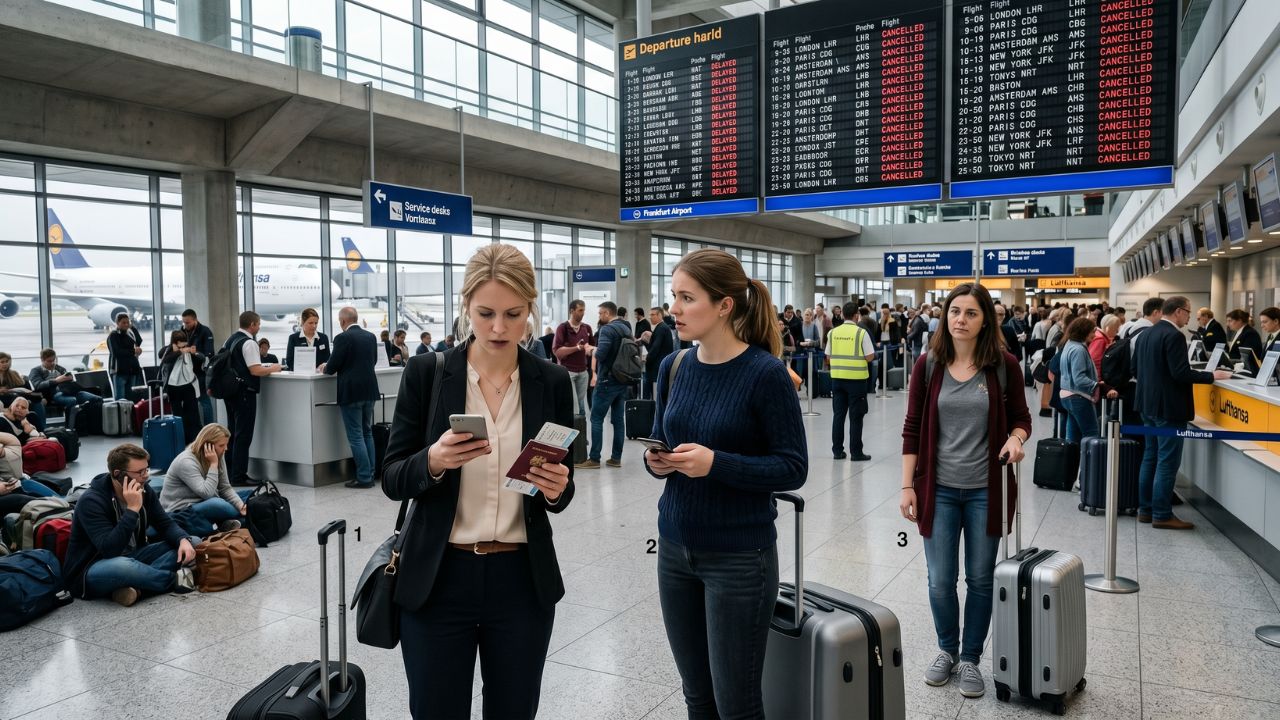
Image generated by AI
In a catastrophic collapse of operational stability that has completely paralyzed one of Europe’s most critical transit networks, a massive wave of airport disruptions has engulfed the German aviation sector. Driven by a deeply entrenched, aggressive labor strike mobilized by the Vereinigung Cockpit union, the ongoing Lufthansa crisis has escalated into a total systemic breakdown. As rolling, short-notice flight cancellations obliterate the summer schedule, extreme travel chaos has violently spread across primary mega-hubs in Frankfurt, Munich, Berlin, Hamburg, Düsseldorf, and Stuttgart. With hundreds of thousands of passengers stranded, massive cargo throughput paralyzed, and regional feeder networks like Lufthansa CityLine entirely suspended, this massive industrial deadlock has utterly devastated Germany's domestic and international routing reliability, representing the premier headline in today's breaking airline news and essential global aviation updates.
By introducing direct passenger coordination and dynamic scheduling backups, the regional aviation hubs target growing passenger demand across vital commerce sectors. The choice to coordinate flight departures in phases helps to manage gate capacity, supporting the country's broader regional transportation network.
Context: The Total Collapse of the German Air Corridor
For the millions of global tourists and corporate professionals relying on the precision of the German aviation grid, the escalating Lufthansa labor dispute has degenerated into an absolute nightmare of travel chaos.
Historically, Germany’s aviation ecosystem was considered the most reliable transport network in Europe. However, a massive deadlock between Deutsche Lufthansa AG and its pilot workforce over defined-benefit pension schemes (bAV) and CPI-linked wage adjustments has shattered that reputation. The Group Tariff Commission (GTK) has utilized legally supported strike mandates to initiate paralyzing industrial action with merely 48 hours’ notice. This militant strategy has entirely removed structural predictability from both domestic and international travel corridors. Compounding the severe airport disruptions, external macroeconomic pressures—including skyrocketing fuel costs exceeding €2 billion driven by the war in Iran—have severely restricted Lufthansa’s financial ability to resolve the crisis. Consequently, the airline has suspended Lufthansa CityLine’s fleet of 27 regional CRJs, forcing stranded feeder passengers onto Deutsche Bahn rail services and completely destabilizing the transatlantic connections typically facilitated by Frankfurt and Munich.
To view live flight schedules, specific strike cancellation updates, or alternative connection options, travelers must consult official German aviation directories. For direct rebooking access and to secure the most efficient flight paths away from paralyzed hubs, travelers should check the official Lufthansa booking portal. To explore live flight tracking and monitor the exact severity of the rolling airspace bottlenecks they are actively avoiding, passengers can consult the official FlightAware tracking service.
Section-Wise Breakdown of the National Meltdown
Frankfurt Airport (FRA): The Core Hub Collapse
Frankfurt Airport is absorbing the most devastating blow. During a brutal six-day strike window in April 2026, approximately 500,000 passengers were directly affected by sudden flight cancellations. Aircraft movements plummeted to just 34,623, while cargo throughput collapsed to 168,526 metric tons. This travel chaos is heavily exacerbated by the simultaneous €1.5 billion refurbishment of Terminal 2, forcing massive traffic redirection into Terminal 3 and utterly destroying hub efficiency.
Munich Airport (MUC): High-Volume Gridlock
At the southern mega-hub of Munich Airport, the strikes have triggered extreme operational instability. During peak strike periods, over 400 of the 915 scheduled movements were canceled in a single day, stranding tens of thousands of passengers. The severe airport disruptions completely neutralized the efficiency gains expected from the newly opened Terminal 1 Non-Schengen Pier.
Berlin Brandenburg (BER) and Hamburg (HAM): Volatility and Contraction
Berlin Brandenburg suffered a massive contraction, with April flight movements dropping to 15,800 and cargo falling to 3,800 tonnes as Lufthansa strikes and Middle East route suspensions removed over 120,000 passengers from the network. Similarly, Hamburg Airport—which processed 14.8 million passengers in 2025—saw single-day strike cancellations strand approximately 40,000 passengers, brutally disrupting its new summer routes to Amman, Bodrum, and Marrakech.
Düsseldorf (DUS) and Stuttgart (STR): The Business Travel Crisis
Operations at Düsseldorf and Stuttgart have been crippled, specifically targeting Eurowings Germany operations. Business travel routes, typically the most reliable sector of the German aviation market, have been heavily devastated. The severe flight cancellations have shattered schedule reliability, completely weakening the corporate travel framework in southern Germany.
Technical Roster: German Aviation Disruption and Strike Impact Matrix
To ensure absolute factual accuracy regarding the specific operational devastation caused by this massive labor crisis, the following table details the exact metrics defining the German airport breakdown:
| Major German Airport / Entity | Exact Operational Disruption Metric | Global Aviation Market Impact |
|---|---|---|
| Frankfurt Airport (FRA) - April | 500,000 Pax Affected (6 Strike Days) | Movements fell to 34,623; cargo dropped to 168,526 tons |
| Frankfurt Airport (FRA) - March | 4.7M Pax (100,000 Strike Losses) | Operational efficiency crushed amid T2 refurbishment |
| Munich Airport (MUC) Peaks | >400 of 915 Movements Canceled | Massive single-day gridlock strands tens of thousands |
| Berlin Brandenburg (BER) - March | 430 Flights Canceled (57,000 Pax Hit) | Ver.di warning strikes cripple the capital's connectivity |
| Berlin Brandenburg (BER) - April | Movements fell to 15,800 (3,800t cargo) | >120,000 pax lost to strikes and Middle East suspensions |
| Hamburg Airport (HAM) | ~40,000 Pax Hit on Single Strike Days | Severe regional volatility despite 14.8M pax volume in 2025 |
| Lufthansa CityLine Subsidiary | 27 Canadair Regional Jets (CRJs) Suspended | Feeder network collapses, shifting passengers to rail |
| Lufthansa Financial Constraints | Fuel Costs > €2 Billion Increase | Geopolitical instability (Iran) destroys operating margins |
| German Aviation Tax Burden | €2.1 Billion across ~84M Pax in 2025 | High regulatory costs severely limit wage negotiation flexibility |
Passenger Impact: Fleeing the German Grid
For the everyday passenger and high-yield corporate traveler moving through Europe, the escalation of the Lufthansa strike demands an immediate, ruthless reassessment of international itineraries to avoid devastating travel anxiety.
The immediate passenger impact is the total destruction of trans-European connectivity. Travelers attempting to connect through Frankfurt or Munich to transatlantic destinations in New York, Chicago, Miami, or Los Angeles are facing massive missed connections and terminal stranding. Because the CityLine feeder network of 27 CRJs has been entirely suspended, domestic passengers are being forced onto overcrowded Deutsche Bahn rail services, massively increasing total journey times. Corporate travelers, exhausted by the rolling flight cancellations, have entirely abandoned the German hub model. They are actively executing multi-hub routing strategies, completely bypassing Germany and utilizing alternative European gateways like Zurich, Vienna, Brussels, and Amsterdam.
Industry Analysis: A Structural Threat to Competitiveness
Aviation industry analysts view the escalating Lufthansa labor crisis as a profound structural threat to the long-term competitiveness of the entire German aviation sector.
Analysts note that the militant tactics employed by Vereinigung Cockpit and the GTK have severely compromised Lufthansa’s ability to guarantee operational reliability. This travel chaos is occurring against a brutal macroeconomic backdrop: a €2.1 billion aviation tax burden and a €2 billion fuel cost spike caused by the war in Iran. These pressures leave Lufthansa management with absolutely no financial flexibility to meet the union's pension and inflation demands. Furthermore, this prolonged instability destroys capital required for decarbonization efforts, such as the hydrogen aviation corridors planned at Hamburg. Analysts warn that if this massive wave of airport disruptions is not immediately resolved, competing European hubs will permanently absorb diverted transatlantic and corporate traffic, causing a fatal long-term redistribution of global aviation flows away from Germany.
Actionable Advice for Bypassing German Travel Chaos
If you are an international traveler seeking to avoid the severe travel chaos currently paralyzing the German aviation network, execute this strategic planning checklist immediately:
- Abandon German Transit Hubs: Do not book connecting flights through Frankfurt (FRA) or Munich (MUC). Actively re-route your transatlantic or European itineraries through highly stable alternative hubs like Amsterdam Schiphol, Zurich, or Vienna to ensure your flight is protected from strike action.
- Avoid Lufthansa CityLine Connections: Be aware that the suspension of the 27 CRJs has destroyed the regional feeder network. If you must travel domestically within Germany, book high-speed Deutsche Bahn rail tickets independently rather than risking an airline connection.
- Monitor 48-Hour Strike Notices: The union is legally authorized to initiate massive strikes with only 48 hours’ notice. You must monitor German labor news daily in the week leading up to your departure to anticipate sudden, rolling flight cancellations.
- Purchase Maximum Flexibility: You must purchase fully flexible fare classes and comprehensive travel insurance to protect your investment. If your Eurowings flight out of Düsseldorf or Stuttgart is suddenly canceled, you will need the ability to pivot to a competitor immediately.
FAQ: Germany Lufthansa Strikes & Travel Chaos 2026
Why is there severe travel chaos across German airports?
Massive, rolling pilot strikes led by the Vereinigung Cockpit union against Deutsche Lufthansa AG over pension and wage disputes have triggered hundreds of thousands of flight cancellations across Germany's major hubs.
Which specific airports are suffering the worst airport disruptions?
Frankfurt and Munich are suffering massive mega-hub gridlock, while Berlin Brandenburg, Hamburg, Düsseldorf, and Stuttgart are experiencing severe schedule volatility and regional flight cancellations.
How bad are the flight cancellations caused by the strikes?
During a six-day strike window in April, 500,000 passengers were affected in Frankfurt alone. Munich suffered days where over 400 out of 915 scheduled flight movements were abruptly canceled.
The Breaking Point of the Lufthansa Network
The explosive wave of flight cancellations ravaging Germany's primary mega-hubs proves definitively that the domestic transit infrastructure is operating under immense, unsustainable stress in 2026. By entirely devastating the highly scheduled operations of Lufthansa mainline, Cargo, CityLine, and Eurowings, this operational meltdown has ruthlessly exposed the fragility of an airline crippled by labor deadlock. As competing hubs in Zurich, Amsterdam, and Vienna aggressively siphon off highly lucrative corporate and transatlantic transit passengers, travelers must accept a brutal reality: navigating European airspace currently requires actively avoiding the German grid to survive unexpected, rolling flight cancellations.
Key Takeaways
- Catastrophic National Breakdown: A massive Lufthansa pilot strike has triggered severe travel chaos, paralyzing operations across Frankfurt, Munich, Berlin, Hamburg, Düsseldorf, and Stuttgart.
- Massive Passenger Impact: Frankfurt Airport saw 500,000 passengers affected by cancellations over six strike days, while Munich suffered peaks of >400 daily cancellations.
- Feeder Network Collapse: Lufthansa CityLine suspended its fleet of 27 CRJ regional jets, destroying domestic connectivity and forcing passengers onto rail services.
- Macroeconomic Pressures: The airline's ability to negotiate is severely restricted by a €2.1 billion aviation tax burden and a €2 billion fuel cost spike driven by the Iran crisis.
- Corporate Hub Bypass: Exhausted business travelers are abandoning German hubs entirely, rerouting transatlantic itineraries through Zurich, Vienna, Brussels, and Amsterdam.
Related Travel Guides
Iran Crisis Triggers Massive Global Travel Chaos
Global Airlines Expand Secondary Hubs to Defeat Travel Chaos
Disclaimer
This article is for informational and educational purposes only. It does not constitute legal, financial, or professional advice. While we strive to provide accurate and up-to-date information, travel policies, regulations, and conditions change rapidly. Always verify information with official sources before making travel decisions. Nomad Lawyer makes no representations about the accuracy, reliability, completeness, or suitability of the information provided. Readers should consult qualified professionals for advice specific to their circumstances. The views expressed in this article are those of the author and do not necessarily reflect the views of Nomad Lawyer.
Kunal K Choudhary
Co-Founder & Contributor
A passionate traveller and tech enthusiast. Kunal contributes to the vision and growth of Nomad Lawyer, bringing fresh perspectives and driving the community forward.
Learn more about our team →