
Germany's First F-35A Lightning II Gets F135 Engine: Rollout and Flight Testing Expected in 2026
Germany's inaugural F-35A Lightning II fighter jet has received its Pratt & Whitney F135 engine at Lockheed Martin's Fort Worth facility, marking a critical milestone toward delivery and NATO integration in 2026.

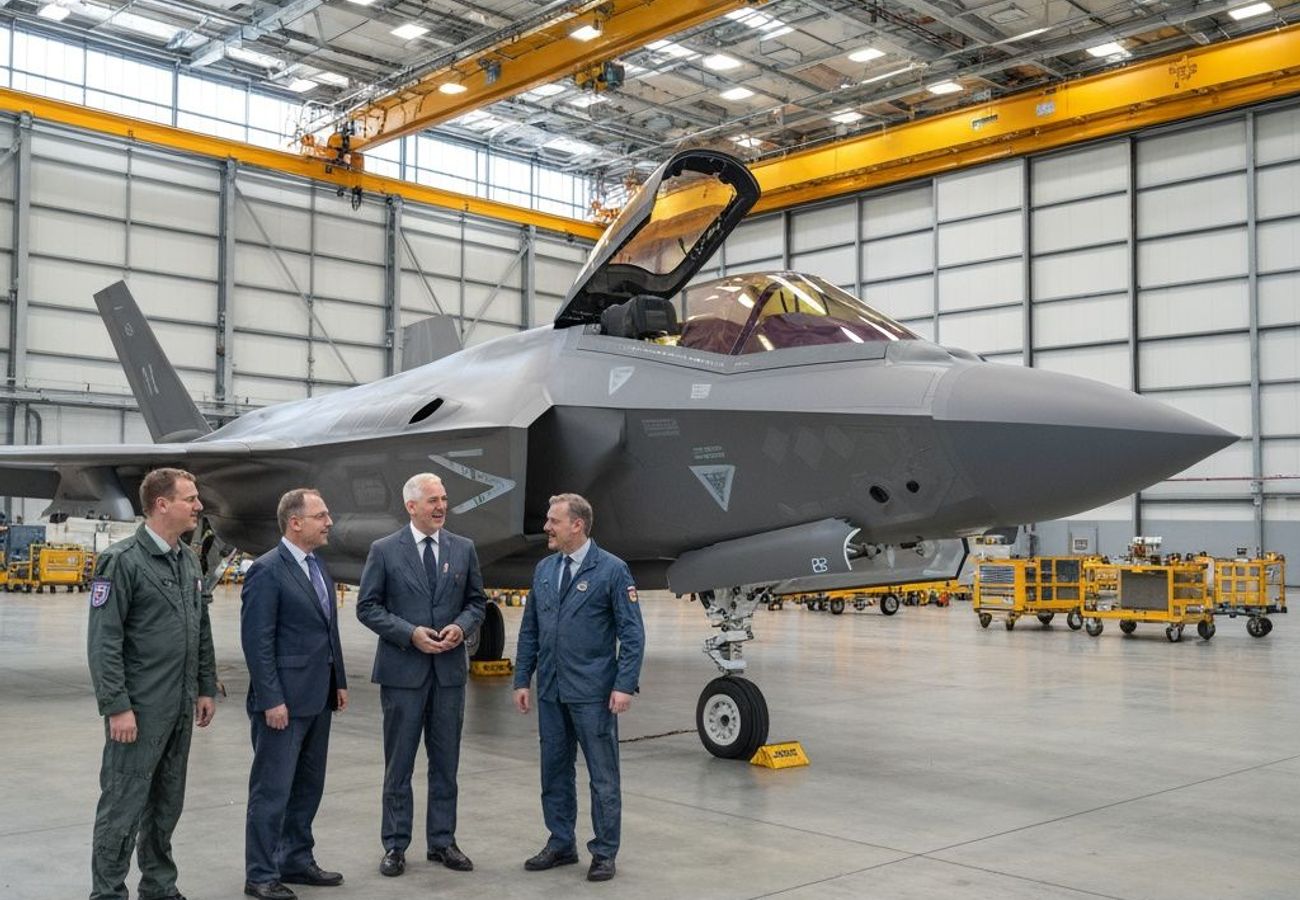
Image generated by AI
Germany's Fighter Jet Milestone: The F-35A Engine Installation That Changes Everything
Germany's first F-35A Lightning II has crossed a major production threshold. The aircraft, stationed at Lockheed Martin's facility near Dallas/Fort Worth, Texas, just received its Pratt & Whitney F135-PW-100 engine—and this isn't just another assembly line moment. This installation signals the Luftwaffe's imminent entry into the fifth-generation fighter era.
The milestone pushes the jet from structural assembly directly into final systems integration, control surface work, and software validation. According to program timelines, rollout and first flight are expected later this 2026, with formal delivery following shortly after.
What This Engine Installation Actually Means
The F135 powering Germany's fighter isn't just powerful—it's the most potent fighter engine in active operational service today. This turbofan generates the thrust required to support the F-35A's stealth design, advanced sensor fusion, and multi-role combat flexibility.
Think of it this way: structural assembly is the skeleton. The engine installation is the moment the skeleton gets a heart. Once installed, engineers can validate electrical systems, hydraulics, software, and the thousands of interconnected components that transform a shell into a combat-ready platform.
Reddit: "The F135 is an absolute powerhouse. You need that kind of thrust to make stealth work at supersonic speeds and carry modern weapons loads." — r/aviation
The German Order: Why 35 Aircraft and Why Now?
Germany approved a government-to-government order for 35 F-35A fighters in December 2022. The decision represented a seismic shift in German defense strategy—abandoning plans for an interim solution in favor of committing to a fifth-generation platform already integrated across NATO's growing roster of allied air forces.
The underlying reason: Germany's aging Panavia Tornado IDS fleet needed replacement. But more critically, Berlin wanted a platform capable of supporting NATO's nuclear sharing mission, where allied aircraft retain the ability to deliver U.S.-supplied B61 nuclear gravity bombs under NATO authorization.
This wasn't just about fighters. It was about cementing Germany's role in NATO's integrated defense architecture while modernizing for contested, high-threat environments.
Why The F-35A Specifically?
The F-35A delivers capabilities far beyond traditional strike missions. Its stealth characteristics, electronic warfare systems, sensor fusion architecture, and networked battlefield awareness allow operation in heavily contested airspace where fourth-generation fighters would be vulnerable.
The acquisition strengthens interoperability with key NATO allies—the United States, Italy, the Netherlands, Belgium, Norway, Finland, Poland, and other European operators flying or preparing to field the aircraft. This interoperability isn't trivial; it's the backbone of modern alliance warfare.
Training Pipeline: Ebbing Air Base as the Gateway
Before any German F-35A arrives at Büchel Air Base (the ultimate home of Germany's fleet), pilots and maintainers will cycle through Ebbing Air National Guard Base near Fort Smith, Arkansas.
Ebbing is rapidly becoming the international F-35 training hub for European operators. The first eight German aircraft are expected to operate there during the initial training phase, with personnel qualification and currency-building underway before transfer to Germany. Program schedules indicate the first operational aircraft should arrive at Büchel in 2027.
This staging arrangement isn't unique to Germany—it reflects how the U.S. military manages international fighter deployments, ensuring proper training integration before aircraft reach their home bases.
The Engine Installation: Technical Deep Dive
The installation process itself highlights modern manufacturing precision. Lockheed Martin employed laser-guided alignment systems during earlier structural assembly phases, joining the four major sections—wing assembly and forward, center, and aft fuselage sections—with exacting tolerances.
The F135 installation follows that methodical progression. Once fitted, the engine enables:
- Final systems integration testing
- Control surface validation
- Software validation across avionics and flight control systems
- Low observable (stealth) finishing work
- Ground testing and low-speed taxi trials
- First flight operations
Each phase cascades into the next. Engineers can't validate software before the engine is in place; they can't conduct full systems checks without power. The engine installation is the lynchpin that unlocks the final assembly sprint.
Strategic Context: Germany's Shift in European Defense
The F-35A arrival for Germany comes amid broader fifth-generation fighter procurement acceleration across Europe. Regional security concerns—from Russia's military posture to evolving threats in Eastern Europe—are driving NATO members to accelerate modernization timelines.
For Germany specifically, the engine installation represents far more than routine manufacturing. It's a visible confirmation that the Luftwaffe's long-planned entry into fifth-generation capability is becoming concrete reality, not policy paper.
This matters for European deterrence architecture. A Germany equipped with modern, interoperable fighters strengthens alliance cohesion and demonstrates committed defense investment during a period when security questions dominate continental politics.
What Comes Next: The 2026 Timeline
Rollout—the moment the aircraft is publicly revealed in complete form—is expected later in 2026. First flight will follow, with test pilots evaluating handling characteristics, engine performance, avionics functionality, and overall systems integration.
Delivery timelines typically follow 60-90 days after first flight, pending satisfactory test results. That positions Germany's inaugural F-35A to transition to Ebbing for Luftwaffe pilot training in late 2026 or early 2027.
The subsequent 34 aircraft on order will follow, with deliveries spread across the late 2020s. This phased approach allows the Luftwaffe to build operational expertise and training capacity in parallel with fleet expansion.
The Bigger Picture: What This Means for NATO and Travel Considerations
For travelers and aviation enthusiasts, Germany's F-35A integration signals deeper NATO modernization underway. Airspace coordination, international flight planning, and military-civil aviation interface protocols continue evolving as fighter modernization accelerates across the alliance.
If you're planning travel to Germany or Europe this year and beyond, be aware that military modernization activities—including training flights, transatlantic ferry operations, and operational testing—may intersect with civilian airspace. Flight delays and rerouting remain manageable but possible.
For defense-focused travelers monitoring these developments, Germany's F-35A milestone represents a tangible step toward credible, interoperable NATO airpower in the heart of Europe.
The skeleton has a heart; now watch it learn to fly.
Related Travel Guides
Disclaimer: This article is for informational purposes only. Military procurement timelines, delivery schedules, and operational decisions are subject to change. Readers should consult official government and defense ministry sources for authoritative information on defense acquisitions and international military cooperation.
Preeti Gunjan
Contributor & Community Manager
A passionate traveller and community builder. Preeti helps grow the Nomad Lawyer community, fostering engagement and bringing the reader experience to life.
Learn more about our team →