
Germany Deploys Coradia iLint Hydrogen Train Fleet to Link Lower Saxony, Bremerhaven and Cuxhaven in 2026
Germany expands sustainable transit with a full fleet of 14 Coradia iLint hydrogen trains serving the RB33 corridor, connecting Buxtehude to the North Sea coast.

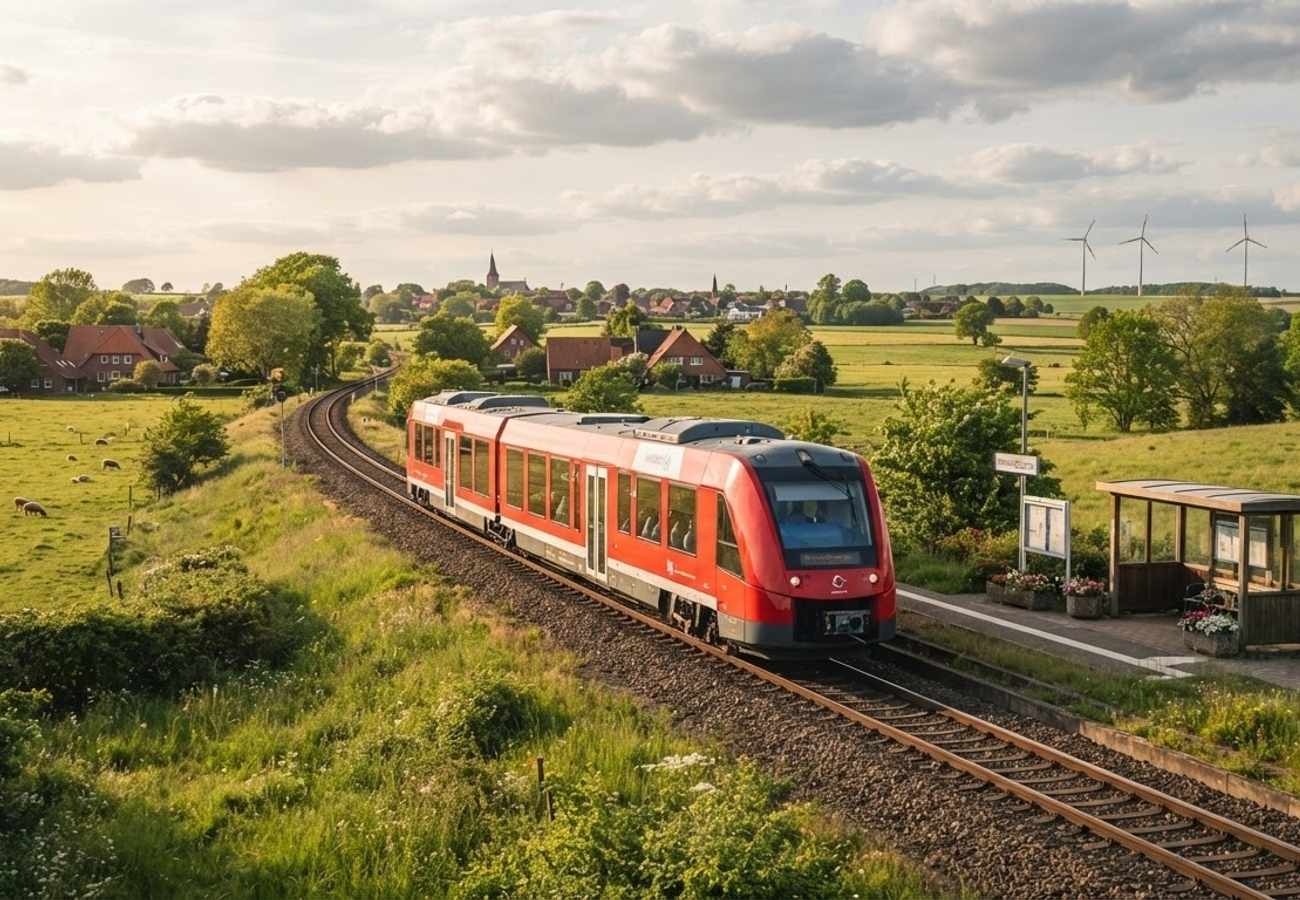
Image generated by AI
Four major German towns are now linked by the world's first fully operational fleet of hydrogen-powered passenger trains, eliminating carbon emissions on the regional corridor to the North Sea. Regular services throughout 2026 utilize the RB33 line to connect Buxtehude, Bremervörde, Bremerhaven, and Cuxhaven, providing a carbon-neutral alternative to diesel rail and private vehicle travel.
The shift toward hydrogen propulsion represents a strategic move by Germany to decarbonize regional lines where full electrification is not yet feasible. By replacing aging diesel units, the regional operator EVB is transforming a standard commute into a sustainable tourism gateway, allowing visitors to reach the maritime hubs of Bremerhaven and the coastal beaches of Cuxhaven without a car.
Transitioning from Diesel to Hydrogen on the RB33 Corridor
The deployment of the Coradia iLint marks a significant milestone in commercial rail. While Germany first introduced two pre-series hydrogen units in Lower Saxony in September 2018 to test viability, those early trials paved the way for a full-scale rollout.
By August 2022, a complete fleet of 14 Coradia iLint trains entered scheduled service. This fleet replaced 15 diesel-powered units across a corridor spanning approximately 100 kilometres. Unlike experimental shuttles, these trains operate as standard regional services; passengers access the hydrogen-powered experience using regular valid tickets.
For the operator EVB, which manages an expansive network carrying roughly two million rail passengers and four million bus passengers annually, the 14-unit fleet establishes the first instance of hydrogen trains in regular, scheduled commercial operation globally.
Technical Specifications of the Coradia iLint System
The propulsion system of the Coradia iLint relies on a combination of onboard hydrogen tanks and fuel cells. The process involves combining hydrogen with oxygen from the ambient air to generate electricity, which then powers the train's traction system. To ensure stability and manage power spikes during acceleration, the trains utilize integrated batteries for energy storage.
The primary environmental advantage is the total absence of carbon dioxide emissions during propulsion. The only byproduct released from the exhaust is water vapour and condensation, offering a stark contrast to the nitrogen oxides and CO2 produced by the diesel trains they replaced.
According to specifications from Alstom, the trains can reach a maximum speed of 140 km/h and possess a standard operating range of 1,000 kilometres. The technology's efficiency was further proven in September 2022, when a single unit completed a 1,175-kilometre journey without requiring a refuel.
Hydrogen Rail Performance Data
| Hydrogen-train feature | Officially reported detail | Relevance for travellers |
|---|---|---|
| Fleet size | 14 Coradia iLint units | Supports scheduled regional services |
| Commercial introduction | Two trains in 2018 | Established Germany as an early adopter |
| Full fleet launch | August 2022 | Expanded hydrogen operation on the corridor |
| Maximum speed | Up to 140 km/h | Suitable for regional passenger travel |
| Stated range | Up to 1,000 km | Enables daily operation without frequent refuelling |
| Direct propulsion emissions | No direct CO₂; water and condensation | Cleaner local operation than diesel traction |
| Principal corridor | Buxtehude–Bremervörde–Bremerhaven–Cuxhaven | Links towns with maritime and coastal destinations |
Boosting Sustainable Tourism in Cuxhaven and Bremerhaven
The RB33 corridor serves as a green artery for leisure travel, specifically targeting the North Sea coast. Cuxhaven, known for its beaches, cycling paths, and nature reserves, is now more accessible to eco-conscious tourists who wish to avoid the congestion of coastal roads and parking lots.
This infrastructure supports a "slow travel" philosophy, encouraging visitors to explore multiple stops—such as historic Buxtehude and Bremervörde—rather than rushing between a major city and a single resort. While there is no specific data confirming that hydrogen trains alone have increased visitor numbers, the fleet improves the destination's positioning as a sustainable travel hub.
In Bremerhaven, the rail link supports a dense urban maritime tourism ecosystem. The city's major attractions, including the Climate House Bremerhaven, the German Emigration Center, and the Zoo at the Sea, are easily accessible from the station via low-floor buses.
Furthermore, the hydrogen rail link integrates with the cruise industry. Shuttle services connect the main station to the Havenwelten waterfront and the cruise terminal, allowing cruise passengers to reduce their overall travel footprint.
Analyzing Tourism Recovery Trends in Bremerhaven
Data from the Statistical Office of Bremen indicates that the maritime tourism sector in Bremerhaven has seen a volatile but generally positive recovery following the 2020-2021 downturn.
In 2023, the hotel sector saw 230,813 arrivals and 416,178 overnight stays, representing increases of 12.4% and 8.2% respectively over 2022. Although 2024 saw a dip—with arrivals falling 8% to 212,408—the trend reversed in 2025.
Between January and October 2025, provisional results show 186,378 hotel arrivals (a 2.1% increase over the same period in 2024) and 363,864 overnight stays (up 7.3%). Notably, international overnight stays rose by 12.5% to 40,123, suggesting a growing global interest in the region.
Bremerhaven Hotel Performance Metrics
| Bremerhaven hotel indicator | 2023 | 2024 | January–October 2025 |
|---|---|---|---|
| Guest arrivals | 230,813 | 212,408 | 186,378 |
| Change from comparable period | +12.4% | −8.0% | +2.1% |
| Overnight stays | 416,178 | 393,669 | 363,864 |
| Change from comparable period | +8.2% | −5.4% | +7.3% |
| International overnight stays | 45,016 | 43,554 | 40,123 |
| International overnight-stay change | +1.1% | −3.2% | +12.5% |
Why This Matters: The Future of Regional Connectivity
For the modern traveler, the deployment of the Coradia iLint fleet removes a significant psychological and environmental barrier to regional exploration. The ability to traverse 100 kilometres of the Lower Saxony landscape without contributing to local air pollution transforms the journey from a mere utility into part of the vacation experience.
From a logistical standpoint, this creates a blueprint for "car-free" regional tourism. When high-speed rail is paired with zero-emission regional feeders and urban bus networks, the reliance on rental cars in coastal zones is diminished. This reduces the pressure on local infrastructure in Cuxhaven and Bremerhaven during peak summer months.
However, the true climate impact remains tied to the "well-to-wheel" efficiency. The environmental benefit of these trains depends on how the hydrogen is produced—whether through "green" electrolysis powered by renewables or "grey" hydrogen derived from natural gas. As Germany scales its green hydrogen production, the RB33 corridor will likely become one of the cleanest transit lines in Europe.
The shift to hydrogen rail proves that regional connectivity does not have to come at the cost of the environment.
Related Travel Guides
Disclaimer
This article is for informational and educational purposes only. It does not constitute legal, financial, or professional advice. While we strive to provide accurate and up-to-date information, travel policies, regulations, and conditions change rapidly. Always verify information with official sources before making travel decisions. Nomad Lawyer makes no representations about the accuracy, reliability, completeness, or suitability of the information provided. Readers should consult qualified professionals for advice specific to their circumstances. The views expressed in this article are those of the author and do not necessarily reflect the views of Nomad Lawyer.
Preeti Gunjan
Contributor & Community Manager
A passionate traveller and community builder. Preeti helps grow the Nomad Lawyer community, fostering engagement and bringing the reader experience to life.
Learn more about our team →