
Aviation Updates: Massive German Airport Meltdown Triggers Terrifying Travel Chaos as 427 Delays and Flight Cancellations Paralyze Munich and Berlin
As a massive logistical collapse completely suffocates Germany's primary aviation gateways, up to 65,000 desperate global travelers face terrifying flight cancellations and agonizing airport disruptions.

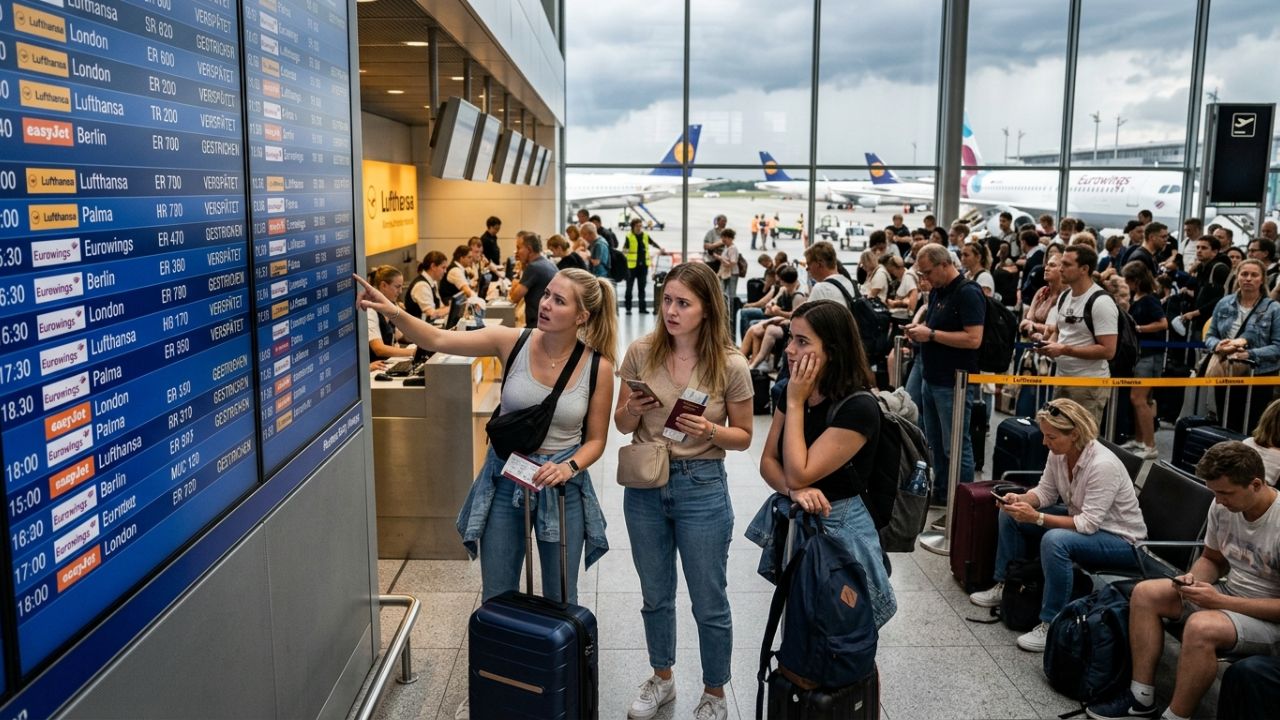
Image generated by AI
Aviation Updates: Massive German Airport Meltdown Triggers Terrifying Travel Chaos as 427 Delays and Flight Cancellations Paralyze Munich and Berlin
As incredibly severe terminal gridlock and massive ground handling failures completely suffocate the primary aviation gateways of Germany, up to 65,000 global passengers are trapped in terrifying travel chaos as 427 flight delays and crippling flight cancellations aggressively paralyze operations across Munich and Berlin, rippling violently into Frankfurt, Hamburg, and Stuttgart.
While incredibly exhausted global passengers desperately navigate an incredibly brutal summer peak travel season, a massive, highly destructive operational meltdown is actively shattering the absolute highest levels of European commercial aviation. According to the absolute latest breaking airline news, the central German aviation system has officially collapsed under the crushing weight of systemic congestion and severe staffing friction. Desperate to ensure that severe, localized regional hub gridlock does not completely destroy the entire intercontinental network, airlines are violently battling a massive logistical backlog at Munich International (MUC) and Berlin-Brandenburg (BER). At the time of reporting, real-time operational tracking systems confirmed an agonizing total of 427 severe delays and 9 outright flight cancellations projected within the next 24 hours, stranding massive volumes of domestic and international travelers indefinitely.
This highly critical operational collapse explicitly exposes Germany not as an efficient global gateway, but as a heavily congested, deeply fragile capacity zone prone to sudden, catastrophic failure. By violently overwhelming ground handling crews and air traffic control sectors, the surge in summer passengers is directly driving massive travel chaos that routinely plagues travelers attempting to transit through under-resourced mega-hubs. Because traditional European transit nodes frequently suffer from severe tarmac congestion leading to massive, unannounced airport disruptions, this current meltdown serves as an absolute warning. It completely bypasses the terrifying logistical nightmares of simple weather delays, representing a systemic structural failure that forces major carriers—including Lufthansa, Eurowings, Ryanair, and easyJet—into a brutal, high-stakes battle of wave-scheduling revisions and agonizing terminal holding patterns.
Aviation Updates: The Collapse of the German Corridor
This massive, highly structural shift in European network stability perfectly illustrates the intense, incredibly fragile nature of modern intercontinental mobility.
According to highly detailed, official aviation updates sourced directly from FlightAware, this strategic capacity failure was explicitly triggered by the absolute breakdown of tight wave-scheduling mechanics. Inbound aircraft simply cannot be turned around quickly enough to fulfill subsequent domestic and short-haul European routes. Because primary connecting hubs like Munich and Berlin are increasingly crippled by rolling travel chaos stemming from low staffing across ground-handling units, funneling passenger flows through Germany is currently a massive logistical gamble. This massive breakdown prevents a unified, highly reliable transit model, instead generating severe, cascading delays that ripple violently across the entire global air traffic system, directly impacting connecting nodes in Frankfurt, Hamburg, and Stuttgart and severing vital links to North America and Asia.
Section-Wise Breakdown: Navigating the Paralyzed Hubs
The sudden, massive evolution of these critical transit failures actively impacts several incredibly distinct, highly sensitive operational dynamics at Germany's primary airports.
The Munich International (MUC) Long-Haul Trap
At the absolute core of this massive operational pivot is the total logistical failure at Munich International, the first-order gateway of the German system. Operating as the epicenter of the crisis, MUC has reported an absolutely terrifying 267 delays and 5 total cancellations. As the critical global hub for flagship carrier Lufthansa, the terminal complex is actively trapping passengers in massive, agonizing security and rebooking queues. Because Lufthansa completely relies on Munich for rapid turnaround, the ground handling failure actively subjects transatlantic and Asian long-haul passengers to severe travel chaos. Arriving passengers physically watch their carefully timed connecting flights depart without them, triggering massive hotel and ground transport nightmares.
The Berlin-Brandenburg (BER) Regional Gridlock
The ultimate execution of this highly destructive failure heavily targets regional European point-to-point operations at Berlin-Brandenburg. Functioning as the second-order international airport, BER has officially recorded 160 delayed flights and 4 cancellations. By completely failing to maintain scheduled rotations, the airport explicitly inflicts direct, brutal airport disruptions on operators with massive regional market shares like Eurowings, Ryanair, and easyJet. Because these airlines maximize aircraft utilization, a single delayed arrival systematically compromises up to four subsequent flight legs across neighboring European capitals, stranding thousands of regional passengers in heavily congested, overcrowded terminal waiting areas.
Flight Details and Verified Disruption Impact Matrix
To fully understand the exact structural parameters of this massive performance collapse and how airlines are desperately attempting to navigate complex regional congestion, the following matrix explicitly details the operational failures at each hub.
Confirmed German Disruption Impact Matrix
| Aviation Facility / Hub | Documented Delays | Confirmed Cancellations | Primary Traffic Type Impacted |
|---|---|---|---|
| Munich International (MUC) | 267 | 5 | International Long-Haul, Lufthansa Hub Connections. |
| Berlin-Brandenburg (BER) | 160 | 4 | Regional Point-to-Point, Eurowings, Ryanair, easyJet. |
| Combined German Network | 427 | 9 | System-Wide Network Rotations (Next 24 Hours). |
| Estimated Passenger Impact | 50,000 to 65,000 travelers stranded. | Severe travel chaos spreading to Frankfurt and Hamburg. | |
| Root Cause of Failure | Low staffing in ground handling and Air Traffic Control. | Triggers catastrophic, rolling airport disruptions. | |
| Passenger Rights (EC 261) | Airlines legally mandated to provide food, hotel, €250-€600. | Supervised by the Federal Aviation Office (LBA). |
Data explicitly reflects the massive, highly structural operational collapse currently paralyzing Germany, directly forcing legacy and low-cost carriers to violently abandon their daily flight schedules.
Passenger Impact: The Financial Toll of the German Lock
For the highly demanding passengers actively engaged in this massive European mobility crisis, traditional, highly anticipated summer travel is currently viewed as completely terrifying and incredibly unpredictable.
Aviation analysts estimate that between 50,000 and 65,000 passengers are currently trapped in this gridlock. Instead of relying absolutely solely on a highly competitive global network, travelers are gridlocked within crowded concourses, navigating grueling queues. However, passengers are heavily protected under the European Union Regulation (EC) No 261/2004. If delayed beyond two hours (short-haul) or four hours (long-haul), airlines must provide free meals and telecom access. If delayed overnight, airlines must fund hotel and ground transport. For the 9 absolute flight cancellations, airlines must offer rerouting or a full refund, plus fixed financial compensation ranging from €250 to €600. Claiming these rights during active airport disruptions, however, remains a terrifying, anxiety-inducing reality.
Industry Analysis: The Economics of Ground Handling Failure
Aviation structural analysts strictly point out that this massive, multi-national operational collapse perfectly illustrates the extreme, highly vital importance of heavily optimized, continuous ground operations.
According to the German Federal Ministry for Economic Affairs and Climate Action (BMWK), major hubs act as primary economic multipliers for regional tourism. Industry observers strongly view this 427-delay meltdown as the absolute ultimate catalyst for broader European aviation instability. When transit pipelines halt, the economic damage stretches far beyond the airport. International visitors face broken travel chains, missed hotel reservations, and canceled regional train transfers. By aggressively failing at the ground level due to low staffing, Munich and Berlin absolutely ensure that they maintain a highly unpredictable grip on European transit, completely exposing their local hospitality infrastructure to the massive strain of absorbing thousands of displaced travelers.
Conclusion: A Highly Congested European Future
The massively evolving infrastructure dynamics directly defining the integration of summer volume into the German network violently reflect a much broader, highly critical structural transformation currently dominating how European commercial aviation is physically managed in 2026.
Rather than violently forcing massive international traffic through deeply congested, highly restricted, delay-prone legacy networks, global travelers must actively reconsider routing through German airspace. As airlines aggressively struggle to clear the backlog and permanently alter their immediate flight paths, travelers actively navigating the incredibly busy intercontinental sector must absolutely remain highly vigilant. To actively survive potential travel chaos over the next two days, passengers must aggressively monitor all breaking aviation updates, actively utilize airline applications to check real-time status before leaving for the airport, and perfectly understand that escaping modern airport disruptions fundamentally requires accepting that schedules out of Munich and Berlin will not return to standard parameters quickly.
Key Takeaways
- Massive System Failure: Munich and Berlin-Brandenburg suffer a combined 427 delays and 9 flight cancellations due to overwhelming summer volume and low ground staffing.
- MUC Takes the Brunt: Munich (MUC) is the epicenter of the crisis, reporting 267 delays and trapping Lufthansa long-haul passengers.
- BER Regional Collapse: Berlin (BER) records 160 delays, crushing the tight schedules of Eurowings, Ryanair, and easyJet.
- Massive Passenger Impact: An estimated 50,000 to 65,000 travelers face severe travel chaos and broken itineraries.
- Economic Friction: The BMWK notes that these delays destroy regional tourism, causing missed hotel and train reservations.
- Passenger Rights (EC 261/2004): Stranded travelers are legally entitled to food, hotel accommodations, and €250-€600 in compensation for cancellations, overseen by the LBA.
Related Travel Guides
- Aviation Updates: Massive Travel Chaos Engulfs Atlanta Airport as Delta and Southwest Face 154 Flight Disruptions
- United Airlines Boeing 787-9 Dreamliner UAL1855 from Los Angeles to New York Makes Emergency Landing at Chicago O'Hare to Prevent Airfield Airport Disruptions and Severe Travel Chaos: New Airline News and Aviation Updates
- Saudi Arabia Issues Critical Aviation Safety Alert as GACA Bans In-Flight Power Bank Charging on Riyadh and Jeddah Flights to Prevent Catastrophic Fires, Flight Cancellations, and Airport Disruptions: Latest Airline News and Aviation Updates
Disclaimer
This article is for informational and educational purposes only. It does not constitute legal, financial, or professional advice. While we strive to provide accurate and up-to-date information, travel policies, regulations, and conditions change rapidly. Always verify information with official sources before making travel decisions. Nomad Lawyer makes no representations about the accuracy, reliability, completeness, or suitability of the information provided. Readers should consult qualified professionals for advice specific to their circumstances. The views expressed in this article are those of the author and do not necessarily reflect the views of Nomad Lawyer.
Preeti Gunjan
Contributor & Community Manager
A passionate traveller and community builder. Preeti helps grow the Nomad Lawyer community, fostering engagement and bringing the reader experience to life.
Learn more about our team →