
France's Major Airports Gridlocked: 379 Delays and 9 Cancellations Hit Air France, EasyJet, Ryanair Across Paris, Nice, Marseille
French aviation chaos: 379 flight delays and 9 cancellations paralyze Paris CDG, Nice, Marseille, and Toulouse airports as five major carriers struggle with operational strain.

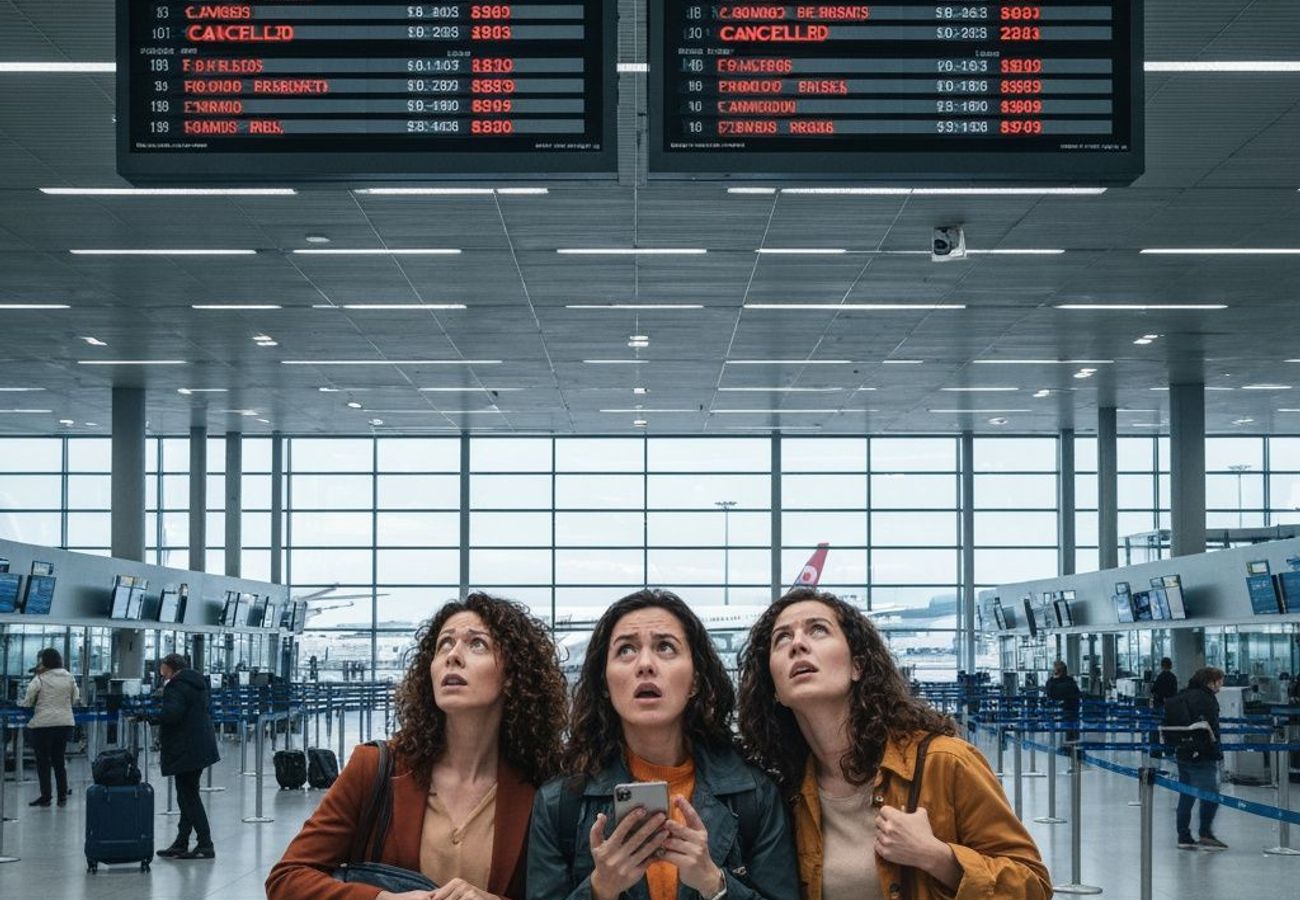
Image generated by AI
The Day French Aviation Came to a Standstill
France's aviation system faced unprecedented strain on June 9, 2026, as major carriers collided with operational gridlock across the nation's busiest hubs. The numbers tell a devastating story: 379 flight delays and 9 cancellations cascaded through Charles de Gaulle/Roissy, Marseille Provence, Nice Côte d'Azur, and Toulouse-Blagnac airports, leaving thousands of passengers stranded and the tourism-dependent economy reeling.
This wasn't a single airport meltdown—it was a systemic failure affecting France's entire air travel infrastructure. What caused it, who suffered most, and what does this mean for your summer vacation plans?
Charles de Gaulle Takes the Hit Hardest
The crown jewel of French aviation—Charles de Gaulle/Roissy—bore the brunt of today's chaos. The airport recorded 214 delayed flights and 4 cancellations, cementing its status as the hardest-hit facility in the country. As Europe's third-busiest hub connecting North America, Asia, and Africa to continental Europe, delays here don't just disrupt individual flights—they trigger cascading failures across the entire network.
One traveler summed it up bluntly on Reddit: "I missed my connection to Frankfurt because CDG couldn't get us airborne on time. Three-hour layover became nothing. Airlines offer rebooking, but now I'm stuck for 24 hours." — r/travel
Marseille Provence experienced 44 delays and 2 cancellations, while Nice Côte d'Azur—the gateway to the French Riviera—recorded 84 delays and 1 cancellation. Toulouse-Blagnac saw 37 delays and 2 cancellations. Together, these four airports represent France's lifeline to the world, and today that lifeline was severely compromised.
Which Airlines Got Hammered?
Five major carriers bore responsibility for the disruptions, though operational limitations—not airline incompetence—appeared to be the root cause:
Air France took the hardest blow, facing multiple delays and cancellations primarily at its flagship hub, Charles de Gaulle/Roissy. As France's national carrier and the airport's dominant operator, Air France's scheduling fragility became painfully obvious.
EasyJet reported cascading delays across Nice Côte d'Azur and Marseille Provence, hitting budget-conscious leisure travelers particularly hard. The low-cost carrier's thin operational margins mean delays compound quickly into cancellations.
Transavia France, Ryanair, and Volotea rounded out the disruption list, with operational strain evident at Toulouse-Blagnac and secondary hubs. Budget carriers running near-maximum capacity leave zero room for weather, staffing, or technical issues.
According to FlightAware's real-time tracking data, operational limitations and elevated traffic volume—not mechanical failures or security incidents—drove the disruptions. Both factors point to systemic capacity issues rather than isolated incidents.
The Tourism Domino Effect
Here's where the damage extends beyond inconvenient departure boards. France's tourism engine runs on reliable connectivity, and today's disruptions threaten the economic foundation of four major cities.
Paris, Marseille, Nice, and Toulouse collectively attract millions of international visitors annually. Hotels pre-sold rooms to guests who never arrived. Tour operators scrapped itineraries. Restaurants, museums, and local attractions faced ghost-town foot traffic. When passengers encounter repeated delays, they don't just lose trust in individual airlines—they reconsider whether France deserves their vacation budget at all.
The ripple effects extended beyond tourism. Ground transportation services, event venues, and hospitality businesses dependent on consistent visitor flow experienced cascade losses. A single delayed flight from Charles de Gaulle to Barcelona doesn't just frustrate one passenger—it erases revenue from three hotels, two restaurants, and four activity operators across two countries.
What Passengers Faced Today
Thousands of travelers found themselves trapped in a system beyond their control. The experience wasn't uniform—some faced minor 30-minute adjustments, while others endured 4-6 hour delays with minimal communication.
Airlines activated their contingency protocols: rebooking options, refund processing, and accommodation support for extended delays. However, the sheer volume of disrupted passengers overwhelmed customer service desks. Check-in lines snaked through terminals. Security queues doubled in length as rebooked passengers attempted to catch later flights.
The smart play for travelers today? According to airport advisories, passengers should have:
- Confirmed flight status directly with their airline before leaving home
- Arrived 3+ hours early for international departures (standard 2-hour minimums became death traps)
- Checked official government travel portals rather than relying on airline announcements
- Had backup plans ready: alternate airports, different travel dates, or alternative transportation modes
The Hub-and-Spoke Fragility Problem
Charles de Gaulle/Roissy operates as a critical hub in the classic hub-and-spoke model, where incoming flights feed outgoing connections. When inbound aircraft arrive late, downstream connections suffer exponentially. A single delayed aircraft from Frankfurt creates ripple effects touching flights destined for Tokyo, New York, and Accra—all from passengers who missed tight connections.
Nice Côte d'Azur and Marseille Provence serve more point-to-point routes, but still face connection challenges to secondary European destinations. Toulouse-Blagnac, though smaller, handles crucial domestic connections that feed international services at larger hubs.
The architecture works when operations run smoothly. Today exposed the system's fragility when operational margins tighten.
Why It Happened: Root Causes
Airport authorities attributed disruptions to operational limitations and elevated traffic volume. Translation: France's major airports were operating at or near maximum capacity with minimal buffer for disruptions.
Summer peak season hasn't even arrived. School holidays in northern Europe don't start until late June. Yet airports were already straining under demand. What happens when actual peak season hits?
The finding suggests that France's aviation infrastructure—both airside and terminal-side—operates with insufficient slack. Whether that's a staffing shortage, ground equipment constraints, or air traffic control capacity limits remains unclear. But the pattern is unmistakable: the system ran out of room to absorb normal operational variations.
Recommendations for Travelers Booked on Future French Flights
Don't assume today's chaos was a one-off anomaly. Summer travel to France requires defensive planning:
Check real-time flight status through official airline websites or FlightAware before committing to departure for the airport.
Build 3+ hour buffers between arriving at the airport and your international departure time, particularly from Charles de Gaulle.
Know your airline's rebooking policy before you fly. Some carriers force you onto flights weeks later; others allow rapid rebooking to competing airlines.
Consider flying through secondary hubs if your destination isn't Paris. Marseille or Nice sometimes offer better connectivity during peak periods, even for northern European destinations.
Stay flexible on travel dates. If you're booking now for summer, consider Tuesday-Thursday departures over Friday-Sunday. Peak capacity periods compress around weekends.
Document everything related to delays. EU regulations entitle passengers to compensation (€250-€600 depending on distance) for delays exceeding 3 hours caused by airline operational failures. Keep boarding passes, delay confirmations, and communication records.
What Comes Next?
Airport authorities must coordinate responses with airlines and government officials to prevent cascading delays from becoming the norm. Options include increased staffing, enhanced ground equipment, modified scheduling to reduce peak-hour concentration, or investment in terminal expansion.
But none of that happens overnight. For now, travelers booking summer flights through France should assume disruptions are possible and plan accordingly.
French aviation's infrastructure just showed its limits—and we're not even in peak season yet.
Related Travel Guides
Disclaimer
This article is for informational and educational purposes only. It does not constitute legal, financial, or professional advice. While we strive to provide accurate and up-to-date information, travel policies, regulations, and conditions change rapidly. Always verify information with official sources before making travel decisions. Nomad Lawyer makes no representations about the accuracy, reliability, completeness, or suitability of the information provided. Readers should consult qualified professionals for advice specific to their circumstances. The views expressed in this article are those of the author and do not necessarily reflect the views of Nomad Lawyer.
Kunal K Choudhary
Co-Founder & Contributor
A passionate traveller and tech enthusiast. Kunal contributes to the vision and growth of Nomad Lawyer, bringing fresh perspectives and driving the community forward.
Learn more about our team →