
Flights Cancelled Throughout The USA As 182 Cancellations And 3,592 Delays Impacted Travel Across Dallas, Boston, And Beyond
Flights Cancelled Throughout The USA As 182 Cancellations And 3,592 Delays Impacted Travel Across Dallas, Boston, And Beyond

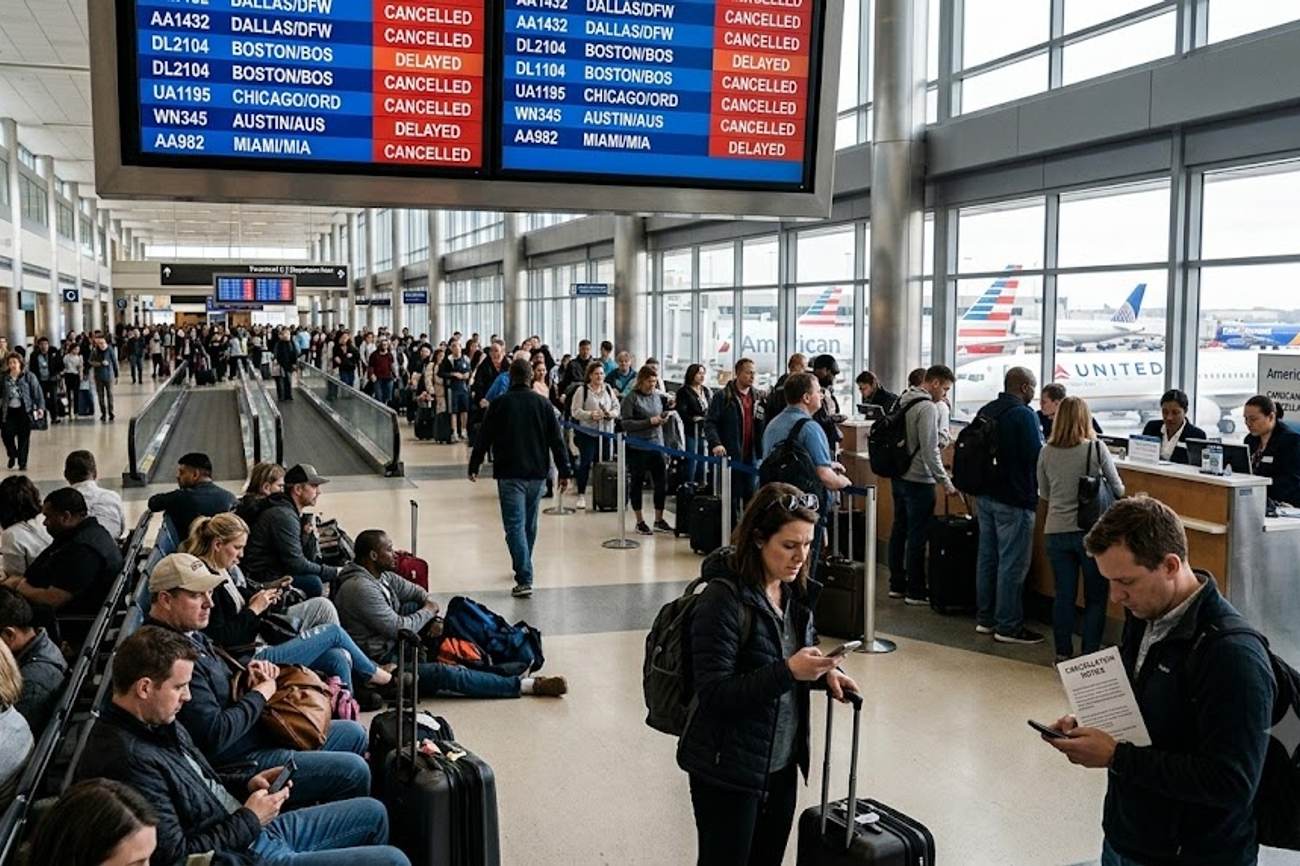
Image generated by AI
The Logistics of Air Traffic Collapse
5,855 flight delays and 201 cancellations paralyzed the United States aviation network as of 5:42 p.m. ET on September 20, 2026. This surge in disruptions highlights a fragile synchronization between regional weather patterns and the operational capacity of the Federal Aviation Administration (FAA), where localized atmospheric events triggered a systemic ripple effect across the country's primary hubs.
The current crisis is not the result of a single failure but a convergence of diverse meteorological stressors. From the low-ceiling conditions hindering visibility in the Midwest and West Coast to the violent thunderstorms stalling operations in Florida, the national airspace is currently fragmented. These restrictions force air traffic controllers to implement ground stops and traffic-management initiatives, which effectively throttle the flow of aircraft to prevent airborne congestion and ensure safety. When a primary hub like Chicago O’Hare slows down, the delay is not contained locally; it migrates through the network as aircraft are held at their origin airports, creating a cascading failure of schedules.
Hub-and-Spoke Vulnerabilities: The Data Breakdown
The current disruptions are concentrated in the nation's most critical transit nodes. The data reveals a stark disparity in how different airports are absorbing these shocks, with some experiencing moderate delays and others facing near-total operational stagnation.
| Airport | Delays | Cancellations | Originating Delay Rate | Destination Delay Rate | Primary Cause |
|---|---|---|---|---|---|
| Chicago O'Hare | 556 | 40 | 21% | 18% | Low Ceilings |
| Boston Logan | 396 | 40 | 20% | 39% | Operational Factors |
| Atlanta Hartsfield-Jackson | 312 | 25 | 13% | 13% | Systemic |
| Dallas-Fort Worth | 298 | 8 | 15% | 11% | Systemic |
| San Francisco | 210 | 5 | 12% | N/A | Low Ceilings |
| Newark Liberty | 120 | 13 | 10% | 10% | Systemic |
| Los Angeles | 118 | 8 | 5% | 7% | Systemic |
| Orlando | 105 | 3 | N/A | 10% | Weather |
| Seattle-Tacoma | 81 | 9 | 5% | 6% | Systemic |
| Fort Lauderdale | 74 | 2 | N/A | N/A | Thunderstorms |
The severity of these numbers is most evident at Boston Logan, where destination flights are seeing a staggering 39% delay rate, and the FAA has reported a ground delay averaging 95 minutes. Similarly, San Francisco is struggling with low ceilings that have pushed average ground delays to 52 minutes. In Orlando, weather-driven traffic management has pushed departure delays to an average of 45 minutes, with the FAA noting that these wait times are continuing to climb.
Expert Analysis: The Carrier Collision Course
The data reveals a critical distinction between "delay pressure" and "cancellation risk." For the traveler, these are two different logistical nightmares. American Airlines and Southwest are currently absorbing the highest volume of delays—614 and 594 respectively. This suggests that these carriers are attempting to keep their flight schedules intact, opting to push back departures rather than scrubbing flights from the board.
However, United and Delta Air Lines are exhibiting a different operational strategy, with United reporting 35 cancellations and Delta reporting 34. For travelers booking these routes, the direct consequence is a higher likelihood of a total flight void rather than a mere time shift. This often occurs when an airline determines that a crew will "time out" (exceed legal flying hours) due to delays, making a cancellation the only legal option.
The pricing pressure this creates is immediate. When United or Delta cancels a high-capacity flight, the remaining available seats on subsequent flights spike in value. This creates a secondary market of desperation where passengers are forced into expensive last-minute rebookings or stranded in hubs like Chicago O'Hare, where the 21% originating delay rate is creating massive terminal congestion.
Furthermore, the reliance on hub-and-spoke models means that a ground stop at Fort Lauderdale due to thunderstorms does not just affect Florida; it traps aircraft intended for other cities, removing capacity from the rest of the International Air Transport Association (IATA) regulated network. The systemic fragility is exposed when we see that even airports with lower delay rates, such as Seattle-Tacoma at 5%, are still feeling the effects of disruptions occurring thousands of miles away.
Key Takeaways
- Hub Criticality: Chicago O'Hare and Boston Logan are the current epicenters of disruption, both recording 40 cancellations each, with Boston seeing the most severe destination delay rate at 39%.
- Carrier Divergence: American Airlines (614 delays) and Southwest (594 delays) are facing the most significant scheduling pressure, while United (35 cancellations) leads in flight voids.
- Meteorological Triggers: Low ceilings are the primary driver of delays in San Francisco and Chicago, while thunderstorms have completely halted operations via a ground stop in Fort Lauderdale.
- Operational Lag: Ground delays are most severe in Boston (95 minutes) and San Francisco (52 minutes), indicating significant bottlenecks in getting aircraft off the tarmac.
FAQ: USA Flight Disruptions 2026
What should I do if my flight is canceled by United or Delta? Contact the airline immediately via their app or customer service line. Since these carriers have higher cancellation rates today, demand for rebooking will be extreme. Request the earliest possible alternative or check for flights into nearby secondary airports.
How do "low ceilings" affect my flight departure? Low ceilings mean clouds are very low to the ground, reducing visibility for pilots during takeoff and landing. The FAA restricts the number of aircraft allowed to take off or land per hour to maintain safety, which creates the increasing delays seen at O'Hare and San Francisco.
Why is my flight delayed if the weather at my destination is clear? Aviation operates on a network. If your aircraft is coming from a hub like Fort Lauderdale or Chicago, it may be stuck there due to a ground stop or low ceilings. The plane cannot reach you until the disruption at the origin point is resolved.
Are these delays likely to last into the next travel day? Yes. When delays reach the levels seen today—over 5,800 across the USA—aircraft and crews are displaced from their scheduled locations. This "knock-on effect" typically causes residual delays for 24 to 48 hours as airlines work to reposition their fleet.
The fragility of the American sky is once again laid bare by a few clouds and a thunderstorm.
Tags: American Airlines, United Airlines, Chicago O'Hare, FAA Restrictions 2026, Boston Logan, US Aviation Logistics
Related Travel Guides
- Maui Flight Diverts to Honolulu After Fumes Reported on Delta’s Seattle-Bound Aircra
- Charleston Joins Ontario and More as America’s Rising Airports Redefine the Journey Before Take-Off
- Asia Travel Disrupted as Major Airports Including Tokyo, Singapore and Others Face 245 Cancellations and 4,100 Delays
Disclaimer
This article is for informational and educational purposes only. It does not constitute legal, financial, or professional advice. While we strive to provide accurate and up-to-date information, travel policies, regulations, and conditions change rapidly. Always verify information with official sources before making travel decisions. Nomad Lawyer makes no representations about the accuracy, reliability, completeness, or suitability of the information provided. Readers should consult qualified professionals for advice specific to their circumstances. The views expressed in this article are those of the author and do not necessarily reflect the views of Nomad Lawyer.
Kunal K Choudhary
Co-Founder & Contributor
A passionate traveller and tech enthusiast. Kunal contributes to the vision and growth of Nomad Lawyer, bringing fresh perspectives and driving the community forward.
Learn more about our team →