
Flights Cancelled Over The US As Atlanta, Houston, And More Airports Cancel 473 And Delay 2,723, Impacting Air Travel
Flights Cancelled Over The US As Atlanta, Houston, And More Airports Cancel 473 And Delay 2,723, Impacting Air Travel

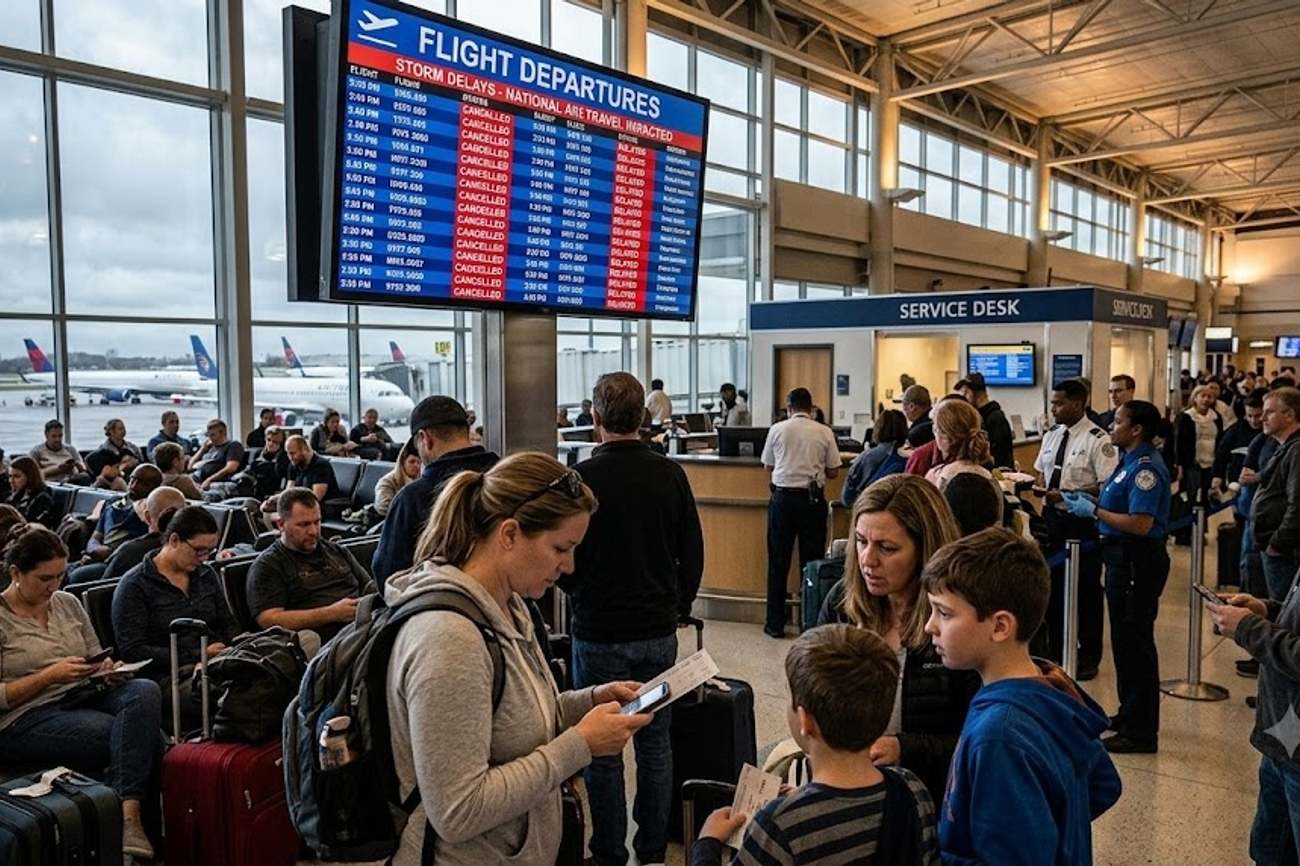
Image generated by AI
[Chicago, September 2024] — Widespread operational failures across the United States aviation network have triggered 2,723 flight delays and 473 cancellations today. The disruption is centered heavily in the Midwest, with Chicago O’Hare International Airport emerging as the primary epicenter of the chaos.
The systemic interruptions are impacting a broad spectrum of carriers, including major legacy airlines and regional partners. United, American Airlines, and Southwest are reporting significant schedule slips, while regional operators such as SkyWest, Republic, Envoy Air, and GoJet are seeing high percentages of cancelled departures. The crisis is coinciding with a critical period of infrastructure tension, as the Federal Aviation Administration (FAA) prepares to deploy new technology to mitigate such operational collapses.
Systemic Network Failures
The current volatility is characterized by a cascade of delays that have paralyzed key hubs. Chicago O’Hare is currently the most severely impacted facility in the country, recording 1,042 delays and 342 cancellations. The airport is seeing a 12% cancellation rate and a 35% delay rate for originating flights, while destination figures are even more volatile, with a 39% delay rate.
Simultaneously, Chicago Midway is struggling with a high volume of total losses, reporting 74 delays and 71 cancellations. Midway’s origin figures show a stark 16% cancellation rate and a 16% delay rate, while destination figures mirror this at 13% for both metrics.
Outside of the Chicago corridor, the disruptions have rippled through the East Coast and South. Hartsfield-Jackson Atlanta International Airport, the world's busiest hub, is managing 116 delays and 12 cancellations. In the Northeast, Boston Logan has recorded 105 delays and seven cancellations, while LaGuardia reports 62 delays and eight cancellations.
Who Is Affected
The disruptions are not limited to a single carrier but are spread across the domestic network. The following data outlines the specific impact on airports and airlines:
Major Airport Disruptions
| Airport | Delays | Cancellations | Origin Delay Rate | Origin Cancel Rate |
|---|---|---|---|---|
| Chicago O'Hare | 1,042 | 342 | 35% | 12% |
| Hartsfield-Jackson | 116 | 12 | 5% | N/A |
| Boston Logan | 105 | 7 | 8% | N/A |
| Orlando | 86 | 8 | N/A | N/A |
| Reagan National | 84 | 10 | 15% | 1% |
| Houston Bush | 81 | 12 | 6% | 2% |
| Chicago Midway | 74 | 71 | 16% | 16% |
| LaGuardia | 62 | 8 | 10% | 1% |
| Detroit Metro | 61 | 9 | 4% | 1% |
| Minneapolis/St Paul | 58 | 12 | 7% | 1% |
Carrier-Specific Impact
- United: 511 delays and 42 cancellations (17% delay rate).
- American Airlines: 466 delays and 41 cancellations (14% delay rate).
- Southwest: 341 delays and 79 cancellations (10% delay rate; 2% cancellation rate).
- SkyWest: 293 delays and 76 cancellations (12% delay rate; 3% cancellation rate).
- Envoy Air: 142 delays and 58 cancellations (13% delay rate; 5% cancellation rate).
- GoJet: 67 delays and 46 cancellations (24% delay rate; 16% cancellation rate).
- Republic: 63 delays and 71 cancellations (6% delay rate; 7% cancellation rate).
What This Means for Travelers
For passengers currently at the airport or preparing for departure, these numbers translate to a high probability of missed connections and extended tarmac wait times. The high "destination delay rate" at airports like O'Hare (39%) means that even if your flight departs on time from another city, you are likely to face arrival delays that could jeopardize onward travel.
Travelers should prioritize digital communication over airport kiosks. Because carriers like GoJet are seeing cancellation rates as high as 16%, passengers on regional legs of their journey are at the highest risk of being stranded. If you are flying through a Chicago hub, the data suggests a nearly 1-in-3 chance of a delay, meaning you should not book tight connections.
Passengers are advised to:
- Use the official United Airlines, American Airlines, or Southwest Airlines mobile apps for real-time push notifications.
- Request immediate rebooking the moment a cancellation is confirmed, as available seats on subsequent flights will fill rapidly.
- Verify the status of connecting flights before departing for the airport if the first leg is delayed.
The AI Solution: Project SMART
To combat these recurring failures, the FAA is accelerating the rollout of a new AI-driven operational tool. The system, known as SMART (Strategic Management of Airspace, Routes, and Trajectories), is scheduled to potentially enter service as early as September 21.
Developed by Air Space Intelligence under an $875 million, 12-year government contract, SMART is designed to function as a high-level decision-support tool. The software will analyze airspace and trajectories in real-time to help controllers and airlines manage schedules more efficiently during periods of extreme disruption.
The initial deployment will be concentrated in the Washington, D.C. area, specifically targeting the airspace around Reagan National, before a wider national expansion. This move is a direct response to the aging infrastructure of the US National Airspace System and the ongoing shortage of air traffic controllers. By automating parts of the trajectory management process, the FAA aims to reduce the "ripple effect" where a delay in one hub, such as Chicago, causes a systemic collapse across other major airports.
FAQ: US Flight Disruptions 2024
What should I do if my flight is cancelled today? Immediately check your airline's app or website for rebooking options. Contact the carrier's customer service via phone or chat to request the earliest available alternative flight. If the airline cannot provide a same-day flight, inquire about hotel vouchers or refunds.
Which airports are currently the most unstable? Chicago O'Hare and Chicago Midway are experiencing the most severe disruptions. O'Hare has recorded over 1,000 delays and 300+ cancellations, making it the primary point of failure in the current network.
Are regional airlines more affected than major carriers? Yes, in terms of percentages. While United and American have more total delays, regional carriers like GoJet are seeing much higher cancellation rates (16%) and delay rates (24%), posing a higher risk to passengers on short-haul legs.
Will the new FAA AI tool prevent these delays in the future? The SMART system is intended to provide better decision support for air traffic controllers. While it cannot stop weather or mechanical failures, it is designed to help the FAA manage the resulting disruptions more efficiently to prevent total network gridlock.
Travelers are urged to monitor flight boards and airline alerts continuously as the situation evolves.
#ORD2024 #ATL2024 #FAA_SMART #UnitedAirlines #AmericanAirlines #SouthwestAirlines
Related Travel Guides
Disclaimer
This article is for informational and educational purposes only. It does not constitute legal, financial, or professional advice. While we strive to provide accurate and up-to-date information, travel policies, regulations, and conditions change rapidly. Always verify information with official sources before making travel decisions. Nomad Lawyer makes no representations about the accuracy, reliability, completeness, or suitability of the information provided. Readers should consult qualified professionals for advice specific to their circumstances. The views expressed in this article are those of the author and do not necessarily reflect the views of Nomad Lawyer.
Naina Thakur
Contributor & Travel Specialist
Travel enthusiast and legal writer covering visa regulations, responsible tourism, and cultural journeys across global destinations.
Learn more about our team →