
FAA World Cup 2026 Airspace Restrictions: No-Fly Zones, Drone Bans & Travel Alert
The FAA has imposed sweeping airspace restrictions across 11 FIFA World Cup 2026 host cities. Drone bans, TFRs, and military intercept rules now apply.

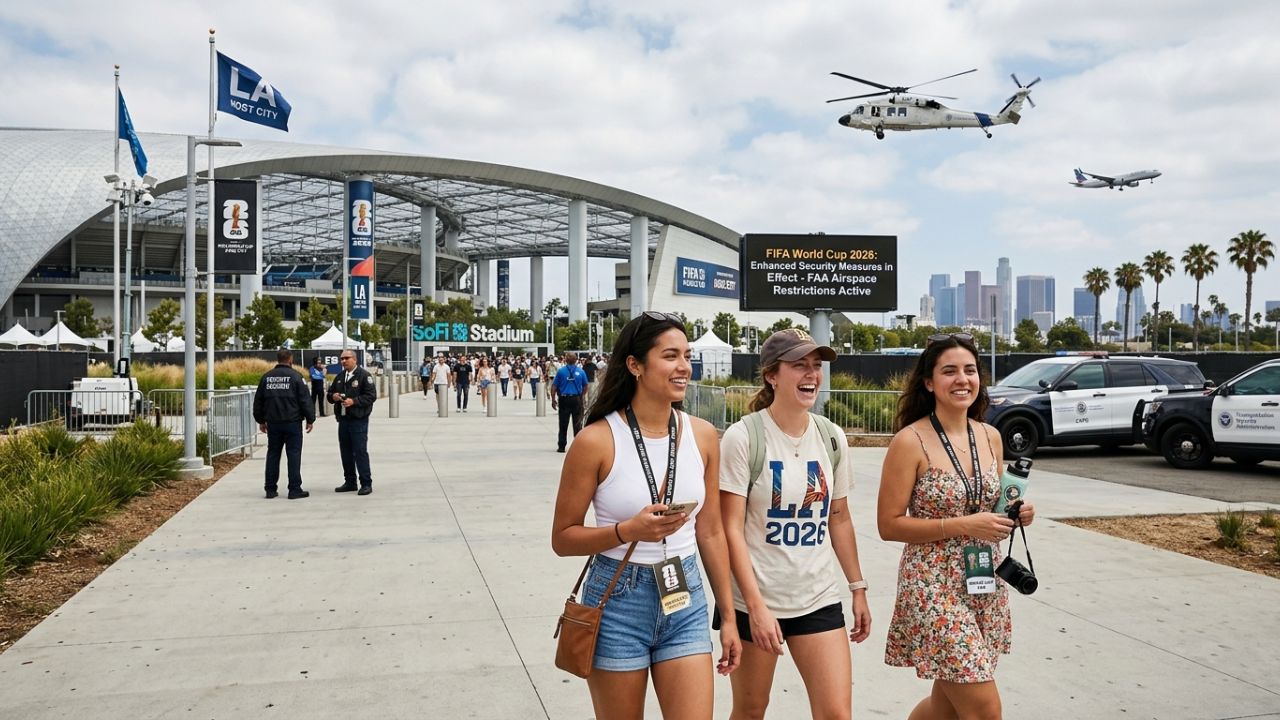
Image generated by AI
FAA Enforces Sweeping World Cup 2026 Airspace Restrictions Across 11 US Host Cities — Drone Bans, Military Intercept Powers, and $100,000 Fines Now in Effect: New Travel Alert
Published on June 17, 2026
The Federal Aviation Administration (FAA) has activated one of the most comprehensive aerial security frameworks in American history, locking down airspace above all 11 FIFA World Cup 2026 host cities across the United States. Working in coordination with the FBI, the Department of Homeland Security, and local law enforcement, the FAA has designated stadiums, fan zones, and public gathering areas as strict No Drone Zones, with violations carrying civil penalties of up to $75,000 and criminal fines reaching $100,000. Travelers, private pilots, corporate flight departments, and travel trade professionals must urgently familiarize themselves with these rules before approaching any host venue.
Quick Summary
- The FAA, FBI, and DHS have jointly established a multi-layered aerial security grid across all 11 FIFA World Cup 2026 host cities.
- All stadiums are designated No Drone Zones; operating any unmanned aerial system (UAS) near venues is a federal offense.
- Civil penalties reach $75,000 per violation; criminal fines can reach $100,000.
- Private pilots must file flight plans at least 6 hours but no more than 24 hours before departure; airborne IFR pick-ups are flatly refused.
- Military fighters are authorized to intercept — and in extreme cases use lethal force against — non-compliant aircraft.
The Scale of the FAA's World Cup 2026 Security Operation
The breadth of the FAA's World Cup 2026 airspace restrictions is unprecedented in scope. The agency has formally partnered with elite intelligence bodies — including the FBI and the Department of Homeland Security — alongside regional police forces to create what authorities describe as an uncompromised aerial shield over every host city.
The cities affected span the continental United States: Los Angeles and Santa Clara in California; Seattle, Washington; Arlington and Houston, Texas; Atlanta, Georgia; Foxborough, Massachusetts; Miami, Florida; Kansas City, Missouri; East Rutherford and Philadelphia in New Jersey and Pennsylvania respectively; and New York, New York. Together, these cities host every group stage match, knockout round, and the final itself, making air traffic management a mission-critical national security priority.
No Drone Zones: What the Federal Prohibitions Cover
The FAA has declared all official stadiums and adjacent event spaces absolute No Drone Zones, meaning any takeoff, landing, or operation of an unmanned aerial system (UAS) within designated perimeters constitutes a serious federal offense — regardless of whether the operator holds a valid commercial licence.
To enforce these bans in real time, the FAA has launched the Drone Expedited and Targeted Enforcement Response (DETER) initiative. DETER coordinates real-time drone tracking across all host cities and is designed to isolate and penalize rogue operators instantly during active match windows.
Even licensed commercial remote pilots are grounded during live events at venues including Lumen Field in Seattle, AT&T Stadium in Arlington, MetLife Stadium in East Rutherford, and Lincoln Financial Field in Philadelphia. The DETER system operates continuously throughout the tournament period.
Penalties for Violations: Financial and Criminal Consequences
The financial and legal consequences for non-compliance are severe. Under the updated federal framework:
- Civil penalties can scale up to $75,000 per violation
- Criminal fines can reach $100,000
- Immediate arrest of non-compliant operators by on-site security teams
- Permanent seizure of unauthorized drone equipment by federal law enforcement officers
Federal agents in cities including Boston, Miami, Dallas, and Los Angeles have been granted explicit legal authority to intercept, disrupt, and permanently confiscate any UAS equipment found operating in restricted zones.
Stadium Match Schedule and Active Restriction Windows
Travelers must cross-reference active Notices to Airmen (NOTAMs) to verify the exact hours during which airspace restrictions are in effect at each venue. Below is the full list of host stadiums and their confirmed match dates:
| Host City | State | Stadium | Key Match Dates |
|---|---|---|---|
| Los Angeles | California | SoFi Stadium | June 12, 15, 18, 21, 25, 28; July 2, 10 |
| Santa Clara | California | Levi's Stadium | June 13, 16, 19, 22, 25; July 1 |
| Seattle | Washington | Lumen Field | Refer to active NOTAMs |
| Arlington | Texas | AT&T Stadium | June 14, 17, 22, 25, 27, 30; July 3, 6, 14 |
| Houston | Texas | NRG Stadium | Refer to active NOTAMs |
| Atlanta | Georgia | Mercedes-Benz Stadium | Refer to active NOTAMs |
| Foxborough | Massachusetts | Gillette Stadium | Refer to active NOTAMs |
| Miami | Florida | Hard Rock Stadium | Refer to active NOTAMs |
| Kansas City | Missouri | Arrowhead Stadium | Refer to active NOTAMs |
| East Rutherford | New Jersey | MetLife Stadium | June 13, 16, 22, 25, 27, 30; July 5, 19 |
| Philadelphia | Pennsylvania | Lincoln Financial Field | Refer to active NOTAMs |
The inner security ring enforces a 3-Nautical-Mile Radius (NMR) up to 3,000 feet Above Ground Level (AGL) around every stadium. Any unauthorized intrusion into these corridors triggers immediate defensive protocols from military air commands.
Strict Flight Procedures for Private and Corporate Aviation
Corporate flight departments and private pilots face a dramatically altered operational environment during the tournament. According to the Federal Aviation Administration (FAA), all private pilots must file comprehensive flight plans within a mandatory window of at least 6 hours but no more than 24 hours prior to departure. This rule applies across all host city airports to allow air traffic controllers to assess real demand and prevent dangerous congestion.
Flight dispatchers operating out of East Rutherford, New Jersey and New York, New York must be aware that airborne IFR pick-ups and air files are flatly rejected. Except in verified, life-threatening emergencies, airborne changes of destination are also strictly prohibited within the busy terminal radar approach control zones of Los Angeles and Santa Clara, California.
Traffic Management Initiatives (TMIs) further require that all corporate flight departments moving high-net-worth individuals into cities like Atlanta or Houston completely restructure their standard operational timelines. Local training flights, practice approaches, and student solo flights face total suspension near Boston and Miami throughout the tournament period.
Anup Kumar Keshan, founder and editor-in-chief of Travel And Tour World, underscored the urgency: "The introduction of the FAA World Cup 2026 airspace restrictions represents a vital turning point for international aviation management across key corridors like Miami, Florida and Los Angeles, California. Global travel trade professionals must meticulously educate their commercial clients and private charter networks to guarantee flawless compliance with these newly updated American security mandates."
Public Fan Zones Are Also Restricted Airspace
The no-fly framework extends well beyond stadium perimeters. Drone bans apply to heavily populated public fan zones and pedestrian areas within a 1-Nautical-Mile Radius (NMR) up to 1,000 feet AGL across cities including Dallas and Houston.
Security forces will heavily police fan festivals at locations such as Centennial Olympic Park in Atlanta, Georgia and City Hall Plaza in Boston, Massachusetts. Media personnel must be warned that unauthorized commercial filming using drones is entirely illegal throughout all designated boundaries.
Additionally, iconic public spaces are under active surveillance:
- Rockefeller Center, New York, New York
- Lemon Hill Park, Philadelphia, Pennsylvania
- Harrison, New Jersey and Flushing, New York — under continuous military surveillance
- Brooklyn, New York and Los Angeles, California — subject to electronic interference deployment if a drone is deemed a credible hazard
The Transportation Security Administration (TSA) is coordinating with stadium security at all venues to maintain consistent checkpoint operations throughout the tournament.
Military Intercept Authority and Lethal Force Authorization
The most critical — and unprecedented — element of the World Cup 2026 security framework is the authorization granted to the Department of Defense. Per the Special Security Instruction TFRs, non-compliant aircraft face immediate interception by armed military fighters over cities including Seattle, Washington and Arlington, Texas.
Pilots who ignore restrictions face immediate suspension or permanent revocation of their aviation certificates, alongside severe criminal prosecution under federal statutes.
In the most extreme circumstances, the federal government has confirmed that lethal force is authorized against any aircraft deemed an imminent security threat over hubs like Los Angeles or Houston. The Department of Defense has stated it will not hesitate to neutralize any target posing a genuine threat to stadium spectators in cities including Miami or Kansas City.
Practical Checklist for Travelers and Travel Trade Professionals
Travel agencies, corporate travel managers, and tour operators managing World Cup itineraries must implement the following measures immediately:
- Brief all clients on the drone prohibition before arrival in any host city
- Use the MyTSA app to track real-time airport security wait times across Dallas and Miami
- Enforce the TSA 3-1-1 liquids rule to accelerate checkpoint processing in Boston and Atlanta
- Mandate early airport arrivals — allow extra time at all 11 host city airports
- Cross-reference NOTAMs before any private or charter flight departure
- File flight plans within the 6-to-24-hour window without exception
- Brief all drone operators in media or production teams about DETER enforcement powers
- Avoid any UAS activity within 3 NMR of stadiums or 1 NMR of public fan zones
According to the FIFA World Cup 2026 official site, the tournament spans multiple weeks across 11 US cities — making continuous compliance monitoring essential for any travel operator managing group movements.
What Happens Next: Ongoing Enforcement Throughout the Tournament
The FAA's World Cup 2026 airspace framework is not a one-time event — it is an active, rolling enforcement operation that intensifies on every match day. The DETER initiative will maintain real-time drone tracking from the tournament's first whistle through to the final on July 19, 2026 at MetLife Stadium in East Rutherford, New Jersey.
Aviation authorities will continue issuing updated NOTAMs as match schedules progress and security assessments evolve. Travel trade professionals managing itineraries in Philadelphia, Houston, Seattle, and Santa Clara should monitor FAA advisory channels continuously and update client briefings accordingly.
Any pilot certificate suspension or drone seizure will be processed immediately — there are no warnings or grace periods built into the DETER enforcement protocol.
Final Word: Compliance Is Non-Negotiable
The FAA World Cup 2026 airspace restrictions represent the most sweeping aerial security mobilization ever deployed for a sporting event on American soil. With military intercept authority, lethal force provisions, six-figure fines, and real-time drone tracking all active simultaneously, the consequences of non-compliance are catastrophic. Travelers, pilots, media crews, and travel trade professionals must treat these restrictions with the highest level of seriousness and build complete compliance into every World Cup itinerary now.
FAQ: FAA World Cup 2026 Airspace Restrictions
Can I fly a drone near a FIFA World Cup 2026 stadium in the US? No. All official stadiums are designated No Drone Zones. Operating any unmanned aerial system (UAS) within the restricted perimeter — typically 3 nautical miles and up to 3,000 feet AGL — is a federal offense, regardless of whether you hold a commercial drone licence.
What is the DETER initiative? DETER stands for Drone Expedited and Targeted Enforcement Response. It is the FAA's real-time drone tracking and enforcement program specifically launched for the 2026 World Cup, designed to identify and penalize unauthorized drone operators instantly during match windows.
What are the fines for violating FAA World Cup 2026 airspace rules? Civil penalties can reach $75,000 per violation, and criminal fines can reach $100,000. Equipment can be permanently seized, and aviation certificates can be permanently revoked.
Can private pilots fly into World Cup host cities during the tournament? Yes, but with strict conditions. Private pilots must file a comprehensive flight plan at least 6 hours — but no more than 24 hours — before departure. Airborne IFR pick-ups, air files, and mid-flight destination changes are prohibited except in verified life-threatening emergencies.
Can military aircraft shoot down a drone or plane near a World Cup venue? The federal government has confirmed that armed military fighters are authorized to intercept non-compliant aircraft, and in the most extreme circumstances where an aircraft poses an imminent security threat, lethal force is authorized by the Department of Defense.
Related Travel Guides
Northern Plains Severe Storms 2026: Travel Safety Warning for US Travelers
FAA World Cup 2026 Private Aviation Guide: Full TFR Compliance Checklist for Corporate Flyers
Disclaimer
This article is for informational and educational purposes only. It does not constitute legal, financial, or professional advice. While we strive to provide accurate and up-to-date information, travel policies, regulations, and conditions change rapidly. Always verify information with official sources before making travel decisions. Nomad Lawyer makes no representations about the accuracy, reliability, completeness, or suitability of the information provided. Readers should consult qualified professionals for advice specific to their circumstances. The views expressed in this article are those of the author and do not necessarily reflect the views of Nomad Lawyer.
Kunal K Choudhary
Co-Founder & Contributor
A passionate traveller and tech enthusiast. Kunal contributes to the vision and growth of Nomad Lawyer, bringing fresh perspectives and driving the community forward.
Learn more about our team →