
FAA Ground Stops Trigger 3,842 Flight Delays at Dallas-Fort Worth International Airport in 4 Days
Dallas-Fort Worth International Airport faced severe operational collapse this week, with FAA ground stops and thunderstorms driving total flight delays to 3,842 between Monday and Thursday.

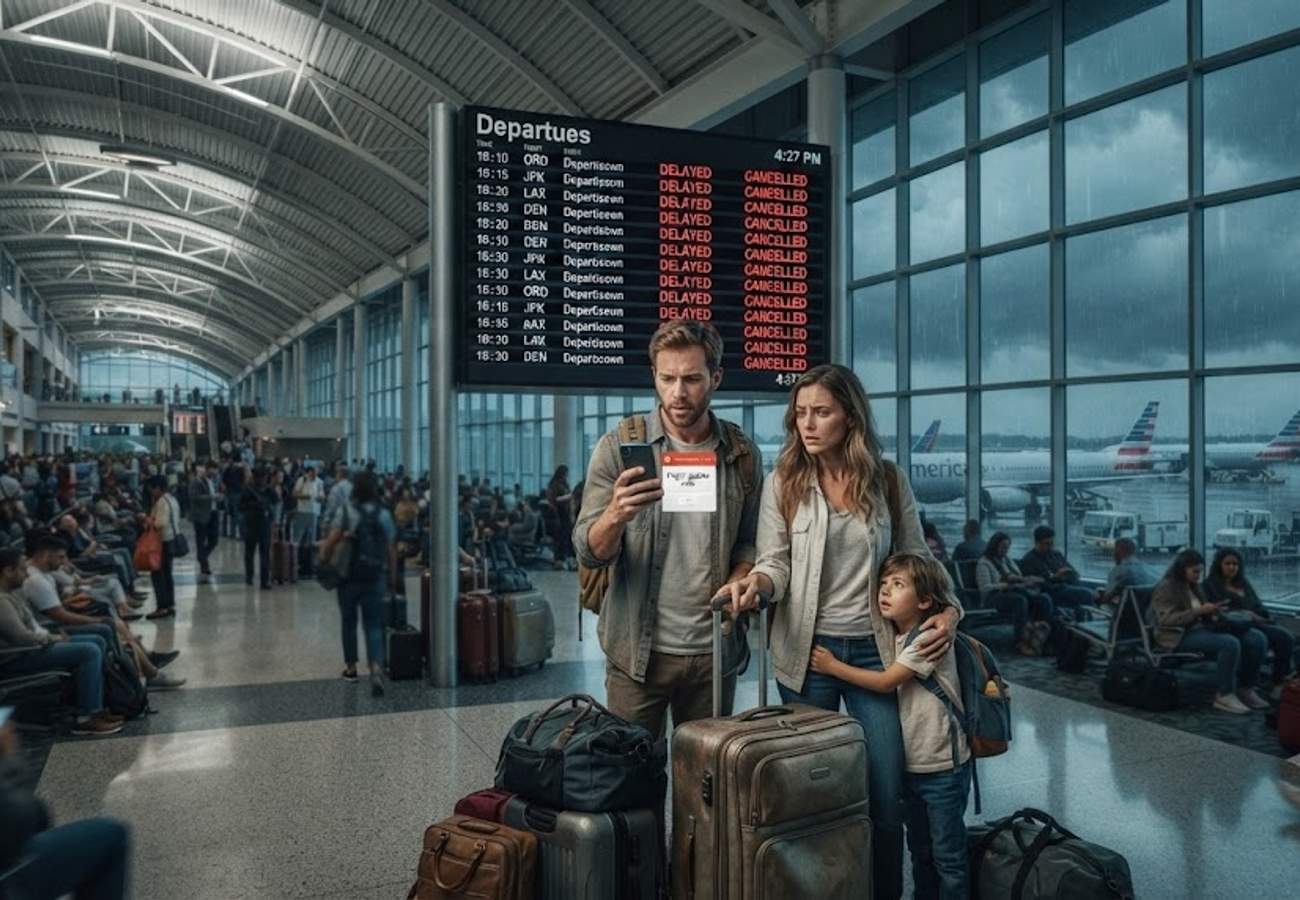
Image generated by AI
Operational instability at Dallas-Fort Worth International Airport (DFW) reached a critical peak this week, with total flight delays hitting 3,842 over a four-day period.
The Federal Aviation Administration (FAA) implemented ground stops on three of the four days between Monday, July 13, and Thursday, July 16. These interventions, primarily triggered by severe thunderstorms, crippled the major hub for American Airlines and contributed to a wider trend of national aviation instability.
On Thursday, July 16, the crisis intensified. FlightAware data shows 9,362 total delays across the United States, with DFW topping the list. The airport recorded 1,051 total delays on Thursday alone, with departure delays averaging 75 minutes.
Breakdown of DFW Operational Failures
The disruptions were not limited to weather-related ground stops. Industry data and passenger reports indicate a compounding effect of systemic failures:
- Departure Volatility: 634 departure delays occurred on Thursday, affecting 52% of all DFW flights.
- Cancellations: 23 flights were canceled at DFW on July 16.
- Carrier Impact: American Airlines, as the dominant carrier at DFW, recorded 586 delays at the hub on Thursday.
- Network Strain: American Airlines suffered 1,292 total delays nationwide on July 16, the second-highest among U.S. airlines.
- Secondary Failures: Beyond the FAA stops, passengers reported aircraft maintenance issues and crew "time-outs," where pilots and flight attendants exceeded legal working hours due to the backlog.
DFW Daily Delay Volume (July 13–16)
| Date | Total Delays |
|---|---|
| Monday, July 13 | 1,374 |
| Tuesday, July 14 | 518 |
| Wednesday, July 15 | 899 |
| Thursday, July 16 | 1,051 |
National Ripple Effects and Other Affected Hubs
While DFW was the epicenter, several other major U.S. gateways experienced significant disruptions on July 16. Seattle Tacoma International Airport saw 66% of its total flight volume affected by 477 departure delays, alongside a 50% delay rate for arriving flights. Physical infrastructure failures were also noted in Seattle, where water leaked through the C concourse ceiling during a ground stop.
Other Airports Facing FAA Disruptions on July 16:
- Ground Stops: Austin-Bergstrom International, Seattle International.
- Departure Delays: JFK, LaGuardia, O'Hare.
- Ground Delays: Philadelphia International, San Francisco International.
Why This Matters: The Hub Vulnerability Analysis
Our analysis of this data reveals a dangerous "compounding failure" loop. When a primary hub like DFW—which serves as a critical node for American Airlines—experiences a ground stop, the impact is not linear but exponential.
First, the weather forces the FAA to halt traffic. Second, the resulting backlog creates "crew time-outs," where flight crews legally cannot fly because their duty day has expired. Third, the scarcity of available aircraft at the hub leads to maintenance delays and the inability to swap planes for grounded flights.
For the traveler, this means a weather delay of two hours can evolve into a 12-hour ordeal or a cancellation because there is no legal crew available to fly the aircraft, even after the skies clear. This highlights the fragility of the current hub-and-spoke model when faced with volatile summer weather patterns.
Forward Outlook
As of Friday morning, DFW delays have dropped to 29 with four cancellations. However, the industry outlook remains cautious. With a high-volume travel weekend approaching, the ability of American Airlines to recover its crew schedules and reposition aircraft after nearly 4,000 delays in four days will be the primary determinant of stability. Travelers should expect residual delays as the network attempts to reset.
Aviation networks remain highly susceptible to cascading failures during peak summer weather windows.
Related Travel Guides
Disclaimer
This article is for informational and educational purposes only. It does not constitute legal, financial, or professional advice. While we strive to provide accurate and up-to-date information, travel policies, regulations, and conditions change rapidly. Always verify information with official sources before making travel decisions. Nomad Lawyer makes no representations about the accuracy, reliability, completeness, or suitability of the information provided. Readers should consult qualified professionals for advice specific to their circumstances. The views expressed in this article are those of the author and do not necessarily reflect the views of Nomad Lawyer.
Preeti Gunjan
Contributor & Community Manager
A passionate traveller and community builder. Preeti helps grow the Nomad Lawyer community, fostering engagement and bringing the reader experience to life.
Learn more about our team →