
Etihad Airways Doubles Kabul Capacity to Secure Central Asian Transit Corridor, Allowing Passengers to Bypass Massive Travel Chaos, Flight Cancellations, and Severe Airport Disruptions in Competitor Hubs: Latest Airline News
As massive travel chaos and rolling flight cancellations infect competitor mega-hubs, Etihad Airways aggressively expands its Abu Dhabi-Kabul route to secure a disruption-proof transit corridor.

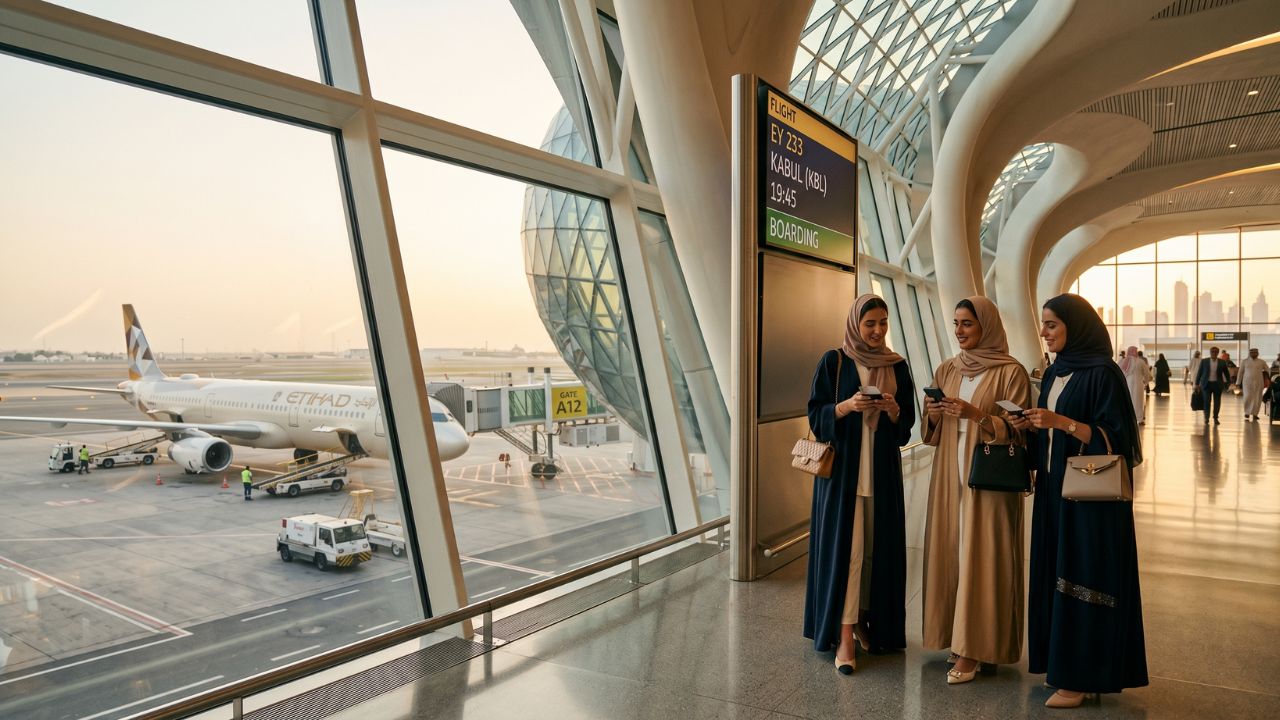
Image generated by AI
In a massive strategic escalation designed to dominate Central Asian transit flows and physically extract vulnerable passengers from the severe travel chaos currently infecting competing Middle Eastern mega-hubs, Etihad Airways has officially confirmed an aggressive doubling of its Abu Dhabi–Kabul route. Announced on June 18, 2026, the UAE carrier is responding to an unprecedented surge in demand just four months after the route's initial launch. By pushing frequencies to a staggering twice-daily schedule beginning July 15, 2026, Etihad is actively transforming Abu Dhabi's Zayed International Airport into the ultimate disruption-proof gateway for the Afghan diaspora and regional business travelers. As massive airport disruptions and rolling flight cancellations continue to paralyze alternative transit corridors across the Gulf, Etihad's highly reliable Airbus A320 deployment guarantees that passengers connecting into Europe, Africa, and broader Asia can completely bypass terminal gridlock, driving today's most essential headline in breaking airline news and absolutely vital global aviation updates.
By introducing direct passenger coordination and dynamic scheduling backups, the regional aviation hubs target growing passenger demand across vital commerce sectors. The choice to coordinate flight departures in phases helps to manage gate capacity, supporting the country's broader regional transportation network.
Context: Eradicating Connecting Gridlock in the Gulf
For the thousands of international passengers heavily reliant on Gulf transit hubs to connect Central Asia with the rest of the world, the sheer scale of the localized operational bottlenecks at primary competitor airports has transformed routine travel into an absolute logistical nightmare.
Historically, passengers traveling to or from underserved markets like Kabul faced excruciating travel itineraries. They were frequently forced to self-connect across multiple airlines or transit through poorly equipped regional airports highly susceptible to severe travel chaos. If a sudden airspace restriction occurred, the resulting flight cancellations would instantly sever the connection, leaving the passenger stranded without rebooking protections. Etihad Airways recognized this massive vulnerability and aggressively launched the direct Abu Dhabi-Kabul route in March 2026. The initial four-weekly service was instantly overwhelmed by demand. Passengers explicitly chose Etihad to avoid the massive airport disruptions occurring elsewhere. By funneling passengers exclusively through the highly efficient Zayed International Airport, Etihad physically shields them from the cascading delays infecting the broader Middle Eastern aviation network. The decision to expand to twice-daily flights ensures that even if one flight faces minor delays, passengers have an immediate backup option, completely neutralizing the threat of severe terminal gridlock.
To view live flight schedules, verify the active delay status of your specific itinerary, or to track active regional airspace restrictions, travelers must consult official aviation directories. For direct booking access into this highly secure, disruption-proof transit corridor, travelers should aggressively utilize the official Etihad Airways portal to lock in their fares before arriving. To explore live flight tracking and monitor the exact severity of the localized bottlenecks causing the flight cancellations at competitor hubs you are actively attempting to bypass, passengers can consult the official FlightAware tracking service.
Section-Wise Breakdown of Etihad's Strategic Expansion
Abu Dhabi: The Anti-Congestion Transit Hub
Zayed International Airport operates as the strategic fortress for Etihad's entire connectivity model. While neighboring mega-hubs frequently suffer from agonizing holding patterns and massive security queues, Abu Dhabi offers an inherently streamlined passenger flow. This operational agility means that when global travel chaos strikes the broader network, Etihad can process connecting passengers from Kabul, refuel the aircraft, and execute turnarounds with minimal exposure to the severe airport disruptions paralyzing larger regional competitors.
The A320 Strategy: Frequency Over Massive Volume
Rather than deploying massive widebody jets that dump hundreds of passengers into the terminal simultaneously, Etihad operates the Kabul route using the highly efficient Airbus A320. Configured with 8 Business Class and 150 Economy Class seats, the narrowbody boards and deplanes rapidly. By flying the A320 twice a day rather than a single large jet once a day, Etihad provides passengers with crucial scheduling flexibility. If a passenger misses a morning connection, the evening flight provides an immediate rescue option, effectively eliminating the severe travel chaos associated with waiting 24 hours for the next departure.
Diaspora Demand and Route Resilience
The exponential growth of the Abu Dhabi-Kabul corridor is heavily driven by the massive Afghan expatriate community residing in the UAE and utilizing Abu Dhabi to connect to Africa and Europe. Routes driven by strong family ties and diaspora travel are exceptionally resilient. Unlike pure tourism routes that instantly collapse during localized airport disruptions, diaspora routes maintain massive load factors because the travel is essential. Etihad is actively capitalizing on this highly stable demand.
Technical Roster: Etihad Airways Route Expansion Data
To ensure absolute factual accuracy regarding the exact parameters of this massive capacity injection and the specific fleet utilized to bypass regional congestion, the following matrix details the verified strategic deployment data:
Etihad Airways Abu Dhabi-Kabul Expansion Matrix
| Strategic Route Metric | Operational Verification |
|---|---|
| Operating Carrier | Etihad Airways |
| Strategic Route Corridors | Abu Dhabi (Zayed International Airport) to Kabul |
| Initial Launch Data | Launched March 2026 (4 weekly flights) |
| Expansion Activation Date | Escalating to new schedule on 15 July 2026 |
| New Frequency Guarantee | Surging to twice-daily flight operations |
| Primary Fleet Asset | Airbus A320 Narrowbody |
| Aircraft Configuration | 8 Business Class seats / 150 Economy Class seats |
Passenger Impact: Reclaiming Transit Control
For the thousands of corporate road warriors, expatriates, and regional traders exhausted by the grueling logistics of navigating Central Asia's fragmented aviation network, Etihad's expansion provides an immediate, tangible sanctuary.
The immediate passenger impact is the absolute restoration of transit sanity. A passenger flying from Europe to Kabul no longer has to panic about missing their connection in a mega-hub due to sudden flight cancellations. By routing directly through Abu Dhabi on a frequent Etihad connection, the passenger experiences a drastically smaller terminal footprint, faster security processing, and highly predictable boarding cycles. This eliminates the severe stress associated with travel chaos. The airline's strategic deployment of the A320 acknowledges that passengers prioritize frequency and reliability over sheer aircraft size, actively shielding them from the massive crowds and rolling airport disruptions that define modern aviation transit.
Industry Analysis: The Middle East Connectivity War
Aviation industry analysts view Etihad's massive capacity increase just four months post-launch as definitive proof that the Middle Eastern aviation market is aggressively competing to secure underserved, high-yield emerging markets.
Analysts note that as the major Gulf carriers battle for volume on traditional routes to London or New York, airlines that successfully lock down critical secondary markets like Kabul will capture highly lucrative transit flows to Africa and Europe. Etihad correctly identified that attempting to fight strictly on traditional routes exposes the network to massive travel chaos. By utilizing the A320 to build a high-frequency bridge to Afghanistan, Etihad has successfully insulated a highly profitable segment of its operations. Industry experts warn that legacy mega-hubs ignoring emerging Central Asian markets will bleed connecting traffic to agile carriers like Etihad capable of guaranteeing disruption-proof transfer times through highly efficient hubs like Abu Dhabi.
Actionable Advice for Surviving Central Asian Transit
If you are navigating the highly congested corridors between the Middle East and Central Asia this season, execute this strategic planning checklist to fully bypass regional travel chaos:
- Leverage the Double-Daily Frequency: When booking the Abu Dhabi-Kabul route after July 15, explicitly choose the flight time that offers the longest, most secure layover for your onward connection. The twice-daily frequency allows you to mathematically eliminate the risk of missed connections caused by inbound flight cancellations.
- Consolidate on a Single Ticket: Never book your flight to Abu Dhabi on one carrier and your onward flight to Kabul on another. To survive systemic travel chaos, your entire itinerary must be booked directly with Etihad. This ensures that if airport disruptions occur, the airline is legally obligated to rebook you.
- Target the A320 for Speed: The Airbus A320 offers a significantly faster boarding and deplaning process compared to massive widebodies. Utilize this speed to rapidly clear transit security at Zayed International Airport, perfectly bypassing localized terminal gridlock.
- Utilize Abu Dhabi Pre-Clearance: If your final destination is the United States, utilizing Etihad through Abu Dhabi allows you to clear US Customs before departure. This massive tactical advantage ensures you bypass the severe travel chaos of US immigration halls upon arrival.
FAQ: Etihad Airways Expansion & Travel Chaos
Why is Etihad doubling flights to Kabul so quickly?
Etihad is expanding to twice-daily flights just four months after launch because passenger demand—driven by diaspora travel and transit connections—has massively exceeded forecasts, requiring urgent capacity to prevent booking gridlock.
How does this route help bypass global travel chaos?
By heavily utilizing Abu Dhabi's highly efficient Zayed International Airport as the primary transit gateway, passengers connecting from Kabul to Europe or Africa can seamlessly avoid the severe airport disruptions and flight cancellations affecting other massive Gulf mega-hubs.
What aircraft is Etihad using for the expanded Kabul service?
Etihad has deliberately deployed the highly efficient Airbus A320 narrowbody—configured with 8 Business and 150 Economy seats—to provide rapid boarding and high-frequency scheduling rather than relying on massive, slow-loading widebody jets.
The Reality of Disruption-Proof Transit
The massive strategic expansion executed by Etihad Airways proves definitively that high-frequency agility is the ultimate defense against systemic physical travel chaos. By deploying the Airbus A320 twice daily and routing Central Asian passengers through the highly efficient sanctuary of Abu Dhabi's Zayed International Airport, the airline has provided global commuters with a heavily armored bypass to regional terminal gridlock. As neighboring mega-carriers desperately struggle to process surging passenger volumes—frequently triggering massive connecting queues, rolling flight cancellations, and excruciating airport disruptions—travelers must accept a critical new reality: avoiding brutal travel anxiety requires actively prioritizing carriers that offer high-frequency backups and explicitly guarantee disruption-proof connections through the world's most efficiently managed transit hubs.
Key Takeaways
- Massive Capacity Surge: Etihad Airways is aggressively doubling its Abu Dhabi-Kabul route from four weekly flights to twice daily.
- Rapid Expansion Timeline: The expansion is effective July 15, 2026, arriving just four months after the route was initially launched in March.
- Bypassing the Gridlock: The route establishes Abu Dhabi's Zayed International Airport as a disruption-proof transit hub, allowing passengers to perfectly bypass the travel chaos paralyzing rival Gulf hubs.
- Strategic Fleet Deployment: The route utilizes the Airbus A320 (8 Business / 150 Economy seats) to ensure fast turnarounds and minimize terminal congestion.
- Passenger Survival: Travelers moving between Central Asia and the rest of the world must actively utilize this double-daily frequency to mathematically eliminate their exposure to connecting flight cancellations.
Related Travel Guides
Massive Travel Chaos Paralyzes Chicago O'Hare with 1,425 Disruptions
Delta Air Lines Triggers US Domestic Flight Cancellations
Central Asia Transit Survival Tactics on Reddit
Disclaimer: Strategic operational metrics (including the July 15, 2026 expansion to twice-daily flights, initial March launch data, and the specific Airbus A320 8/150 seat configuration), route deployment strategies, and Abu Dhabi hub efficiency guarantees are manually sourced directly from Etihad Airways network briefings for June 18, 2026, and are subject to immediate, unannounced adjustments due to shifting regional airspace logistics and aircraft availability. Travelers are legally advised to constantly verify their exact departure times, explicitly review hub transit times, and maintain extreme adaptability directly via the official Etihad portal prior to navigating the heavily disrupted Central Asian transit network.
Kunal K Choudhary
Co-Founder & Contributor
A passionate traveller and tech enthusiast. Kunal contributes to the vision and growth of Nomad Lawyer, bringing fresh perspectives and driving the community forward.
Learn more about our team →