
Etihad Airways Hits 1.9M Passengers in Feb 2026 — What's Driving the Surge

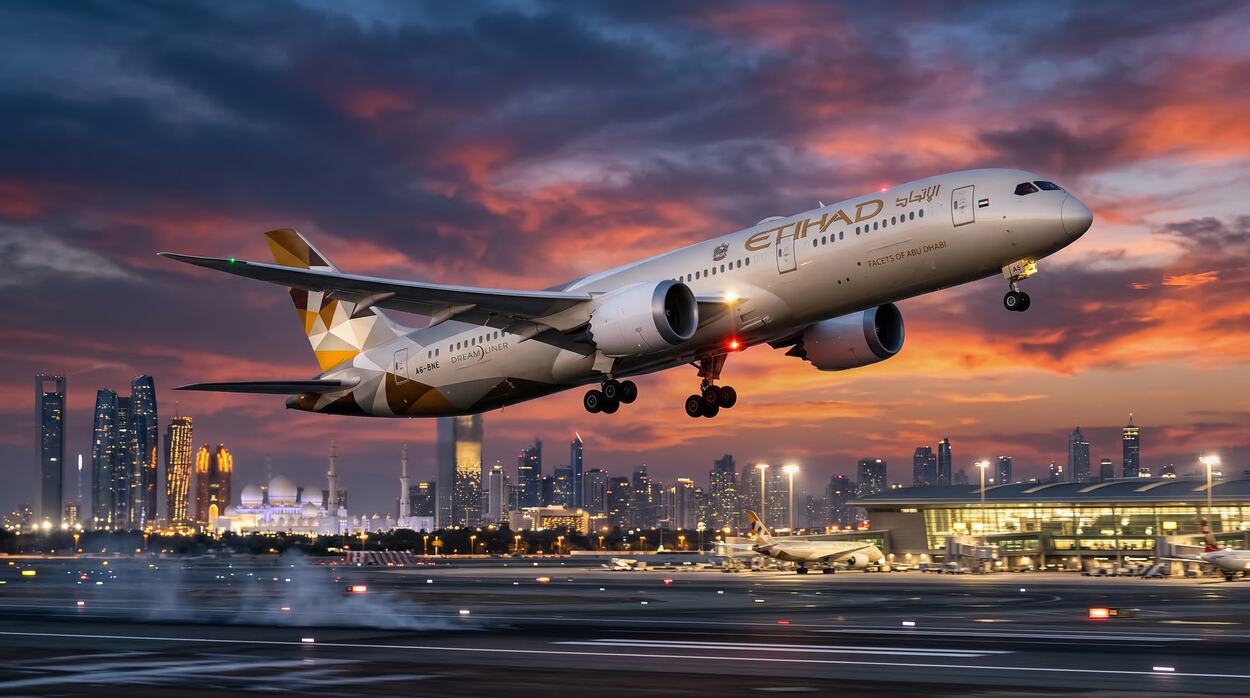
Image generated with AI
**
⚡ Quick Summary
- • Etihad Airways carried 1.9 million passengers in February 2026, continuing a record-breaking growth run
- • January 2026 set the prior monthly record at 2.2 million passengers — a 30% year-on-year jump
- • Full-year 2025 total reached a historic 22.4 million passengers with a load factor of 89–90%
- • The airline reported a record profit of 2.6 billion dirhams for 2025, up 50% year-on-year
Etihad Airways has reported 1.9 million passengers for February 2026, extending a streak of record-level traffic that has firmly established the Abu Dhabi carrier as one of the world's fastest-growing long-haul airlines. The milestone follows January 2026's all-time monthly high of 2.2 million passengers and a full-year 2025 figure of 22.4 million — the highest in the airline's history.
The numbers confirm that passenger demand at Zayed International Airport is accelerating well beyond pre-pandemic baselines, with no sign of the growth curve flattening.
Etihad Passenger Traffic: February 2026 in Context
February's 1.9 million passengers marks the first time Etihad has surpassed the 1.9 million threshold in that month. The figure builds directly on January 2026's 2.2 million, which itself represented a 30% year-on-year increase.
The airline's 2025 annual total of 22.4 million passengers is a historic high that exceeded previous records and demonstrated consistent demand across Etihad's long-haul network. A cabin load factor running between 89% and 90% signals that the airline is filling seats at near-capacity levels even as it expands capacity.
What Is Driving Etihad's Surge at Abu Dhabi
A major structural reason behind the growth is fleet expansion. Etihad grew its fleet from fewer than 100 aircraft in early 2024 to more than 120 by the start of 2026 — an increase achieved in under 18 months.
New-generation wide-body jets, including Boeing 787 Dreamliners and Airbus A350s, have powered this expansion. These aircraft offer lower fuel and maintenance costs while enabling Etihad to add long-haul routes that smaller planes cannot efficiently serve.
The airline has also extended its geographic reach across Europe, North America, Africa, and Asia. Recent additions include services to secondary European cities such as Luxembourg, new long-haul routes to Canadian markets, and codeshare and joint venture agreements that extend Etihad's effective network into Africa and Southeast Asia.
Abu Dhabi Benefits as Etihad Traffic Grows
Zayed International Airport is handling both more point-to-point travelers and more transfer passengers as Etihad's network expands. Tourism officials in Abu Dhabi attribute an increase in stopover stays and extended city visits directly to the airline's higher flight frequency and wider route map.
Etihad's promotional stopover programs actively encourage connecting passengers to explore Abu Dhabi rather than transit without leaving the terminal. The programs have measurably increased the length of stays in the emirate, generating downstream revenue for hospitality, retail, and business travel sectors.
Infrastructure investment at Zayed International Airport is keeping pace with demand. Terminal upgrades designed to handle higher passenger volumes and accelerate connection times have contributed to the smoother transfer experience Etihad relies on to compete with rival Gulf hubs.
Record 2025 Financials: What the Numbers Show
Etihad's operational growth has translated directly into financial results. The airline posted a record profit after tax of 2.6 billion dirhams for 2025 — a 50% increase on the prior year.
Revenue growth from high passenger volumes, stronger yields on long-haul services, and the fuel and maintenance savings unlocked by new-generation aircraft all contributed to the result. The airline has credited a disciplined commercial strategy that prioritizes high-value traffic flows and optimizes connection routing through Abu Dhabi.
Operational Disruptions Did Not Halt Momentum
February 2026 was not without complications. Regional airspace restrictions and temporary flight suspensions in late February and early March created operational pressure on Etihad's schedule.
The airline responded by expanding rebooking flexibility for affected passengers and deploying wide-body aircraft on selected key routes to absorb displaced demand. Management has noted that the full impact of those disruptions will be more visible in the March 2026 data, but February's numbers are considered a reliable indicator of the airline's underlying resilience.
Key Facts at a Glance
- February 2026 passengers: 1.9 million
- January 2026 passengers: 2.2 million (30% year-on-year growth)
- Full-year 2025 passengers: 22.4 million (historic high)
- 2025–26 load factor: 89–90%
- Fleet size early 2024: under 100 aircraft
- Fleet size start of 2026: over 120 aircraft
- Aircraft types added: Boeing 787, Airbus A350
- New routes: Luxembourg, Canadian long-haul markets, expanded Africa and Southeast Asia
- 2025 profit after tax: 2.6 billion dirhams (50% year-on-year increase)
- Hub: Zayed International Airport, Abu Dhabi
What This Means for Travelers
If you are considering a long-haul trip through Abu Dhabi, Etihad's network is currently one of the most expansive it has ever been, with more connecting options across Europe, Asia, North America, and Africa than at any point before.
High load factors (89–90%) mean popular routes fill early. Travelers booking Etihad on peak travel windows should expect limited seat availability and should book well in advance to secure preferred cabins and schedules.
For passengers who experienced disruptions in late February or early March, Etihad's enhanced rebooking flexibility remains in effect. Check the airline's app or website for the latest status on affected bookings.
Looking Ahead for Etihad and Abu Dhabi's Aviation Sector
Etihad has confirmed plans for further route expansions through 2026, including seasonal leisure destinations. Combined with Abu Dhabi's ongoing airport infrastructure investment, the trajectory points toward continued growth even against a challenging global economic backdrop.
For travelers, that means a wider choice of destinations, more competitive fares on key corridors, and a strengthening Abu Dhabi hub for onward connections across the globe.
FAQ: Etihad Airways February 2026 Growth
How many passengers did Etihad carry in February 2026?
Etihad Airways carried 1.9 million passengers in February 2026, a record for that month, following 2.2 million in January 2026.
What was Etihad's full-year passenger total for 2025?
Etihad carried 22.4 million passengers across the full year 2025 — the highest annual total in the airline's history.
What profit did Etihad report for 2025?
Etihad posted a record profit after tax of 2.6 billion dirhams for 2025, representing a 50% increase compared to the prior year.
Is Etihad expanding its routes in 2026?
Yes. Etihad has confirmed additional route launches in 2026, including seasonal leisure destinations and expanded coverage in Europe, North America, Africa, and Southeast Asia.
Related Travel Guides
Disclaimer
This article is for informational and educational purposes only. It does not constitute legal, financial, or professional advice. While we strive to provide accurate and up-to-date information, travel policies, regulations, and conditions change rapidly. Always verify information with official sources before making travel decisions. Nomad Lawyer makes no representations about the accuracy, reliability, completeness, or suitability of the information provided. Readers should consult qualified professionals for advice specific to their circumstances. The views expressed in this article are those of the author and do not necessarily reflect the views of Nomad Lawyer.
Preeti Gunjan
Contributor & Community Manager
A passionate traveller and community builder. Preeti helps grow the Nomad Lawyer community, fostering engagement and bringing the reader experience to life.
Learn more about our team →