
Etihad A380 Makes Dramatic Abu Dhabi Return After 6.5 Years in France, Restoring Superjumbo Travel
Etihad Airways reactivates its final stored Airbus A380 (A6-APB) from France after 6.5 years, completing the return of nine superjumbos to service through Abu Dhabi.

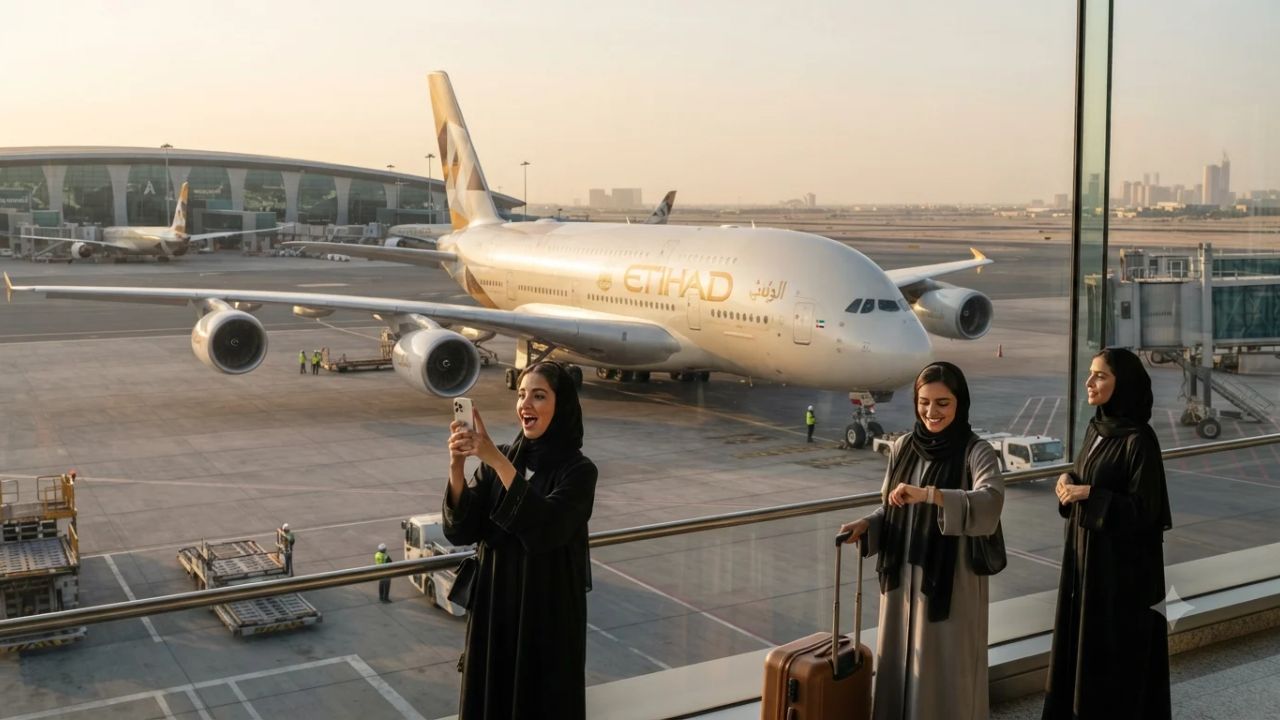
Image generated by AI
Ending an exile of approximately 6.5 years that began in March 2020, the ferry flight of Airbus A380-861 registration A6-APB from Tarbes–Lourdes–Pyrénées Airport on September 17, 2026, officially completes the commercial resurrection of Etihad Airways’ nine surviving superjumbos. Departing the French storage airfield at approximately 9:36 local time following a planned 9:00 departure slot, the double-decker aircraft crossed southern France, Mediterranean airspace, Egypt, and Saudi Arabia before touching down at Zayed International Airport in Abu Dhabi. The transatlantic and Eurasian widebody repositioning marks the ultimate milestone in Etihad Airways’ calculated reversal of its pandemic-era fleet retirements. Having originally operated 10 superjumbos before grounding the entire sub-fleet amid global border closures, the reactivation of A6-APB leaves only airframe A6-APA—which was dismantled at Tarbes in July 2025—permanently excised from service. In an international aviation market constrained by protracted Boeing 777X delivery delays and supply-chain bottlenecks at Airbus, Etihad’s decision to restore its four-engine flagships injects indispensable heavy-lift capacity into slot-constrained international corridors connecting the UAE capital with London, Paris, Tokyo, Singapore, and Toronto.
The Pyrenean Awakening: Tracking A6-APB’s Long Journey from Tarbes to Abu Dhabi
The return of A6-APB represents one of the most prolonged storage-to-flight reactivations executed by a Middle Eastern legacy carrier. When international passenger demand collapsed in early 2020, Etihad initially grounded its A380 fleet at Abu Dhabi International Airport. On December 3, 2020, the airline transferred A6-APB to Tarbes–Lourdes–Pyrénées Airport in southwestern France, a facility chosen for its specialized preservation infrastructure, dry microclimate, and dedicated parking aprons for dormant widebody aircraft.
For over half a decade, the fate of the airframe hung in balance. Many industry observers anticipated that Etihad's superjumbos would follow the retirement trajectory of rival European operators who permanently scrapped their four-engine fleets in favor of twin-engine alternatives. That assumption gained traction when sister aircraft A6-APA, which had been transferred to Tarbes in November 2020, was formally broken up and dismantled in July 2025.
However, rapid post-pandemic passenger recovery on high-density long-haul routes altered Etihad’s commercial calculus. The airline commenced a gradual reactivation program, systematically retrieving airframes from deep preservation, subjecting them to heavy C-checks and cabin refurbishments, and reintroducing them into revenue service. The departure of A6-APB on September 17, 2026, concludes this preservation cycle, ensuring that every structurally viable superjumbo in Etihad’s inventory is returned to active commercial service.
| Fleet Metric | Aircraft Specification / Milestone | Operational Context |
|---|---|---|
| Original A380 Fleet | 10 Airbus A380-861 aircraft | Acquired as flagship widebody capacity between 2014 and 2017 |
| Surviving Fleet in Service | 9 aircraft restored to active duty | Reintroduced progressively on high-density long-haul sectors |
| Airframe Dismantled | A6-APA (scrapped July 2025 at Tarbes) | Broken down for spare parts to support remaining active fleet |
| Final Restored Airframe | A6-APB (ferried September 17, 2026) | Re-enters active fleet following 6.5 years in storage |
| Initial Grounding Date | March 2020 | Global pandemic response halting long-haul international flights |
| Transfer to Tarbes Storage | December 3, 2020 | Long-term deep storage in Tarbes–Lourdes–Pyrénées, France |
| Maximum Passenger Capacity | Over 500 passengers (four-class layout) | Configured with The Residence, First, Business, and Economy |
| Maximum Design Range | Approximately 14,800 kilometres | Capable of non-stop operations to North America, Europe, and Asia |
Superjumbo Fleet Logistics and Route Deployment Matrix
The operational value of the A380 lies in its extraordinary cabin real estate, which allows Etihad to segment premium and mass-market volume with unmatched yield efficiency. Across its 14,800-kilometer design range, the aircraft operates as a high-margin revenue engine across several core intercontinental routes:
| Route Sector | Scheduled Aircraft Deployment | Core Cabin Product Featured | Strategic Route Purpose |
|---|---|---|---|
| Abu Dhabi (AUH) – London Heathrow (LHR) | Multi-daily Airbus A380 operations | The Residence, First Apartments, Business Studios, Economy Smart Seats | Maximizing passenger throughput across Europe's most congested, slot-restricted hub |
| Abu Dhabi (AUH) – Paris Charles de Gaulle (CDG) | Two daily A380 flights plus Boeing 787-9 | Full four-class superjumbo configuration with private shower suites | Dominating summer leisure and corporate demand into mainland Europe |
| Abu Dhabi (AUH) – Tokyo Narita (NRT) | Daily Airbus A380 service (introduced June 2026) | Debut of The Residence and First Apartments on Japanese routes | Capturing surging premium outbound travel and long-haul Asian transit flows |
| Abu Dhabi (AUH) – Toronto Pearson (YYZ) | Daily high-capacity widebody service | Premium four-class long-haul configuration | Serving North American business corridors and dense transatlantic connecting traffic |
| Abu Dhabi (AUH) – Singapore Changi (SIN) | Daily A380 scheduled services | Luxury multi-room suites and high-capacity main-deck seating | Connecting Southeast Asian commercial capital to European and Middle Eastern banks |
The aircraft's internal configuration sets it apart from conventional twin-engine aircraft. On the upper deck, Etihad provides The Residence—a three-room private suite designed for up to two guests that includes a dedicated living area, double bedroom, and ensuite bathroom equipped with a functional shower. Adjacent to The Residence are nine First Apartments featuring private sliding doors and lie-flat beds, followed by 70 Business Studios. The lower main deck accommodates hundreds of Economy Smart Seats, featuring ergonomic headrests and expansive legroom options.
Expert Analysis: Slot Economics, Premium Yields, and the Second Life of the A380
The reactivation of A6-APB illuminates the fundamental economic contradictions governing contemporary long-haul aviation. While twin-engine aircraft like the Airbus A350 and Boeing 787-9 offer superior fuel burn per engine cycle, they cannot solve the structural barrier of airport slot congestion. At mega-airports such as London Heathrow, Paris Charles de Gaulle, and Tokyo Narita, airport authorities cannot add additional takeoff and landing slots. For travelers booking these high-density sectors, the direct consequence is that airlines must up-gauge aircraft capacity rather than schedule additional flights. Deploying an A380 capable of carrying over 500 passengers allows Etihad to double its seat inventory on a single slot pair, maximizing revenue without requiring additional runway access.
The pricing pressure this creates across premium travel classes is equally notable. By offering ultra-luxury products like The Residence and First Apartments, Etihad captures outsized revenue from high-net-worth travelers, corporate executives, and luxury leisure clients. The exorbitant fares generated by these elite cabins effectively subsidize the operational overhead and fuel consumption of the four Engine Alliance GP7200 turbofans, allowing the airline to offer competitive pricing on the hundreds of economy seats situated across the lower deck.
Additionally, the superjumbo's revival is accelerated by acute aircraft manufacturing delays. Airbus permanently ceased A380 production in 2021 after delivering 251 aircraft to 14 global customers, intending for twin-engine widebodies to absorb long-haul networks. However, severe certification hurdles for the Boeing 777X and ongoing delivery shortfalls for new-generation widebodies have left global carriers starved for capacity. Reactivating fully depreciated, parked A380 airframes from storage facilities like Tarbes provides airlines with immediate widebody lift that bypasses multi-year aircraft manufacturing queues.
This operational expansion is inextricably linked to the rapid maturation of Zayed International Airport as a global mega-hub. Abu Dhabi’s destination positioning—supported by strong civic safety rankings where the city secured the top global ranking in early-2026 annual safety indexes before ranking second behind Ajman in mid-year audits—relies on seamless passenger transfer connectivity. By marshaling its full contingent of nine operational superjumbos through Zayed International, Etihad fortifies Abu Dhabi’s competitive stance against neighboring Gulf hubs, ensuring the superjumbo remains an enduring pillar of luxury international transit well into the next decade.
Key Takeaways
- Full Fleet Reactivation: The ferry flight of A6-APB from Tarbes on September 17, 2026, marks the return of the final stored superjumbo, bringing nine of Etihad’s original 10 Airbus A380s back into active service.
- Six-Year Storage Closes: A6-APB spent approximately 6.5 years in deep preservation, having initially grounded in March 2020 before relocating to Tarbes, France, on December 3, 2020.
- Single Fleet Loss: Airframe A6-APA remains the sole casualty of the pandemic retirement program, having been dismantled and scrapped at Tarbes in July 2025 for component recycling.
- Slot-Busting Capacity: Deploying superjumbos capable of transporting over 500 passengers across four classes enables Etihad to overcome severe runway slot restrictions in London, Paris, and Tokyo.
- Luxury Anchor: The active fleet retains Etihad's flagship three-room Residence suite alongside First Apartments, generating premium yields that offset the operating costs of four-engine flight operations.
FAQ: Etihad Airways Airbus A380 Fleet and Services 2026
How many Airbus A380 aircraft does Etihad Airways currently operate?
Etihad operates nine active Airbus A380 aircraft. The return of registration A6-APB from France in September 2026 completed the commercial restoration of all surviving superjumbos in the fleet.
What happened to Etihad's 10th Airbus A380 aircraft?
The 10th aircraft, registration A6-APA, was transferred to Tarbes, France, in late 2020 and was formally dismantled in July 2025 to provide replacement components for the active fleet.
Which global destinations are currently served by Etihad's A380?
Etihad schedules its A380 superjumbos on flagship routes from Abu Dhabi to London Heathrow, Paris Charles de Gaulle, Tokyo Narita, Singapore Changi, and Toronto Pearson.
What makes The Residence on Etihad's A380 unique in commercial aviation?
The Residence is a private three-room penthouse suite located on the upper deck, featuring a dedicated living room, separate double bedroom, and an ensuite bathroom with a functional shower for up to two passengers.
[By reviving its four-engine flagship in an era of production shortages, Etihad demonstrates that passenger demand and airport slot limits can outmuscle the conventional retirement cycle.]
Related Travel Guides
Japan Airlines Sets New Green Aviation Milestone With CORSIA Carbon Removal Partnership
Cathay Pacific Celebrates Skytrax Success With World’s Best Cabin Crew and Lounge Recognition
10 Best Airline Lounges at JFK Airport: Complete Terminal Guide 2026
Disclaimer
This article is for informational and educational purposes only. It does not constitute legal, financial, or professional advice. While we strive to provide accurate and up-to-date information, travel policies, regulations, and conditions change rapidly. Always verify information with official sources before making travel decisions. Nomad Lawyer makes no representations about the accuracy, reliability, completeness, or suitability of the information provided. Readers should consult qualified professionals for advice specific to their circumstances. The views expressed in this article are those of the author and do not necessarily reflect the views of Nomad Lawyer.
Raushan Kumar
Founder & Lead Developer
Full-stack developer with 11+ years of experience and a passionate traveller. Raushan built Nomad Lawyer from the ground up with a vision to create the best travel and law experience on the web.
Learn more about our team →