
Emirates A380 Network Expands to 48 Routes in July 2026: Full Deployment Schedule & Route Map
Emirates operates the world's largest A380 fleet across 48 global destinations in July 2026, with 2,139 scheduled flights and 69 daily departures from Dubai hub.

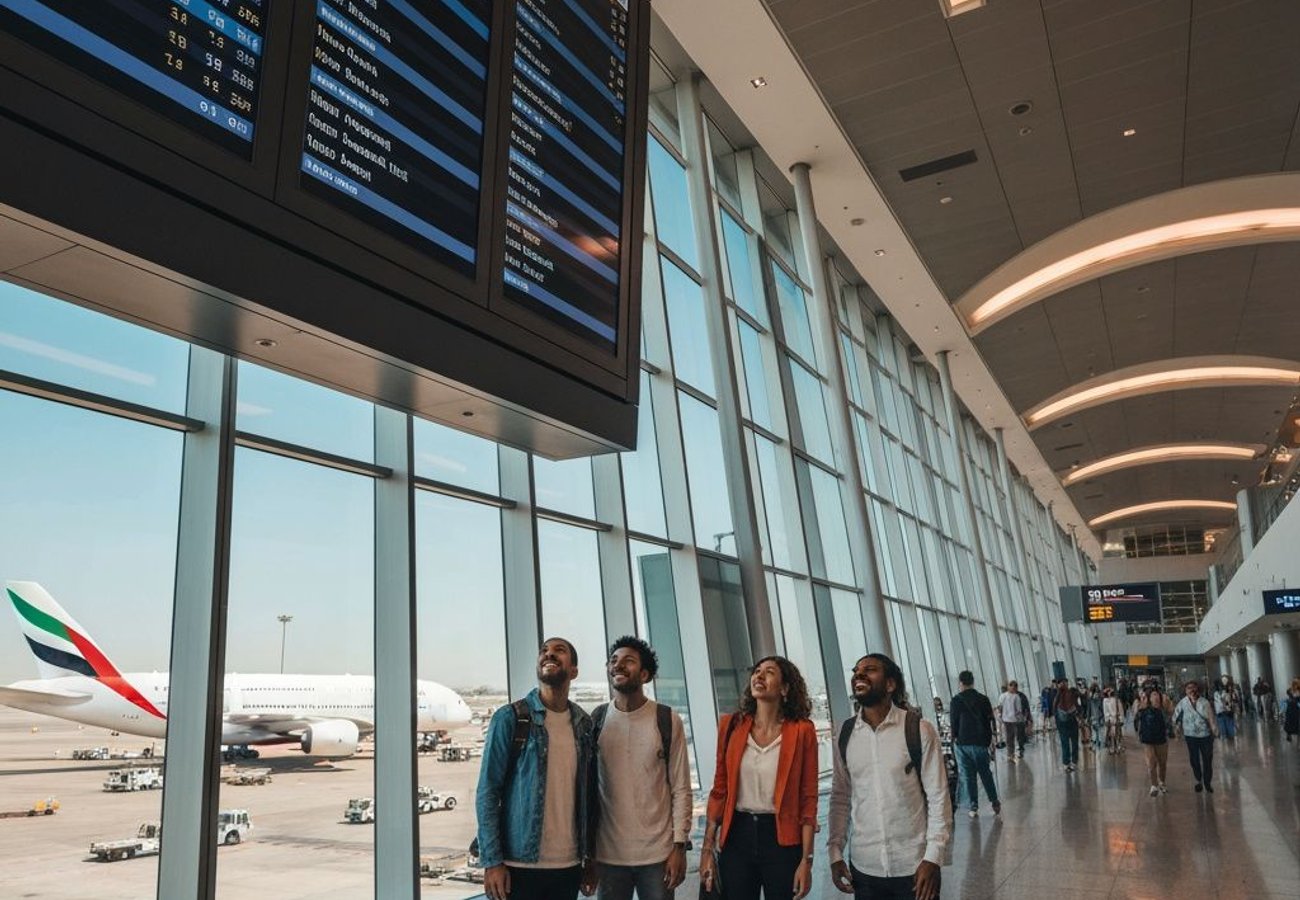
Image generated by AI
The World's Largest A380 Operator Expands Its Summer Network
Emirates, the globe's dominant operator of the Airbus A380, is ramping up its summer presence across its widebody network. As we head into July 2026, the Dubai-based carrier has locked in a commanding schedule: 2,139 A380 flights spanning 48 destinations worldwide, generating approximately 69 daily departures from its headquarters at Dubai International Airport (DXB).
This ambitious deployment marks a significant recovery phase for the airline, though regional dynamics continue to reshape operations across the Middle East.
The Real Story: A 15% Dip From Last Year, But Momentum is Returning
Here's what the numbers tell us: Emirates is scheduled to operate roughly 15% fewer A380 flights in July 2026 compared to July 2025—a direct consequence of the ongoing regional conflict forcing capacity adjustments across Middle Eastern carriers.
Despite this headwind, the trend is unmistakably positive. The airline is strategically reintroducing the aircraft to key European markets. In July, four routes will see the A380 return to service after June absences: Copenhagen (CPH), Munich (MUC), Manchester (MAN), and London Gatwick (LGW). While capacity on Manchester and Gatwick remains well below pre-crisis levels, the message is clear—Emirates is gradually normalizing operations.
Reddit: "Glad to see Emirates bringing the A380 back to more European cities. The product is unmatched on long-haul." — r/aviation
London and Manchester: The Markets Hit Hardest
The United Kingdom has absorbed the steepest capacity cuts, and the numbers justify the concern.
London's story is particularly revealing. Historically, Emirates operated six daily A380 services to London Heathrow (LHR) and two daily A380s to Gatwick (LGW)—totaling eight A380 flights daily across both airports. By June 2026, the airline cut this to just four A380 services (all to Heathrow). July's schedule shows modest improvement: six A380 services total, split between five at Heathrow and one at Gatwick. That's still 25% below historical norms.
Manchester Airport (MAN) faced even steeper reductions. The carrier previously deployed three daily A380 services to Manchester and held slots for a fourth. Fast-forward to June 2026—the A380 disappeared entirely from the route. July brings a partial recovery: one daily A380 service, with two additional flights using Boeing 777-300ERs to maintain connectivity.
The Complete Route Network: Where You Can Fly Emirates A380 in July
Emirates' A380 network spans five major geographic clusters in July 2026. While most routes see single daily frequencies, a select tier commands multiple daily departures—primarily Bangkok Suvarnabhumi (BKK) with three daily A380s and London Heathrow (LHR) with five.
The Asia-Pacific region remains the backbone, with services to Bangkok (3 daily), Hong Kong (2 daily), Melbourne (2 daily), Sydney (3 daily), Bengaluru, Guangzhou, Kuala Lumpur, Shanghai, Singapore, and Tokyo. The carrier also serves secondary hubs like Amman (1), Jeddah (1), and Seoul (1).
Europe absorbs significant A380 capacity. Beyond the UK gateways, Emirates deploys the aircraft to Paris (3 daily), Amsterdam (1), Barcelona (1), Birmingham (1), Copenhagen (1), Düsseldorf (1), Frankfurt (1), Istanbul (1), Madrid (1), Milan (2), Munich (1), Nice (1), Rome (1), Vienna (1), and Zurich (1).
African destinations include Cairo (2 daily), Casablanca (1), Johannesburg (1), and Mauritius (2). The Americas see three gateways: Houston (1), Los Angeles (1), New York (3 daily), San Francisco (1), and Toronto (1). Australasia rounds out the network with Auckland, Brisbane, Christchurch, and additional Sydney capacity.
Why This Matters for Travelers and the Industry
The A380's return to full utilization signals broader confidence in demand recovery. For business and leisure travelers, this means more premium cabin availability on key long-haul routes—particularly on Emirates' celebrated First and Business Class products. The aircraft's capacity gives the carrier flexibility to maintain frequency while absorbing demand fluctuations.
Operationally, the gradual redeployment reflects sophisticated revenue management. Emirates isn't rushing capacity back; it's matching aircraft to demand signals. This discipline matters because premature over-capacity can destroy profitability, while under-capacity loses market share to competitors like Qatar Airways and Singapore Airlines.
The Middle East conflict remains the elephant in the room. All regional carriers are continually "reviewing changes to passenger demand and modifying schedules to ensure operational efficiency," as the airline stated. That euphemism masks complex geopolitical risk assessment. But the fact that Emirates is adding routes rather than cutting more suggests confidence in stabilization.
What's Next: Watch These Indicators
Monitor these developments over the coming weeks:
- Return of A380s to North American routes beyond the current three daily New York services. Chicago, a historic Emirates A380 gateway, remains absent.
- Capacity levels on UK routes. If London and Manchester approach historical frequency by August, that signals genuine recovery momentum.
- Colombo and Riyadh, which some observers note have dropped from the A380 schedule and represent untapped capacity opportunities.
The A380 remains the ultimate symbol of long-haul ambition. Emirates operates nearly 115 of them—roughly 10% of all A380s ever built. As regional tensions gradually ease, this fleet will become increasingly critical to the airline's competitive positioning against competitors deploying newer widebodies like the Boeing 777X and Airbus A350-900.
Emirates' A380 comeback is half-speed for now—but momentum is unmistakably shifting toward full throttle.
Related Travel Guides
Disclaimer
This article is for informational and educational purposes only. It does not constitute legal, financial, or professional advice. While we strive to provide accurate and up-to-date information, travel policies, regulations, and conditions change rapidly. Always verify information with official sources before making travel decisions. Nomad Lawyer makes no representations about the accuracy, reliability, completeness, or suitability of the information provided. Readers should consult qualified professionals for advice specific to their circumstances. The views expressed in this article are those of the author and do not necessarily reflect the views of Nomad Lawyer.
Raushan Kumar
Founder & Lead Developer
Full-stack developer with 11+ years of experience and a passionate traveller. Raushan built Nomad Lawyer from the ground up with a vision to create the best travel and law experience on the web.
Learn more about our team →