
Dublin, Reykjavik, Amsterdam Pricing Out Digital Nomads: Europe's Most Expensive Cities Create Travel Disruption Crisis
Dublin leads Europe's digital nomad exodus with $4,995/month Airbnb costs. Remote workers flee expensive cities like Reykjavik, Amsterdam, Paris, Copenhagen as affordability crisis reshapes European travel.

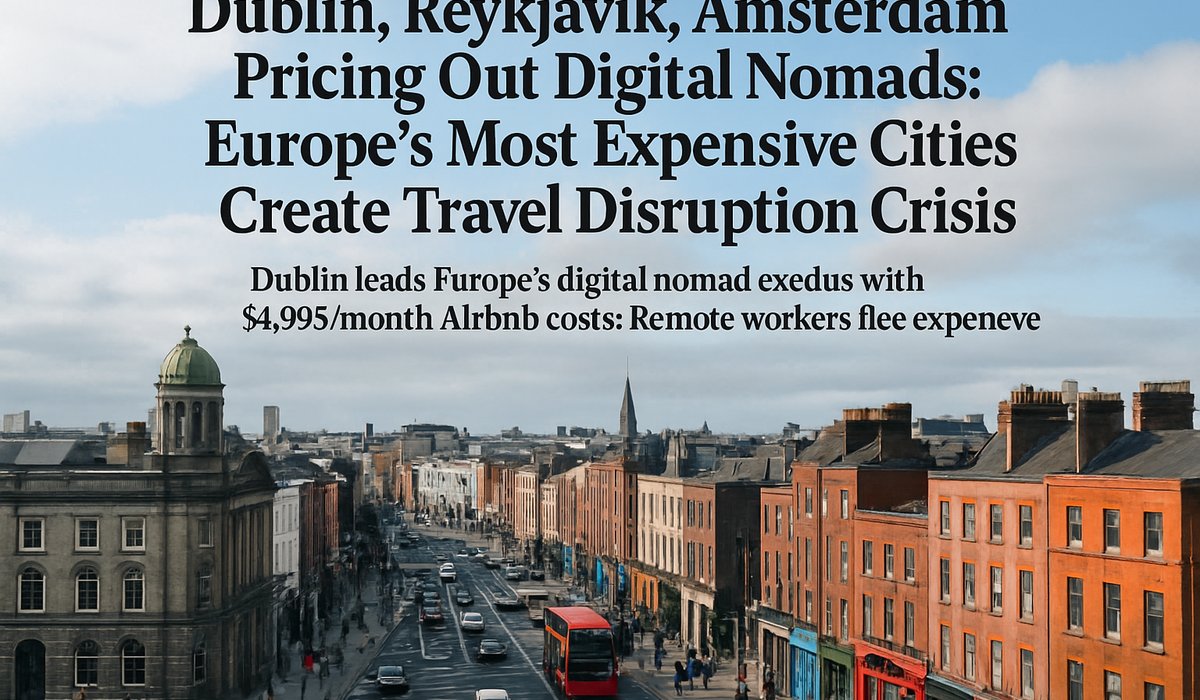
Image generated by AI
A seismic shift is reshaping European travel patterns as digital nomads face an unprecedented affordability crisis across the continent's most iconic destinations. A comprehensive analysis of 35 major European cities reveals that Dublin, Reykjavik, Amsterdam, Paris, and Copenhagen are rapidly pricing out remote workers, forcing a dramatic exodus toward more budget-friendly alternatives. The data signals a structural transformation in how professionals choose where to live and work abroad, with accommodation costs on platforms like Airbnb and Booking.com becoming the primary driver of destination selection.
Dublin has emerged as the least attractive destination for digital nomads despite its global cultural appeal, commanding an eye-watering $4,995 per month in average Airbnb accommodation costs. This staggering figure places the Irish capital at the absolute top of Europe's cost spectrum, followed closely by Reykjavik at $4,733 monthly, Amsterdam at $4,252, Paris at $4,026, and Copenhagen at $3,281. The pricing crisis extends further down the list, with Heraklion, Greece at $3,241, Rome, Italy at $2,911, Bruges, Belgium at $2,899, Milan at $2,878, and Florence at $2,782 monthly. Remote workers are increasingly questioning whether premium European cities offer sufficient value when basic necessities, transport, and food costs are factored into the equation alongside skyrocketing accommodation expenses.
The disruption to Europe's digital nomad ecosystem has created a competitive vacuum that emerging destinations are rapidly filling. While Dublin ranks lowest for remote worker satisfaction with a score of just 43 despite its vibrant culture and strong economy, cities like Krakow are winning the battle for long-stay professionals seeking balance between infrastructure quality and affordability. The shift represents more than temporary travel trends—it reflects a fundamental restructuring of how international remote workers evaluate European destinations. According to the International Air Transport Association (IATA), the rise of remote work has created new categories of travelers whose needs diverge sharply from traditional tourists, requiring cities to compete not just for short-term visitors but for sustained, long-term residents who demand flexibility, safety, and cost efficiency.
Digital nomads are abandoning traditional hotel accommodations in favor of short-term rentals through platforms like Airbnb and Booking.com, which now dominate remote worker preferences across Europe. These platforms offer kitchen access, dedicated workspace flexibility, and longer-stay discounts that hotels simply cannot match. Serviced apartments represent an alternative, but they typically command premium pricing that further strains already-stretched budgets. The structural shift toward short-term rentals reflects remote workers' prioritization of autonomy and functionality over luxury amenities, fundamentally altering how European cities must position themselves to remain competitive in the digital nomad economy.
Reykjavik presents a fascinating paradox within this crisis, combining some of Europe's highest accommodation costs with exceptional infrastructure that appeals to high-income remote professionals. The Icelandic capital boasts internet speeds among the fastest in Europe—a critical advantage for professionals whose livelihoods depend on reliable connectivity—yet monthly food costs alone reach $444, making it accessible only to affluent digital nomads. Amsterdam maintains stronger appeal despite elevated expenses, offering excellent public infrastructure, high safety levels, and cultural diversity that justify its costs for many remote workers. However, even Amsterdam's reputation is being tested as the broader affordability crisis forces professionals to conduct rigorous cost-benefit analyses before committing to long-term stays in Western and Northern European cities.
The data clearly indicates a regional pattern of exclusivity emerging across Western and Northern Europe, where countries including Ireland, Iceland, France, and Denmark are becoming increasingly inaccessible to budget-conscious remote workers. This geographic concentration of high costs is creating a two-tier European travel market: premium destinations catering to high-income professionals and emerging alternatives in Central and Eastern Europe attracting cost-conscious digital nomads seeking better value propositions. The U.S. Department of Transportation has noted that changing work patterns are reshaping international travel demand, with implications for airlines, accommodation providers, and destination marketing organizations across the continent.
What Travelers Should Do: If you're planning an extended stay in Europe as a remote worker, conduct thorough cost-of-living research beyond accommodation prices alone. Compare total monthly expenses including food, transport, and co-working space access across multiple destinations. Consider emerging alternatives in Central Europe that offer strong internet infrastructure without the premium pricing of Dublin, Reykjavik, or Amsterdam. Book accommodations through established platforms like Airbnb and Booking.com that offer longer-stay discounts, and verify internet speeds directly with providers before committing to any destination. Monitor currency fluctuations and seasonal pricing variations, as these factors can significantly impact your overall budget in expensive European cities.
Related Travel Guides
- Imagine Cruising Appoints Pamela Nielsen as Head of Trade Partnerships, Strengthening Global Cruise Distribution Networks
- Beyond the World Cup Whistle: What the Post-Tournament Travel Reset Means for US Visitors in 2026
- New Evidence Delays 2026 Washington Trial of Abu Agila Mohammad Mas’ud in Pan Am Flight 103 Case
Disclaimer
This article is for informational and educational purposes only. It does not constitute legal, financial, or professional advice. While we strive to provide accurate and up-to-date information, travel policies, regulations, and conditions change rapidly. Always verify information with official sources before making travel decisions. Nomad Lawyer makes no representations about the accuracy, reliability, completeness, or suitability of the information provided. Readers should consult qualified professionals for advice specific to their circumstances. The views expressed in this article are those of the author and do not necessarily reflect the views of Nomad Lawyer.
Raushan Kumar
Founder & Lead Developer
Full-stack developer with 11+ years of experience and a passionate traveller. Raushan built Nomad Lawyer from the ground up with a vision to create the best travel and law experience on the web.
Learn more about our team →