
Dallas–Fort Worth Airport Logs 421 Delays and 8 Cancellations Disrupting American, Delta, United and Global Carriers in 2026
Massive operational strain at Dallas–Fort Worth International Airport has triggered 421 delays and 8 cancellations, impacting major airlines like American and Delta across five continents.

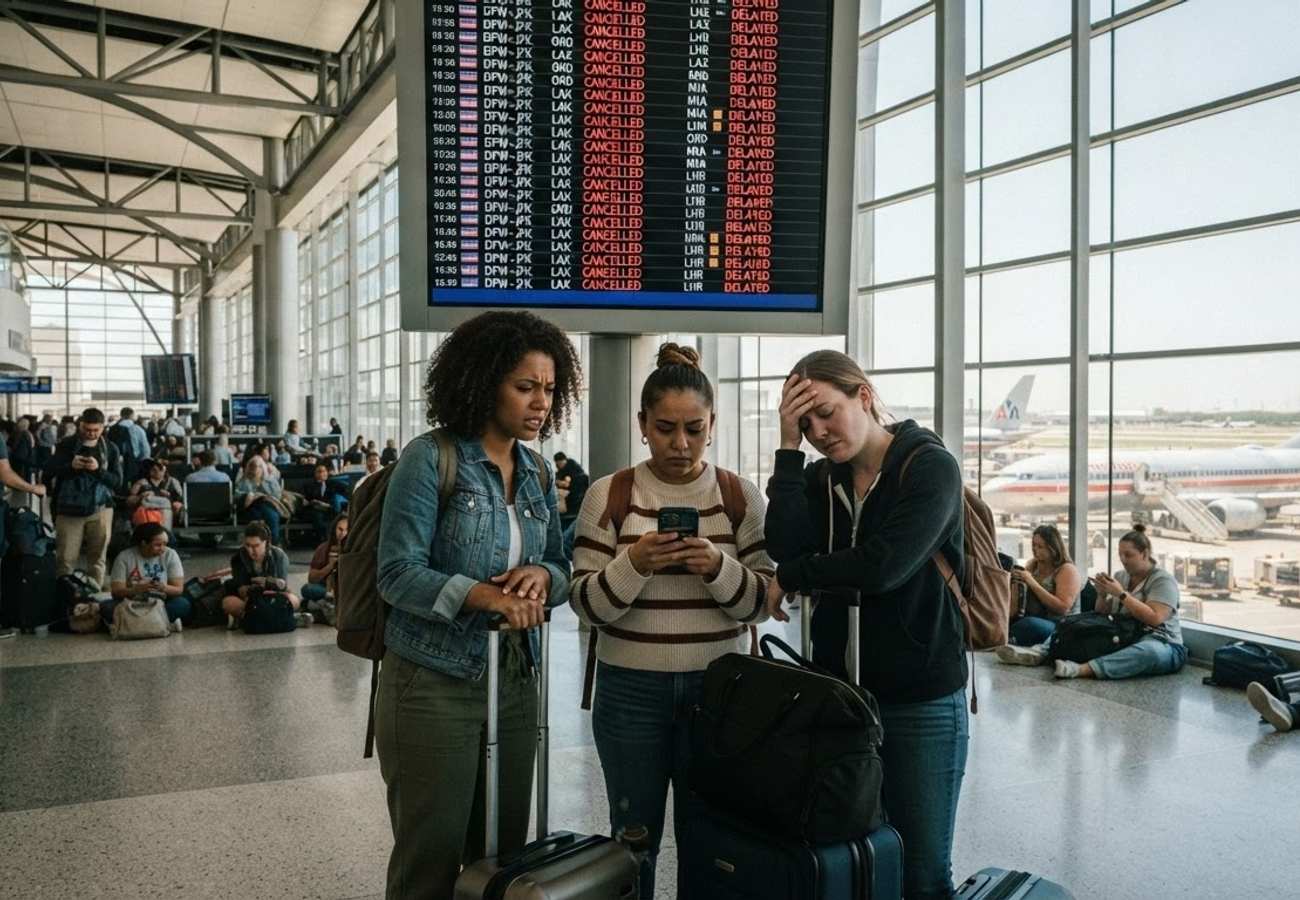
Image generated by AI
[Dallas, July 6, 2026] — A severe operational breakdown at Dallas–Fort Worth (DFW) International Airport has triggered a massive wave of scheduling instability, resulting in 421 recorded delays and 8 flight cancellations. The disruption is heavily impacting American Airlines, Delta Air Lines, United, Air Canada, and several other global carriers, creating a cascading effect on travel corridors spanning the United States, Canada, Mexico, Europe, and Asia.
The scale of the congestion at this primary Texas hub has moved beyond a localized issue, evolving into a systemic failure that is impacting aircraft rotations in major global cities. Reports indicate that secondary delays are now surfacing in New York, Los Angeles, Chicago, Toronto, London, Frankfurt, and Tokyo as airlines struggle to reposition crews and aircraft.
High-Volume US Hubs Drive DFW Arrival Delays
Flight tracking data reveals that the congestion at Dallas–Fort Worth is being fueled by a distributed pattern of inbound disruptions. Rather than a single point of failure, the airport is receiving delayed traffic from a wide array of domestic nodes, which exacerbates the pressure on ground operations and gate availability.
Major U.S. gateways, including LaGuardia, Atlanta, Denver, and Chicago O’Hare, are among the primary contributors to the current instability. The high frequency of feeder flights from these hubs means that any minor delay at the origin is amplified upon arrival at DFW, leading to a saturation of the airspace and tarmac.
The following data highlights the specific impact from high-volume U.S. departure points:
| Origin Airport | Delays | Cancellations |
|---|---|---|
| Minneapolis–St Paul International Airport | 6 | 1 |
| LaGuardia Airport | 5 | 1 |
| Hartsfield-Jackson Atlanta International Airport | 5 | 0 |
| Houston George Bush Intercontinental Airport | 5 | 0 |
| Tampa International Airport | 5 | 0 |
| Charlotte Douglas International Airport | 5 | 0 |
| Miami International Airport | 3 | 0 |
| Chicago O’Hare International Airport | 2 | 0 |
Regional Networks and Secondary Airports Increase Pressure
The operational strain is not limited to "mega-hubs." Industry observers note that secondary and regional airports are also contributing to the inbound backlog. This indicates that the disruption is permeating through the entire domestic aviation grid, affecting a diverse range of geographic regions.
Significant delay clustering has been observed across the Midwest and Southern United States. Additionally, Mountain West gateways—specifically Denver, Salt Lake City, and Phoenix—are showing consistent inbound disruption. Coastal operations in Seattle, Boston, and San Francisco have also reported moderate spillover effects, suggesting that the DFW bottleneck is impacting flight schedules across the entire North American continent.
International Flight Disruptions and Global Reach
The instability at Dallas–Fort Worth has extended its reach far beyond domestic borders, affecting transatlantic and transpacific itineraries. Because DFW serves as a critical connection point for global traffic, the local congestion is causing missed connections and timetable shifts for passengers traveling from Europe and Asia.
International arrival disruptions have been documented at several key global airports:
- Europe: Charles de Gaulle Airport (2 cancellations), Barcelona–El Prat Airport (1 cancellation), Adolfo Suárez Madrid–Barajas Airport (1 cancellation), Amsterdam Airport Schiphol (1 delay), and Dublin Airport (1 delay).
- Asia: Narita International Airport (1 cancellation).
- Americas: Toronto Pearson International Airport (multiple delays) and Bogotá El Dorado International Airport (1 delay).
This global spread emphasizes the extreme dependency of international flight paths on the stability of major U.S. hubs. When a primary node like DFW experiences saturation, the ripple effect is felt immediately in foreign capitals and commercial centers.
Leisure and Tourism Corridors Face Heavy Instability
A significant portion of the current disruption is concentrated in tourism-heavy corridors, particularly those connecting the U.S. to Mexico, the Caribbean, and Central America. These routes are often operated with tight turnaround times, making them hypersensitive to any schedule shifts.
Affected gateways include Mexico City International, Cancun International, and Guadalajara International airports, as well as Los Cabos. Additionally, travel from Nassau, Providenciales, San José (Costa Rica), and El Salvador International Airport has been impacted. Because leisure travel often involves peak-hour surges, the current congestion is creating significant challenges for passengers on return itineraries.
Analysis of Hub Saturation and Network Fragility
The current situation at Dallas–Fort Worth is a textbook example of the "hub saturation effect." In a hub-and-spoke model, the vulnerability of the entire network is concentrated at the center. When the hub's capacity to process arrivals is exceeded, the resulting backlog propagates backward through the feeder systems.
Industry analysis suggests several structural vulnerabilities are at play:
- Interconnectivity Risks: The high level of dependency on DFW for connecting flights means a localized delay quickly becomes a global event.
- Feeder Amplification: Regional airports act as conduits, funneling delays into the hub and sustaining the congestion loop.
- Rotation Failures: Tight aircraft rotations mean a plane delayed in Dallas cannot depart for its next leg to London or Tokyo, spreading the instability to other continents.
While the number of total cancellations (8) remains relatively low compared to the number of delays (421), the sheer volume of delayed flights signals a deep-seated operational strain. Airlines are currently utilizing rerouting and schedule adjustments to recover, but the systemic nature of the congestion suggests a slow return to normalcy.
The current crisis at DFW underscores the fragile equilibrium of modern aviation, where a single point of congestion can disrupt travel for millions across five continents.
Related Travel Guides
Disclaimer
This article is for informational and educational purposes only. It does not constitute legal, financial, or professional advice. While we strive to provide accurate and up-to-date information, travel policies, regulations, and conditions change rapidly. Always verify information with official sources before making travel decisions. Nomad Lawyer makes no representations about the accuracy, reliability, completeness, or suitability of the information provided. Readers should consult qualified professionals for advice specific to their circumstances. The views expressed in this article are those of the author and do not necessarily reflect the views of Nomad Lawyer.
Kunal K Choudhary
Co-Founder & Contributor
A passionate traveller and tech enthusiast. Kunal contributes to the vision and growth of Nomad Lawyer, bringing fresh perspectives and driving the community forward.
Learn more about our team →