
Crew Cabin Rest Solutions Transform Ultra-Long-Haul Aviation in 2026
Airlines operating ultra-long-haul routes in 2026 now utilize hidden crew cabin rest compartments to manage extended duty periods. These specialized spaces enable non-stop flights exceeding 20 hours while maintaining crew fatigue compliance and passenger safety standards.

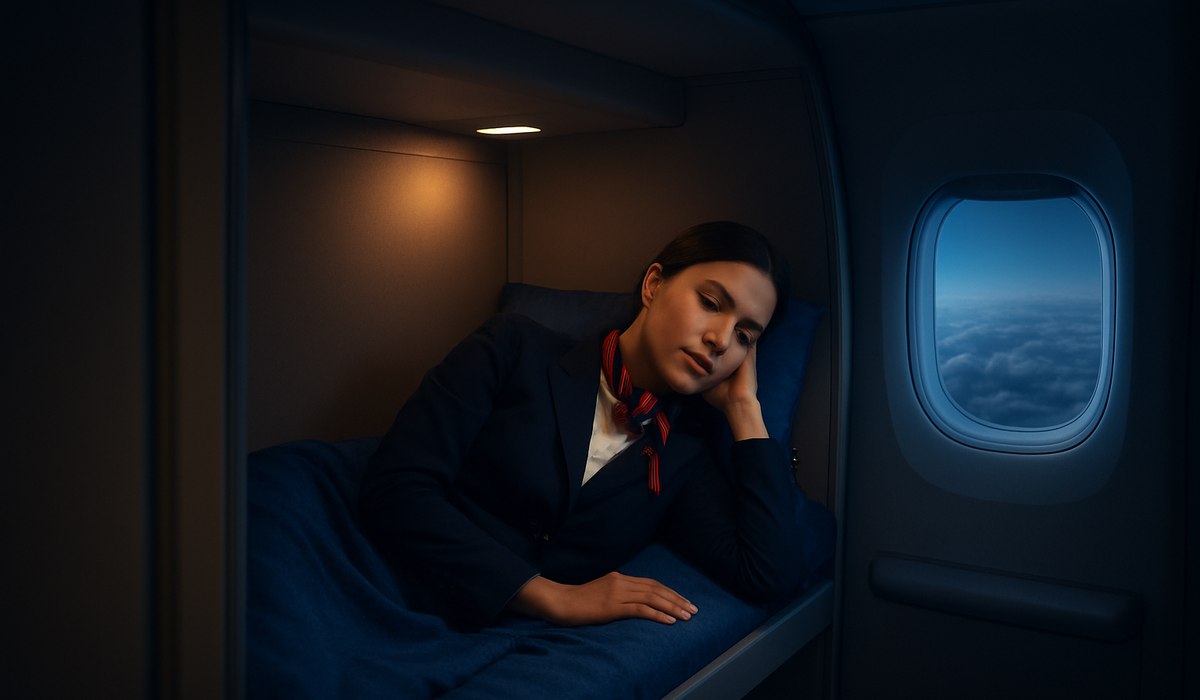
Image generated by AI
The Hidden Reality of Modern Ultra-Long-Haul Flights
Global airlines are fundamentally reshaping crew rest protocols as next-generation aircraft eliminate traditional layover requirements on routes exceeding 18 hours. Airlines including Singapore Airlines, Qatar Airways, and Qantas now operate scheduled flights from Auckland to London and Melbourne to London without intermediate stops, creating unprecedented operational demands on cabin crew. These extended duty periods, sometimes lasting 22+ consecutive hours, necessitate sophisticated crew cabin rest solutions integrated directly into aircraft design. Hidden rest compartments, previously considered luxury features on wide-body jets, have become mandatory safety infrastructure for maintaining crew alertness and passenger security throughout flights lasting well into the second day.
Where Do Cabin Crew Sleep on Ultra-Long-Haul Flights?
Modern ultra-long-haul aircraft feature specialized crew rest areas positioned above or below main passenger cabins, accessible only by hidden stairways or elevators invisible to travelers. Boeing 777-8 and Airbus A350-1000 models incorporate dedicated rest compartments housing multiple bunk-style beds with climate control, minimal lighting, and sound dampening features that create sanctuary environments during continuous flight operations.
Singapore Airlines' recently launched Melbourne-London service, spanning 17 flying hours, rotates crew members through a designated above-cabin rest area on Boeing 777-9 aircraft. Qatar Airways operates similar infrastructure on Doha-London routes, allowing two distinct crew cohorts to manage 15-hour flight segments. These compartments typically accommodate four to eight crew members simultaneously in staggered shifts, enabling two to four hours of consolidated sleep during each crew rotation.
The specifications vary significantly by aircraft model and airline operational philosophy. Some carriers prioritize bunk-style arrangements with reclined seating alternatives, while others implement pod-style sleeping quarters resembling first-class airline seats. Temperature control systems maintain 18-21°C environments, essential for sleep quality at cruising altitude where cabin pressurization affects natural circadian rhythms.
How Rest Requirements Differ Across Airlines and Routes
Regulatory frameworks established by the Federal Aviation Administration and equivalent international authorities mandate minimum rest periods based on cumulative duty time. The FAA's flight and duty time regulations require crew members operating flights exceeding 14 hours to have access to dedicated rest facilities meeting specific architectural and amenity standards.
Airlines operating ultra-long-haul routes implement crew cabin rest protocols differently based on route length, aircraft equipment, and regulatory jurisdiction. Singapore Airlines structures its Melbourne-London crew rotation requiring mandatory 8-hour rest breaks distributed across flight segments. Qatar Airways divides its Doha-London operations into sectors enabling staggered crew relief at 4-hour intervals.
International regulations from the European Union and Australian aviation authorities require longer minimum rest allocations, often exceeding FAA minimums by 25-40%. Qantas' soon-to-launch Perth-London service will operate under combined FAA and UK Civil Aviation Authority regulations, requiring expanded rest facility provisions exceeding aircraft designs on comparable American carriers.
Accessing current FAA regulations provides detailed guidance on crew rest infrastructure requirements. Visit the FAA's official flight standards information for comprehensive duty time regulations affecting crew cabin rest implementations.
Maximizing Sleep Quality in Confined Crew Rest Spaces
Cabin crew employ multiple evidence-based strategies to optimize sleep quality in aircraft rest compartments despite confined dimensions, altitude exposure, and unfamiliar environments. Strategic timing of rest periods relative to circadian rhythms significantly improves sleep consolidation and cognitive performance during extended duty periods.
Airlines increasingly provide specialized sleep aids including noise-cancelling headsets, ergonomic pillows engineered for seated sleeping positions, and blackout eye masks designed for compartments maintaining minimal ambient lighting. Humidity control systems prevent upper respiratory irritation common during prolonged pressurized cabin exposure. Some carriers now offer melatonin-based sleep support approved by aviation medical authorities, administered under crew medical guidance.
Cabin crew training programs now include sleep physiology instruction, teaching professionals techniques for accelerated sleep onset in unconventional environments. Rotation strategies employed by airlines align rest periods with circadian low points, typically occurring during extended overnight hours, improving sleep efficiency by 30-50% compared to daytime rest attempts.
Temperature regulation proves critical—compartments maintaining 18-19°C environments produce superior sleep quality compared to standard 21°C cabin temperatures. Noise isolation utilizing double-wall construction reduces ambient jet engine sound by 40-60 decibels, creating sleep conditions approximating hotel environments rather than active aircraft cabins.
The Future of Crew Rest as Routes Extend Beyond 20 Hours
Airlines planning routes exceeding 22 hours are fundamentally redesigning crew rest architecture to accommodate expanded duty periods. Airbus A380+ concepts and Boeing's next-generation wide-body initiatives allocate increased fuselage volume specifically for crew facilities, reflecting industry recognition that fatigue management now drives aircraft design specifications.
Future implementations will likely incorporate rotating crew configurations enabling true shift-based operations where pilots and flight attendants work staggered duty blocks rather than continuous 20+ hour assignments. Advanced aircraft designs under development feature expandable rest compartments utilizing stored cargo hold space for temporary crew quarters during extended operations.
Technology integration represents another frontier—real-time circadian phase tracking using wearable sensors may soon enable AI-assisted scheduling optimizing individual crew member sleep windows. Pressure cabin altitude regulation technology allows rest compartments to maintain lower effective altitudes, reducing sleep-disrupting physiological stress during high-altitude cruise phases.
The sustainability implications of eliminating layovers extend beyond crew fatigue management. Ultra-long-haul non-stop operations reduce total fuel consumption, carbon emissions, and airport congestion. However, this efficiency gain depends entirely on effective crew rest solutions maintaining human performance standards throughout extended flight operations.
Discover how FlightAware's real-time tracking systems monitor ultra-long-haul operations and crew scheduling coordination across global routes.
Key Data on Crew Cabin Rest Specifications
| Aircraft Model | Rest Compartment Location | Capacity | Sleep Duration | Operator Examples |
|---|---|---|---|---|
| Boeing 777-9 | Upper deck forward section | 6-8 crew | 4-6 hours per rotation | Singapore Airlines, Qatar Airways |
| Airbus A350-1000 | Below-deck compartment | 4-6 crew | 4 hours per rotation | Qatar Airways, Cathay Pacific |
| Boeing 787-10 | Overhead crew rest | 2-4 crew | 2-3 hours per rotation | United Airlines, All Nippon Airways |
| Airbus A380 | Upper deck forward/rear | 8-10 crew | 4-5 hours per rotation | Emirates, Singapore Airlines |
| Boeing 777-8 | Upper deck compartment | 4-6 crew | 4-6 hours per rotation | Singapore Airlines, Qantas (future) |
| Airbus A330-900 | Overhead compartment | 2-4 crew | 2-3 hours per rotation | LATAM, Thai Airways |
What This Means for Travelers on Ultra-Long-Haul Routes
Extended non-stop flights eliminate accumulated fatigue from multiple airport transitions, potentially reducing overall travel exhaustion for passengers despite longer individual flight durations. However, crew rest solutions directly impact passenger safety and service quality throughout extended operations.
Traveler Action Checklist:
- Verify crew rest provisions before booking ultra-long-haul flights by contacting airlines directly—query whether your specific aircraft includes certified crew rest compartments
- Review updated passenger rights on the US Department of Transportation consumer protection portal for extended flight delay compensation protocols
- Understand service variations during extended flights—some airlines reduce cabin service frequency during crew rest periods when limited personnel maintain passenger cabin operations
- **Consider connection
Disclaimer
This article is for informational and educational purposes only. It does not constitute legal, financial, or professional advice. While we strive to provide accurate and up-to-date information, travel policies, regulations, and conditions change rapidly. Always verify information with official sources before making travel decisions. Nomad Lawyer makes no representations about the accuracy, reliability, completeness, or suitability of the information provided. Readers should consult qualified professionals for advice specific to their circumstances. The views expressed in this article are those of the author and do not necessarily reflect the views of Nomad Lawyer.
Kunal K Choudhary
Co-Founder & Contributor
A passionate traveller and tech enthusiast. Kunal contributes to the vision and growth of Nomad Lawyer, bringing fresh perspectives and driving the community forward.
Learn more about our team →