
Colchester Named UK's Driest Summer City as England Rainfall Drops Sharply in 2026 Report
New data identifies Colchester as the UK's driest summer destination, revealing a significant decline in rainfall across southern and eastern England between 2020 and 2025.

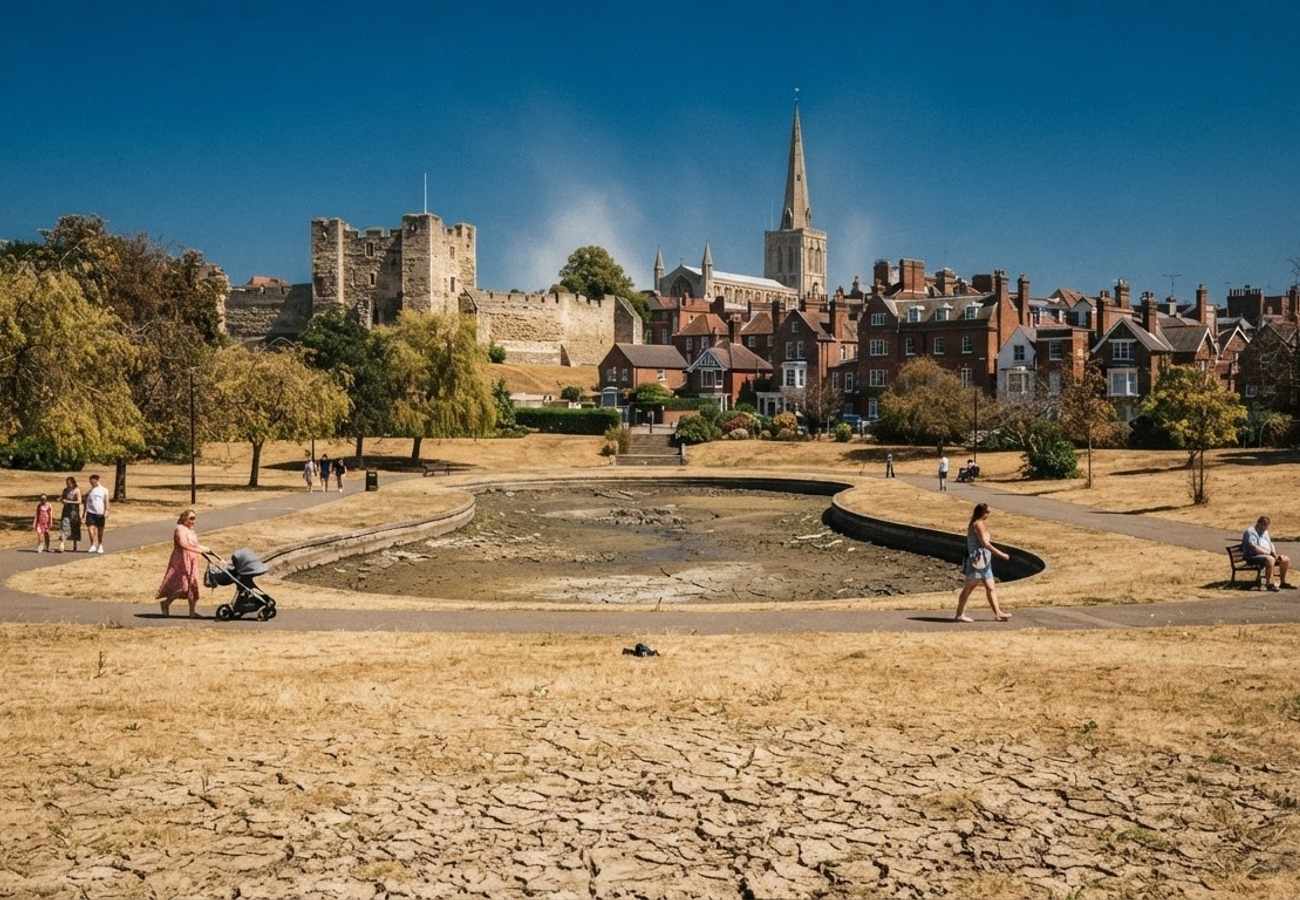
Image generated by AI
Colchester has emerged as the driest summer destination in the UK, marking a sharp decline in precipitation across southern and eastern England. This shift in climatic patterns is creating new operational realities for the tourism sector and regional water management.
Analysis of rainfall data from 2020 to 2025 reveals a widening geographical divide in English weather. While the north and west remain wetter, cities in the south and east are seeing a consistent drop in summer rainfall. Colchester leads this trend, recording the lowest average precipitation of all analyzed urban centers.
The data indicates that while British summers remain volatile, there is a clear trajectory toward drier conditions. Every city in the top 10 driest category recorded less rainfall in 2025 than they did in 2020.
Critical Rainfall Statistics (2020-2025)
- Driest City: Colchester, with a six-year average of 158.6mm.
- Peak Dry Year: 2022 was the driest across all analyzed leading cities.
- Regional Trend: Southern and eastern England dominate the driest rankings.
- 2025 Trend: 100% of the top 10 driest cities saw a rainfall decrease compared to 2020 levels.
- Extreme Drop: Hereford's summer rainfall plummeted from 236.1mm in 2020 to 114.4mm in 2025.
Summer Rainfall Analysis: Top 10 Driest UK Cities
The following data, compiled by ADI Leak Detection across 73 cities and towns, highlights the volatility and decline of summer precipitation.
| Rank | City | Average 2020-2025 (mm) | 2020 (mm) | 2021 (mm) | 2022 (mm) | 2023 (mm) | 2024 (mm) | 2025 (mm) | Change 2020-2025 (mm) | Change % |
|---|---|---|---|---|---|---|---|---|---|---|
| 1 | Colchester | 158.6 | 183.5 | 223.0 | 76.9 | 208.7 | 129.6 | 129.6 | -53.9 | -29.4% |
| 2 | Hereford | 166.1 | 236.1 | 155.2 | 102.1 | 247.1 | 141.6 | 114.4 | -121.7 | -51.5% |
| 3 | Chelmsford | 167.3 | 201.5 | 209.6 | 89.5 | 239.6 | 134.9 | 128.5 | -73.0 | -36.2% |
| 4 | Cambridge | 168.7 | 225.1 | 183.0 | 90.4 | 216.4 | 145.0 | 152.3 | -72.8 | -32.3% |
| 5 | Southend-on-Sea | 169.4 | 186.8 | 222.0 | 84.3 | 233.1 | 136.5 | 154.0 | -32.8 | -17.6% |
| 6 | London | 170.3 | 201.2 | 241.6 | 105.5 | 185.4 | 139.1 | 148.8 | -52.4 | -26.0% |
| 7 | Milton Keynes | 172.8 | 263.4 | 201.6 | 119.5 | 194.6 | 131.2 | 126.5 | -136.9 | -52.0% |
| 8 | Gloucester | 176.2 | 225.7 | 197.7 | 110.0 | 268.8 | 124.8 | 130.3 | -95.4 | -42.3% |
| 9 | Ely | 176.7 | 273.1 | 185.4 | 93.6 | 223.4 | 150.2 | 134.7 | -138.4 | -50.7% |
| 10 | Worcester | 177.9 | 257.3 | 172.3 | 116.8 | 247.6 | 151.0 | 122.5 | -134.8 | -52.4% |
The Colchester Case Study
Colchester's position as the driest city is characterized by extreme fluctuation. In 2021, the city recorded 223mm of summer rain, which crashed to just 76.9mm in 2022. While 2023 saw a temporary rebound to 208.7mm, the subsequent years (2024 and 2025) stabilized at a much lower 129.6mm. This represents a total summer rainfall decline of 29.4% over the six-year window.
Why This Matters: Industry Implications
From a logistical and travel perspective, this data suggests a fundamental shift in how "peak season" is managed in the UK.
For Travelers: The concentration of dry weather in the south and east—including London, Cambridge, and Southend-on-Sea—makes these regions more reliable for outdoor-centric itineraries, such as heritage tours and coastal holidays. However, the unpredictability remains high; the jump from 76.9mm to 208.7mm in Colchester shows that "dry" is a statistical average, not a guarantee.
For Tourism Operators: While dry weather boosts footfall for festivals and gardens, the systemic decline in rainfall creates a "hidden drought" risk. Our analysis suggests that hospitality providers in these top 10 cities may face increased water conservation mandates. Stressed vegetation in public parks and lower water levels in regional canals can degrade the aesthetic appeal of these destinations, potentially offsetting the benefits of sunny weather.
For Infrastructure: The sharp decline in rainfall, particularly in cities like Worcester and Milton Keynes (both seeing >50% drops since 2020), puts immense pressure on urban water grids. Prolonged dry spells increase the risk of ground subsidence and pipe bursts, which can disrupt local transport and hotel operations.
Industry Outlook
While six years of data is insufficient to declare a permanent climate shift, the consistency of the decline across all ten driest cities is a significant indicator. We expect to see a rise in "climate-adaptive" tourism planning in Southern England. This will likely include a shift toward drought-resistant landscaping in tourist hubs and more aggressive water-recycling mandates for the hospitality sector to maintain operational stability during increasingly arid summers.
The British summer is no longer just unpredictable; it is becoming structurally drier.
Related Travel Guides
Disclaimer
This article is for informational and educational purposes only. It does not constitute legal, financial, or professional advice. While we strive to provide accurate and up-to-date information, travel policies, regulations, and conditions change rapidly. Always verify information with official sources before making travel decisions. Nomad Lawyer makes no representations about the accuracy, reliability, completeness, or suitability of the information provided. Readers should consult qualified professionals for advice specific to their circumstances. The views expressed in this article are those of the author and do not necessarily reflect the views of Nomad Lawyer.
Preeti Gunjan
Contributor & Community Manager
A passionate traveller and community builder. Preeti helps grow the Nomad Lawyer community, fostering engagement and bringing the reader experience to life.
Learn more about our team →