
China Plunged into Massive Travel Chaos: 67 Flight Cancellations and 307 Delays Hit Shenzhen Airlines, China Eastern, and Air China Across Shenzhen, Shanghai, and Beijing Hubs
China faces significant travel chaos as 67 flight cancellations and 307 delays hit major hubs like Shenzhen, Shanghai, and Beijing, impacting thousands of travelers.

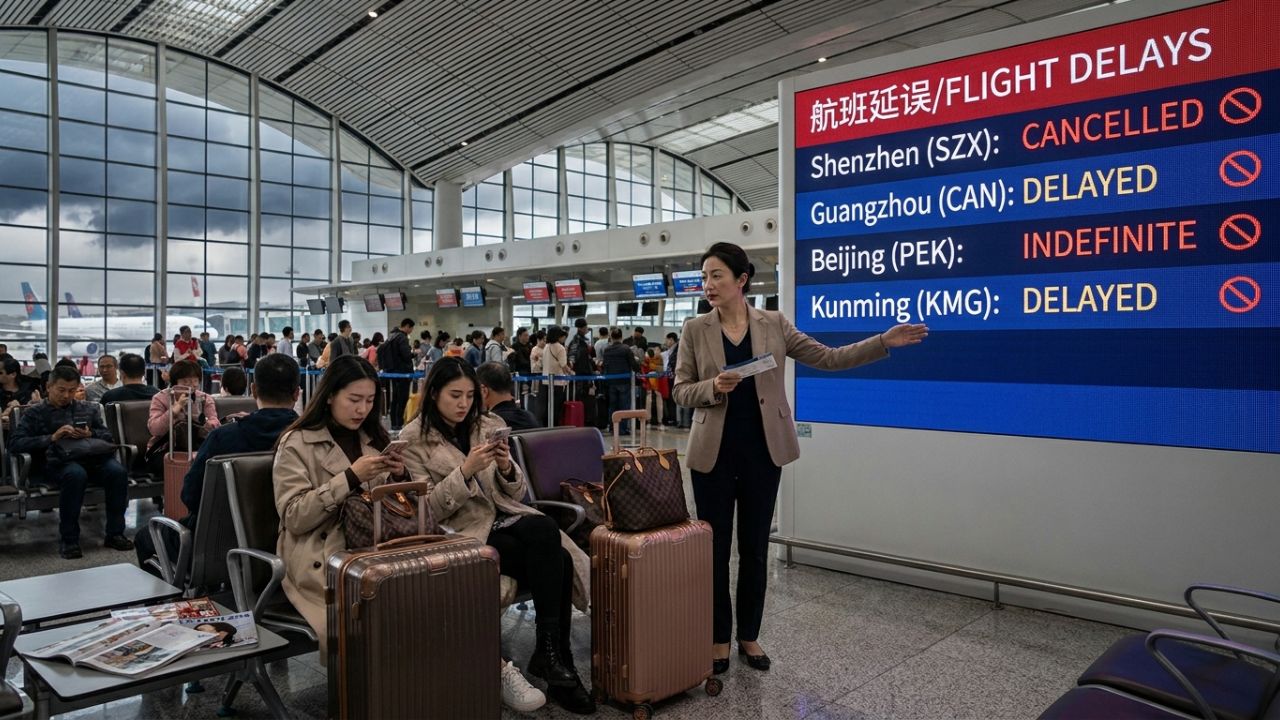
Image generated by AI
In a sweeping wave of operational instability, the Chinese aviation network has been plunged into a state of severe travel chaos. On May 16, 2026, the nation’s busiest hubs witnessed a staggering 67 flight cancellations and 307 delays, a systemic failure that has left thousands of passengers stranded across the country. This major airline news update highlights the mounting pressure on primary carriers like Shenzhen Airlines, China Eastern, and Air China, as they struggle to maintain schedules in the face of widespread airport disruptions. From the high-tech corridors of Shenzhen to the political heart of Beijing, the scale of the irregularities is being described by industry analysts as a critical stress test for the region's aviation resilience.
Breaking: System-Wide Disruptions Paralyze Chinese Transit Gateways
The disruption has been most acutely felt in the key economic and transit gateways that form the backbone of China's domestic and international air bridge. A total of 374 flight irregularities within a single window have placed an unprecedented strain on terminal infrastructure. Travelers navigating the corridors of Shenzhen, Guangzhou, Shanghai, Zhuhai, Chongqing, Kunming, and Beijing have faced a day defined by long queues, shifting departure boards, and the logistical nightmare of missed connections.
Aviation experts suggest that the concentration of these disruptions across multiple top-tier airports indicates a broader operational challenge, potentially linked to regional weather patterns or airspace saturation. Regardless of the cause, the impact on passenger confidence and the tourism ecosystem is expected to be significant as carriers work to stabilize their rotations.
Expanded Overview: Major Airports Facing Operational Meltdown
The impact of today's aviation updates has been distributed across the nation's most vital hubs. Shenzhen Bao’an International Airport emerged as the epicenter of the crisis, recording the highest level of disruption with 20 cancellations and 150 delays. As a primary base for regional and high-tech business travel, the congestion in Shenzhen has created a massive bottleneck for the Greater Bay Area.
Similarly, Guangzhou Baiyun and Shanghai Hongqiao have reported double-digit cancellations, further compromising the "Golden Triangle" of Chinese aviation. In the west, Chongqing and Kunming have seen their local connectivity severed, while the capital's Beijing Capital International Airport has faced enough disruption to trigger a knock-on effect for several connecting international routes to Europe and North America.
Section-Wise Breakdown: Hub-by-Hub Narrative
Shenzhen Bao’an International Airport (SZX)
Shenzhen has borne the brunt of today's instability. Shenzhen Airlines was the most impacted carrier at its home base, grounding 14 flights and delaying 63 others. The terminal has seen heavy congestion in its departure halls as passengers for Air China (22% delay rate) and Sichuan Airlines (36% delay rate) wait for updated schedules.
Guangzhou Baiyun International Airport (CAN)
In the southern transit hub of Guangzhou, China Eastern faced significant hurdles with 5 cancellations and 20 delays. International carriers like Kenya Airways and IndiGo also faced isolated delays, complicating the transit for global travelers heading toward the Middle East and Africa.
Shanghai Hongqiao International Airport (SHA)
Shanghai’s domestic gateway saw China Eastern ground 8 flights. While the numerical delay count at Hongqiao (20) was lower than in Shenzhen, the high percentage of cancellations relative to the schedule has created a high-pressure environment for business travelers.
Beijing Capital International Airport (PEK)
The capital hub faced 8 cancellations, with China Eastern recording a high 8% cancellation rate. This disruption is particularly critical as it impacts the "first leg" for many international journeys, causing cascading delays for travelers heading to destinations like Frankfurt or Seoul.
Regional Hubs: Zhuhai, Chongqing, and Kunming
The disruption extended deep into the provinces. Kunming Changshui recorded 11 cancellations, with Lucky Air and Ruili struggling to maintain regional links. In Zhuhai, China United Airlines saw a critical 33% cancellation rate, while Chongqing faced schedule slippage primarily affecting Hainan Airlines operations.
Flight Details and Operational Data Tables
The following tables provide the exact metrics for the carriers affected at each major airport, as sourced from FlightAware.
Shenzhen Bao’an International Airport Disruptions
| Airline | Cancelled | Cancelled (%) | Delayed | Delayed (%) |
|---|---|---|---|---|
| Shenzhen Airlines | 14 | 4% | 63 | 18% |
| Hainan Airlines | 3 | 3% | 3 | 3% |
| China Eastern | 2 | 3% | 3 | 4% |
| Shanghai Airlines | 1 | 25% | 0 | 0% |
| Air China | 0 | 0% | 17 | 22% |
| Zhejiang Loong | 0 | 0% | 2 | 11% |
| Spring Airlines | 0 | 0% | 8 | 23% |
| Sichuan Airlines | 0 | 0% | 9 | 36% |
| China Southern Airlines | 0 | 0% | 29 | 9% |
| XiamenAir | 0 | 0% | 4 | 13% |
| Donghai Airlines | 0 | 0% | 1 | 1% |
| Lucky Air | 0 | 0% | 2 | 100% |
| LJ Air | 0 | 0% | 2 | 100% |
| Tibet Airlines | 0 | 0% | 2 | 33% |
| Chengdu Airlines | 0 | 0% | 3 | 75% |
Guangzhou Baiyun International Airport Disruptions
| Airline | Cancelled | Cancelled (%) | Delayed | Delayed (%) |
|---|---|---|---|---|
| China Eastern | 5 | 3% | 20 | 14% |
| Hainan Airlines | 3 | 3% | 1 | 1% |
| China Southern Airlines | 2 | 0% | 15 | 2% |
| Shenzhen Airlines | 1 | 1% | 1 | 1% |
| Beijing Capital Airlines | 0 | 0% | 1 | 6% |
| Air China | 0 | 0% | 12 | 11% |
| Shanghai Airlines | 0 | 0% | 4 | 50% |
| IndiGo | 0 | 0% | 1 | 25% |
| 9 Air | 0 | 0% | 2 | 2% |
| Kenya Airways | 0 | 0% | 1 | 50% |
Shanghai Hongqiao International Airport Disruptions
| Airline | Cancelled | Cancelled (%) | Delayed | Delayed (%) |
|---|---|---|---|---|
| China Eastern | 8 | 2% | 10 | 3% |
| Shanghai Airlines | 2 | 1% | 3 | 2% |
| Spring Airlines | 0 | 0% | 2 | 2% |
| China Southern Airlines | 0 | 0% | 4 | 5% |
| Juneyao Airlines | 0 | 0% | 1 | 1% |
Zhuhai Jinwan Airport Disruptions
| Airline | Cancelled | Cancelled (%) | Delayed | Delayed (%) |
|---|---|---|---|---|
| China United Airlines | 2 | 33% | 0 | 0% |
| Air China | 1 | 4% | 4 | 17% |
| Hainan Airlines | 1 | 4% | 6 | 25% |
| Shandong Airlines | 0 | 0% | 2 | 6% |
| China Eastern | 0 | 0% | 2 | 10% |
| China Southern Airlines | 0 | 0% | 4 | 5% |
| Juneyao Airlines | 0 | 0% | 1 | 16% |
| Donghai Airlines | 0 | 0% | 1 | 7% |
| Lucky Air | 0 | 0% | 2 | 100% |
Chongqing Jiangbei International Airport Disruptions
| Airline | Cancelled | Cancelled (%) | Delayed | Delayed (%) |
|---|---|---|---|---|
| Hainan Airlines | 3 | 5% | 0 | 0% |
| Spring Airlines | 0 | 0% | 1 | 4% |
| Chongqing | 0 | 0% | 1 | 9% |
| Sichuan Airlines | 0 | 0% | 3 | 2% |
| China Southern Airlines | 0 | 0% | 3 | 3% |
| Shenzhen Airlines | 0 | 0% | 4 | 15% |
| XiamenAir | 0 | 0% | 1 | 2% |
| Juneyao Airlines | 0 | 0% | 2 | 25% |
| Donghai Airlines | 0 | 0% | 1 | 25% |
| China Express Airlines | 0 | 0% | 3 | 4% |
Kunming Changshui International Airport Disruptions
| Airline | Cancelled | Cancelled (%) | Delayed | Delayed (%) |
|---|---|---|---|---|
| China Eastern | 6 | 1% | 4 | 1% |
| Lucky Air | 2 | 2% | 6 | 6% |
| Ruili | 1 | 2% | 0 | 0% |
| Kunming Airlines | 1 | 1% | 1 | 1% |
| Chengdu Airlines | 1 | 25% | 0 | 0% |
| Shandong Airlines | 0 | 0% | 2 | 20% |
| Spring Airlines | 0 | 0% | 4 | 28% |
| China Southern Airlines | 0 | 0% | 1 | 1% |
Beijing Capital International Airport Disruptions
| Airline | Cancelled | Cancelled (%) | Delayed | Delayed (%) |
|---|---|---|---|---|
| China Eastern | 4 | 8% | 2 | 4% |
| Hainan Airlines | 3 | 1% | 0 | 0% |
| Air China | 1 | 0% | 9 | 1% |
| Dalian Airlines | 0 | 0% | 1 | 3% |
| Shandong Airlines | 0 | 0% | 5 | 12% |
| Shenzhen Airlines | 0 | 0% | 3 | 7% |
| Lufthansa | 0 | 0% | 1 | 50% |
| Korean Air | 0 | 0% | 1 | 8% |
Passenger Impact: Missed Connections and Tourism Fallout
For thousands of travelers, the travel chaos has translated into missed business commitments and ruined vacation plans. Domestic legs utilized by international visitors to jump between Beijing and Shanghai or down to Guangzhou have been the hardest hit.
- Refunds and Rebooking: Under standard Chinese aviation policy, a full refund or a seat on the next available flight is generally offered for cancellations. However, seat availability is currently a major hurdle.
- Logistical Costs: Many travelers in Shenzhen and Guangzhou have reported out-of-pocket expenses for meals and ground transit as delays stretched into several hours.
- Confidence Erosion: Industry analysts warn that if such airport disruptions become a recurring theme, international tour operators may start building larger buffers into Chinese itineraries, impacting the overall efficiency of the travel ecosystem.
Industry Analysis: The Fragility of High-Volume Hubs
While China's aviation sector is known for its massive scale and efficiency, today's events underscore the "fragility" of its high-volume hubs. When 374 irregularities occur within a single window, the terminal infrastructure—from gate availability to ground handling—reaches a breaking point.
The concentration of disruptions in Shenzhen (150 delays) suggests that a localized event, such as weather or ATC restrictions, likely triggered a domino effect across the network. Because Chinese carriers are highly interconnected, an aircraft grounded in Shenzhen often means a cancellation in Kunming or a delay in Beijing later that evening.
Conclusion: A Long Road to Recovery
As carriers like Air China and China Eastern work to reposition aircraft and clear the passenger backlog, the recovery is expected to take at least 24 to 48 hours. The airport disruptions seen today serve as a stark reminder of the complexities inherent in managing one of the world's largest aviation networks. For travelers, the road ahead remains uncertain, and maintaining a flexible itinerary is essential until operational stability is fully restored.
Key Takeaways
- Scale of Chaos: 67 cancellations and 307 delays hit China's aviation network on May 16, 2026.
- Epicenter: Shenzhen Bao’an (SZX) recorded the highest disruption with 170 total irregularities.
- Carriers Affected: Shenzhen Airlines, China Eastern, and Air China are the primary carriers under pressure.
- Regional Reach: Disruptions spread from Beijing in the north to Zhuhai in the south and Kunming in the west.
- Passenger Guidance: Use official airline apps (Air China, China Eastern) for the most immediate updates.
- Tourism Impact: Potential long-term scrutiny of Chinese scheduling reliability by global tour operators.
Related Travel Guides
Disclaimer
This article is for informational and educational purposes only. It does not constitute legal, financial, or professional advice. While we strive to provide accurate and up-to-date information, travel policies, regulations, and conditions change rapidly. Always verify information with official sources before making travel decisions. Nomad Lawyer makes no representations about the accuracy, reliability, completeness, or suitability of the information provided. Readers should consult qualified professionals for advice specific to their circumstances. The views expressed in this article are those of the author and do not necessarily reflect the views of Nomad Lawyer.
Kunal K Choudhary
Co-Founder & Contributor
A passionate traveller and tech enthusiast. Kunal contributes to the vision and growth of Nomad Lawyer, bringing fresh perspectives and driving the community forward.
Learn more about our team →