
China Eastern and Air China Suffer Massive Fleet Paralysis, Unleashing Devastating Travel Chaos Across Shanghai and Beijing: Latest Airline News
As sudden operational gridlock paralyzes China's airspace, massive flight cancellations violently sever domestic and intercontinental transit arteries across nine mega-hubs.

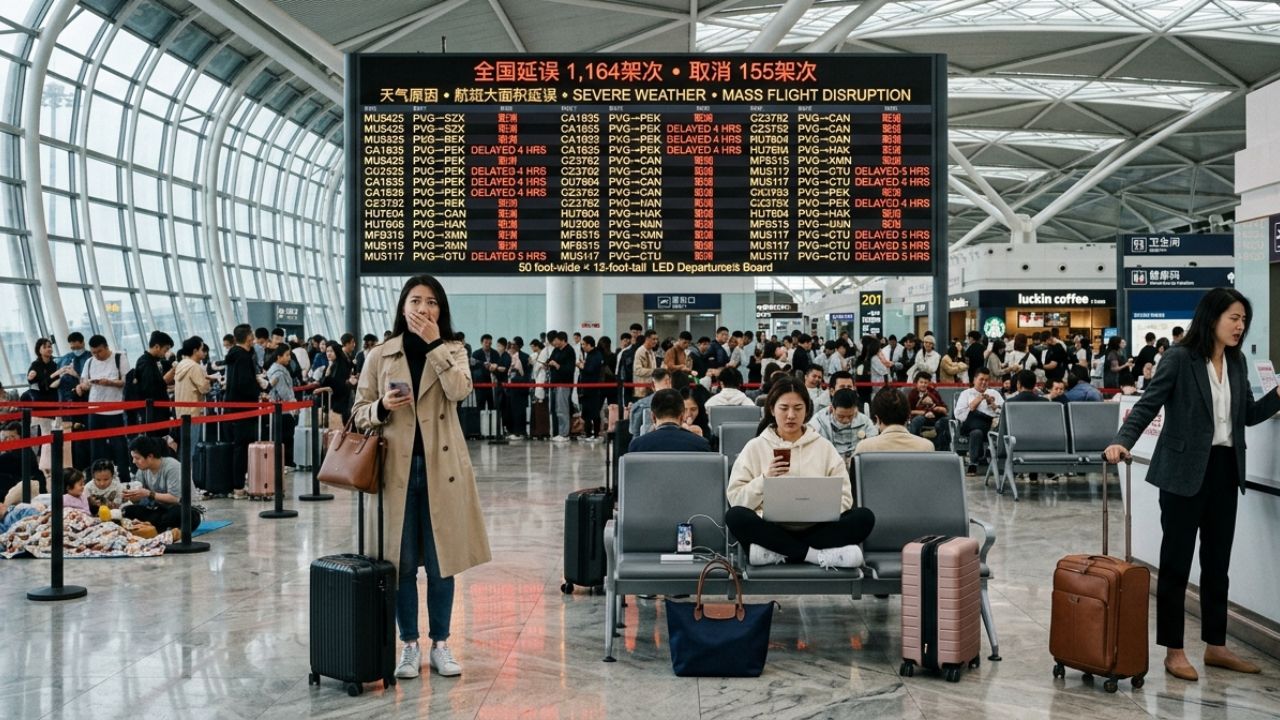
Image generated by AI
In a massive structural breakdown directly triggering a devastating wave of domestic and international travel chaos, the Asian continent's premier aviation network has suffered an unprecedented operational collapse. Driven by compounding operational bottlenecks and severe terminal congestion, an absolutely staggering wave of 155 sudden flight cancellations and 1,164 severe delays violently severed global transit arteries across China's most critical aviation hubs on May 26, 2026. This absolute collapse in connectivity heavily impacted massive aviation titans including China Eastern, Air China, Hainan Airlines, and XiamenAir, completely destroying travel itineraries for tens of thousands of connecting passengers. As widespread airport disruptions physically paralyze critical gateways including Shanghai, Beijing, and Shenzhen, this catastrophic failure totally dominates today’s premier airline news and global aviation updates.
By introducing direct passenger coordination and dynamic scheduling backups, the regional aviation hubs target growing passenger demand across vital commerce sectors. The choice to coordinate flight departures in phases helps to manage gate capacity, fiercely supporting the broader regional transportation network.
Context: The Collapse of the Chinese Crossroads
The historical vulnerability of funneling massive volumes of domestic and regional travelers through highly constrained mega-hubs like Shanghai Pudong and Beijing Capital is that a singular operational failure rapidly cascades into extreme physical exhaustion and severely destroyed passenger itineraries.
Because massive capacity crunches and localized operational strain constantly threaten punctuality, the sudden loss of over 1,300 scheduled flights plunged the entire Asian aviation network into absolute disarray. These paralyzing flight cancellations hit the Chinese hubs violently because they function as the absolute primary switching points for transpacific and domestic travel; a massive cluster of grounded widebody jets immediately triggers catastrophic crew shortages and stranded passengers nationwide. While airlines are desperately attempting to salvage the schedule, thousands of stranded travelers face immediate, severe disruption. Rather than a quick fix, this crisis represents a terrifying synchronization of operational gridlock across nine major metropolitan centers (Shanghai, Beijing, Shenzhen, Changsha, Changchun, Changzhou, Chengdu, Chongqing, and Hangzhou), forcing travelers into agonizing terminal waiting games.
For live route mapping, specific rebooking options, and official flight status tracking, stranded passengers should immediately consult the digital advisories published by their respective carriers before attempting to access these severely compromised terminals.
Section-Wise Breakdown: Hub-by-Hub Travel Chaos
The Financial Epicenter: Shanghai Pudong Int’l
To deliberately manage the immense volume of transcontinental traffic, China relies heavily on its eastern seaboard. However, Shanghai Pudong absorbed a highly destructive blow during this operational meltdown, recording an absolutely staggering 42 cancellations and 356 delays. China Eastern Airlines completely failed, suffering 11 cancellations and 112 delays, mathematically guaranteeing severe gridlock for international and domestic passengers alike.
| Airline | Cancelled | Cancelled (%) | Delayed | Delayed (%) |
|---|---|---|---|---|
| China Eastern Airlines | 11 | 2% | 112 | 27% |
| Air China | 10 | 7% | 31 | 24% |
| Shenzhen Airlines | 8 | 40% | 7 | 35% |
| Shanghai Airlines | 5 | 3% | 37 | 25% |
| Juneyao Airlines | 2 | 1% | 26 | 18% |
| XiamenAir | 2 | 20% | 1 | 10% |
| Spring Airlines | 1 | 0% | 41 | 34% |
| United Airlines | 1 | 20% | 3 | 60% |
| Hainan Airlines | 1 | 4% | 5 | 22% |
| Dalian Airlines | 1 | 20% | 1 | 20% |
| British Airways | 0 | 0% | 1 | 50% |
| China Airlines | 0 | 0% | 3 | 75% |
| Zhejiang Loong Airlines | 0 | 0% | 2 | 100% |
| Shandong Airlines | 0 | 0% | 3 | 30% |
| West Air | 0 | 0% | 2 | 50% |
| China Cargo Airlines | 0 | 0% | 3 | 10% |
| Cathay Pacific | 0 | 0% | 5 | 26% |
| Hong Kong Airlines | 0 | 0% | 2 | 33% |
| Sichuan Airlines | 0 | 0% | 2 | 18% |
| China Southern Airlines | 0 | 0% | 34 | 26% |
| SF Airlines | 0 | 0% | 1 | 11% |
| China United Airlines | 0 | 0% | 1 | 7% |
| China Postal Airlines | 0 | 0% | 1 | 14% |
| Delta Air Lines | 0 | 0% | 1 | 16% |
| Eastar Jet | 0 | 0% | 1 | 25% |
| Ethiopian Airlines | 0 | 0% | 1 | 50% |
| EVA Air | 0 | 0% | 2 | 33% |
| Garuda Indonesia | 0 | 0% | 2 | 100% |
| Japan Airlines | 0 | 0% | 2 | 22% |
| 9 Air | 0 | 0% | 1 | 20% |
| Korean Air | 0 | 0% | 3 | 37% |
| Kunming Airlines | 0 | 0% | 2 | 50% |
| Malaysia Airlines | 0 | 0% | 1 | 16% |
| Singapore Airlines | 0 | 0% | 1 | 8% |
| Turkish Airlines | 0 | 0% | 2 | 33% |
| Suparna Airlines | 0 | 0% | 3 | 12% |
| Asiana Airlines | 0 | 0% | 7 | 87% |
| Air Hong Kong | 0 | 0% | 1 | 50% |
| All Nippon Airways | 0 | 0% | 5 | 41% |
The Northern Anchor: Beijing Capital Int’l
Because massive airport disruptions actively destroy the passenger experience across the region, the operational strain violently spilled over into the capital. Beijing Capital Int’l recorded 22 cancellations and 54 flight delays. Air China, the flagship carrier, was violently paralyzed, logging 10 cancellations and completely severing critical political and corporate travel routes out of the capital.
| Airline | Cancelled | Cancelled (%) | Delayed | Delayed (%) |
|---|---|---|---|---|
| Air China | 10 | 1% | 29 | 3% |
| Hainan Airlines | 6 | 3% | 1 | 0% |
| Shenzhen Airlines | 3 | 7% | 2 | 5% |
| Dalian Airlines | 2 | 7% | 1 | 3% |
| Shandong Airlines | 1 | 2% | 4 | 10% |
| Zhejiang Loong Airlines | 0 | 0% | 2 | 40% |
| China Eastern Airlines | 0 | 0% | 7 | 14% |
| Cathay Pacific | 0 | 0% | 1 | 7% |
| Sichuan Airlines | 0 | 0% | 2 | 5% |
| SF Airlines | 0 | 0% | 3 | 15% |
| Mahan Air | 0 | 0% | 1 | 100% |
| Emirates | 0 | 0% | 1 | 50% |
| United Airlines | 0 | 0% | 1 | 33% |
| Asiana Airlines | 0 | 0% | 1 | 14% |
The Southern Tech Hub: Shenzhen Bao’an Int’l
The southern technology capital suffered total gridlock as Shenzhen Bao’an Int’l reported 24 cancellations and an immense 239 delays. Shenzhen Airlines completely collapsed under the pressure, logging 22 canceled flights and trapping tens of thousands of corporate executives attempting to navigate the Pearl River Delta.
| Airline | Cancelled | Cancelled (%) | Delayed | Delayed (%) |
|---|---|---|---|---|
| Shenzhen Airlines | 22 | 7% | 61 | 19% |
| XiamenAir | 2 | 6% | 16 | 53% |
| AirAsia | 0 | 0% | 2 | 25% |
| China Airlines | 0 | 0% | 1 | 33% |
| Air China | 0 | 0% | 9 | 12% |
| Zhejiang Loong Airlines | 0 | 0% | 7 | 43% |
| Shandong Airlines | 0 | 0% | 5 | 31% |
| China Eastern Airlines | 0 | 0% | 19 | 28% |
| West Air | 0 | 0% | 6 | 75% |
| Hainan Airlines | 0 | 0% | 16 | 20% |
| China Cargo Airlines | 0 | 0% | 1 | 100% |
| China Northwest Int. Cargo | 0 | 0% | 1 | 50% |
| Spring Airlines | 0 | 0% | 15 | 44% |
| Sichuan Airlines | 0 | 0% | 2 | 10% |
| Shanghai Airlines | 0 | 0% | 1 | 25% |
| China Southern Airlines | 0 | 0% | 41 | 13% |
| SF Airlines | 0 | 0% | 7 | 14% |
| China United Airlines | 0 | 0% | 2 | 40% |
| Juneyao Airlines | 0 | 0% | 3 | 18% |
| Donghai Airlines | 0 | 0% | 11 | 22% |
| Tianjin Airlines | 0 | 0% | 2 | 100% |
| Lufthansa Cargo | 0 | 0% | 1 | 100% |
| Hebei Airlines | 0 | 0% | 1 | 50% |
| Central Airlines | 0 | 0% | 1 | 50% |
| Lucky Air | 0 | 0% | 1 | 50% |
| Air Travel | 0 | 0% | 1 | 50% |
| TransNusa | 0 | 0% | 1 | 50% |
| Emirates | 0 | 0% | 1 | 50% |
| Chengdu Airlines | 0 | 0% | 1 | 25% |
| Asiana Airlines | 0 | 0% | 1 | 50% |
| Suparna Airlines | 0 | 0% | 4 | 23% |
| Thai AirAsia | 0 | 0% | 1 | 50% |
Regional Core: Changsha Huanghua Int’l
Passengers travelling through Changsha faced notable schedule adjustments, with 19 cancellations and 37 delays documented, violently degrading regional connectivity.
| Airline | Cancelled | Cancelled (%) | Delayed | Delayed (%) |
|---|---|---|---|---|
| China Eastern Airlines | 6 | 14% | 3 | 7% |
| Shanghai Airlines | 5 | 20% | 4 | 16% |
| Air China | 4 | 14% | 2 | 7% |
| Hainan Airlines | 2 | 4% | 1 | 2% |
| XiamenAir | 1 | 2% | 3 | 7% |
| Chengdu Airlines | 1 | 5% | 0 | 0% |
| West Air | 0 | 0% | 2 | 100% |
| Cathay Pacific | 0 | 0% | 1 | 50% |
| China Southern Airlines | 0 | 0% | 3 | 3% |
| Urumqi Air | 0 | 0% | 2 | 200% |
| Donghai Airlines | 0 | 0% | 1 | 12% |
| Fuzhou Airlines | 0 | 0% | 5 | 100% |
| China Express Airlines | 0 | 0% | 1 | 20% |
| 9 Air | 0 | 0% | 5 | 62% |
| Air Travel | 0 | 0% | 2 | 10% |
| Qingdao Airlines | 0 | 0% | 2 | 28% |
Northern Connectors: Changchun Longjia Int’l
A total of 6 cancellations and 22 delays were logged at this northern hub serving Changchun.
| Airline | Cancelled | Cancelled (%) | Delayed | Delayed (%) |
|---|---|---|---|---|
| Qingdao Airlines | 2 | 14% | 1 | 7% |
| Air China | 2 | 6% | 0 | 0% |
| Shenzhen Airlines | 1 | 14% | 0 | 0% |
| China Eastern Airlines | 1 | 5% | 2 | 11% |
| Spring Airlines | 0 | 0% | 2 | 9% |
| Shanghai Airlines | 0 | 0% | 4 | 25% |
| China Southern Airlines | 0 | 0% | 7 | 12% |
| XiamenAir | 0 | 0% | 1 | 9% |
| Juneyao Airlines | 0 | 0% | 1 | 12% |
| 9 Air | 0 | 0% | 1 | 16% |
| Beijing Capital Airlines | 0 | 0% | 2 | 50% |
| Zhejiang Loong Airlines | 0 | 0% | 1 | 11% |
Secondary Disruption: Changzhou Benniu
The regional facility in Changzhou recorded 4 cancellations alongside 11 flight delays.
| Airline | Cancelled | Cancelled (%) | Delayed | Delayed (%) |
|---|---|---|---|---|
| China Eastern Airlines | 4 | 16% | 2 | 8% |
| Spring Airlines | 0 | 0% | 1 | 10% |
| China Southern Airlines | 0 | 0% | 1 | 16% |
| Shenzhen Airlines | 0 | 0% | 5 | 35% |
| Ruili Airlines | 0 | 0% | 1 | 16% |
Southwestern Dominance: Chengdu Shuangliu Int’l
Aviation services in Chengdu were heavily disrupted by 10 cancellations and 58 delays, isolating the massive Sichuan basin.
| Airline | Cancelled | Cancelled (%) | Delayed | Delayed (%) |
|---|---|---|---|---|
| Air China | 7 | 3% | 19 | 9% |
| China Eastern Airlines | 2 | 4% | 9 | 19% |
| Tibet Airlines | 1 | 1% | 9 | 14% |
| Spring Airlines | 0 | 0% | 2 | 50% |
| Sichuan Airlines | 0 | 0% | 10 | 6% |
| SF Airlines | 0 | 0% | 1 | 12% |
| Shenzhen Airlines | 0 | 0% | 4 | 23% |
| Central Airlines | 0 | 0% | 1 | 100% |
| Air Hong Kong | 0 | 0% | 1 | 50% |
| Chengdu Airlines | 0 | 0% | 4 | 7% |
Central Hub Failure: Chongqing Jiangbei Int’l
A significant backlog was created in Chongqing, where 6 cancellations and an immense 111 delays were registered, severely fracturing central connectivity.
| Airline | Cancelled | Cancelled (%) | Delayed | Delayed (%) |
|---|---|---|---|---|
| Shanghai Airlines | 2 | 40% | 2 | 40% |
| China Eastern Airlines | 2 | 2% | 21 | 25% |
| Shenzhen Airlines | 1 | 4% | 2 | 8% |
| Qingdao Airlines | 1 | 25% | 0 | 0% |
| China Airlines | 0 | 0% | 1 | 33% |
| Beijing Capital Airlines | 0 | 0% | 1 | 16% |
| Air China | 0 | 0% | 19 | 15% |
| Zhejiang Loong Airlines | 0 | 0% | 5 | 125% |
| Air Guilin | 0 | 0% | 1 | 50% |
| Colorful Guizhou Airlines | 0 | 0% | 1 | 50% |
| West Air | 0 | 0% | 9 | 10% |
| Hainan Airlines | 0 | 0% | 2 | 3% |
| Cathay Pacific | 0 | 0% | 1 | 20% |
| Spring Airlines | 0 | 0% | 3 | 13% |
| Sichuan Airlines | 0 | 0% | 15 | 15% |
| China Southern Airlines | 0 | 0% | 3 | 4% |
| XiamenAir | 0 | 0% | 7 | 16% |
| Juneyao Airlines | 0 | 0% | 2 | 25% |
| Tianjin Airlines | 0 | 0% | 3 | 13% |
| China Express Airlines | 0 | 0% | 9 | 15% |
| 9 Air | 0 | 0% | 2 | 100% |
| Tibet Airlines | 0 | 0% | 2 | 16% |
Eastern Mega-Hub: Hangzhou Xiaoshan Int’l
Major disruptions were witnessed in Hangzhou, with 22 cancellations and a devastating 276 flight delays destroying regional travel plans.
| Airline | Cancelled | Cancelled (%) | Delayed | Delayed (%) |
|---|---|---|---|---|
| Air China | 8 | 5% | 36 | 26% |
| Hainan Airlines | 4 | 8% | 10 | 20% |
| XiamenAir | 4 | 3% | 42 | 35% |
| China Eastern Airlines | 3 | 3% | 30 | 30% |
| Shenzhen Airlines | 2 | 11% | 9 | 50% |
| China United Airlines | 1 | 25% | 0 | 0% |
| Dalian Airlines | 0 | 0% | 1 | 25% |
| Zhejiang Loong Airlines | 0 | 0% | 25 | 27% |
| Shandong Airlines | 0 | 0% | 11 | 39% |
| West Air | 0 | 0% | 2 | 100% |
| China Northwest Int. Cargo | 0 | 0% | 1 | 25% |
| Cathay Pacific | 0 | 0% | 4 | 44% |
| Spring Airlines | 0 | 0% | 3 | 20% |
| Hong Kong Airlines | 0 | 0% | 1 | 50% |
| Sichuan Airlines | 0 | 0% | 11 | 36% |
| China Southern Airlines | 0 | 0% | 37 | 33% |
| SF Airlines | 0 | 0% | 6 | 16% |
| Urumqi Air | 0 | 0% | 2 | 100% |
| Juneyao Airlines | 0 | 0% | 7 | 53% |
| Donghai Airlines | 0 | 0% | 2 | 100% |
| Tianjin Airlines | 0 | 0% | 7 | 53% |
| Hebei Airlines | 0 | 0% | 3 | 30% |
| China Express Airlines | 0 | 0% | 3 | 150% |
| 9 Air | 0 | 0% | 1 | 100% |
| Kunming Airlines | 0 | 0% | 1 | 25% |
| Lucky Air | 0 | 0% | 3 | 50% |
| Okay Airways | 0 | 0% | 1 | 12% |
| Qanot Sharq | 0 | 0% | 2 | 100% |
| Tibet Airlines | 0 | 0% | 2 | 33% |
| Asiana Airlines | 0 | 0% | 1 | 50% |
| Suparna Airlines | 0 | 0% | 1 | 25% |
| Air Macau | 0 | 0% | 1 | 25% |
| AirAsia | 0 | 0% | 2 | 100% |
| Beijing Capital Airlines | 0 | 0% | 14 | 28% |
Passenger Impact: The Eradication of Reliable Transit
For the everyday domestic and international traveler, this aggressive spike in flight cancellations and terminal gridlock translates into a massive surge in travel anxiety and the total eradication of passenger confidence.
By heavily experiencing these sudden schedule alterations, passengers face brutal rebooking delays, agonizing missed connections, and severely reduced seat availability on alternative routes. A business executive attempting to cross from Shanghai to Shenzhen, or a family navigating a critical departure out of Beijing, is now forced into a devastating cycle of standby queues and financial loss. The sheer removal of massive domestic capacity mathematically guarantees that hundreds of thousands of passengers are currently suffering maximum emotional and logistical friction.
The Bigger Picture: The Economics of Terminal Gridlock
Aviation industry analysts view these staggering, highly targeted airport disruptions as a critical indicator of systemic operational sensitivity within the massive Chinese transportation sector.
The underlying strategic motivation perfectly reflects a massive industry reality: when high-frequency mega-hubs like Shanghai and Beijing operate at absolute maximum capacity, an isolated operational anomaly—whether driven by airspace control, weather, or capacity limits—rapidly cascades into massive national travel failure. Because China's domestic aviation network demands hyper-precision, airlines will face continued, devastating scheduling pressure if these hub-level disruptions persist. This gridlock inflicts severe economic shockwaves on the hospitality and tourism sectors, causing massive revenue losses for regional hotels and tour operators.
What This Means for Travelers: Actionable Advice
To fully exploit these highly efficient international networks and actively avoid severe, self-inflicted regional travel chaos, execute the following strategies:
- Pivot to High-Speed Rail: If your Air China or China Eastern flight is violently canceled, immediately abandon the airport. China boasts the world's most extensive high-speed rail network. Secure a train ticket to physically insulate yourself from the severe travel chaos paralyzing the aviation sector.
- Demand Immediate Rebooking: Do not wait in physical terminal lines. Instantly access official airline apps (like XiamenAir or Hainan Airlines) to secure alternative routing before other passengers completely deplete the remaining seat inventory.
- Assert Compensation Rights: Under Chinese aviation regulations, airlines are mandated to provide rebooking assistance. If the delay is extensive, aggressively demand complimentary meals and hotel accommodations directly from customer service desks.
- Monitor Digital Telemetry: Always track your flight via local digital platforms before departing for massive hubs like Shenzhen or Hangzhou. Arriving at a paralyzed terminal without verified flight status mathematically guarantees an agonizing, multi-hour wait in extreme congestion.
FAQ: China Flight Disruptions
Why did China suffer massive sudden flight cancellations?
The disruptions were driven by localized operational strain, airspace congestion, and compounding scheduling constraints across nine major metropolitan hubs, forcing a devastating wave of 155 cancellations and 1,164 delays.
Which airlines were most impacted by the travel chaos?
Major flag carriers including China Eastern, Air China, Shenzhen Airlines, and XiamenAir suffered severe network breakdowns, isolating tens of thousands of domestic and international passengers.
What should I do if my flight out of Shanghai or Beijing is canceled?
Immediately utilize the airline's official app to rebook, demand regulatory meal and hotel compensation at the customer service desk, or physically pivot to China's high-speed rail network to bypass the aviation gridlock entirely.
Key Takeaways
- Sudden Disruption Wave: 1,319 highly critical flights were violently delayed or canceled across China.
- Shanghai Epicenter: Pudong International absorbed 356 delays and 42 outright cancellations.
- Flag Carriers Devastated: China Eastern and Air China suffered massive, network-wide operational failures.
- Regional Paralysis: Vital routes through Shenzhen, Hangzhou, and Chongqing were completely severed.
- Passenger Friction: The sudden schedule failures forced thousands of travelers into severe localized travel chaos.
Related Travel Guides
Delta Suffers Massive Emergency Diversion
Disclaimer
This article is for informational and educational purposes only. It does not constitute legal, financial, or professional advice. While we strive to provide accurate and up-to-date information, travel policies, regulations, and conditions change rapidly. Always verify information with official sources before making travel decisions. Nomad Lawyer makes no representations about the accuracy, reliability, completeness, or suitability of the information provided. Readers should consult qualified professionals for advice specific to their circumstances. The views expressed in this article are those of the author and do not necessarily reflect the views of Nomad Lawyer.
Kunal K Choudhary
Co-Founder & Contributor
A passionate traveller and tech enthusiast. Kunal contributes to the vision and growth of Nomad Lawyer, bringing fresh perspectives and driving the community forward.
Learn more about our team →