
China Eastern Adds Starbucks Coffee to First and Business Class Premium Cabins in 2026
China Eastern Airlines has begun serving freshly prepared Starbucks Arabica coffee in first and business class, deepening an aviation plus coffee partnership with Starbucks and Nestle that has been building since 2025 across loyalty programs, airports, and inflight service.

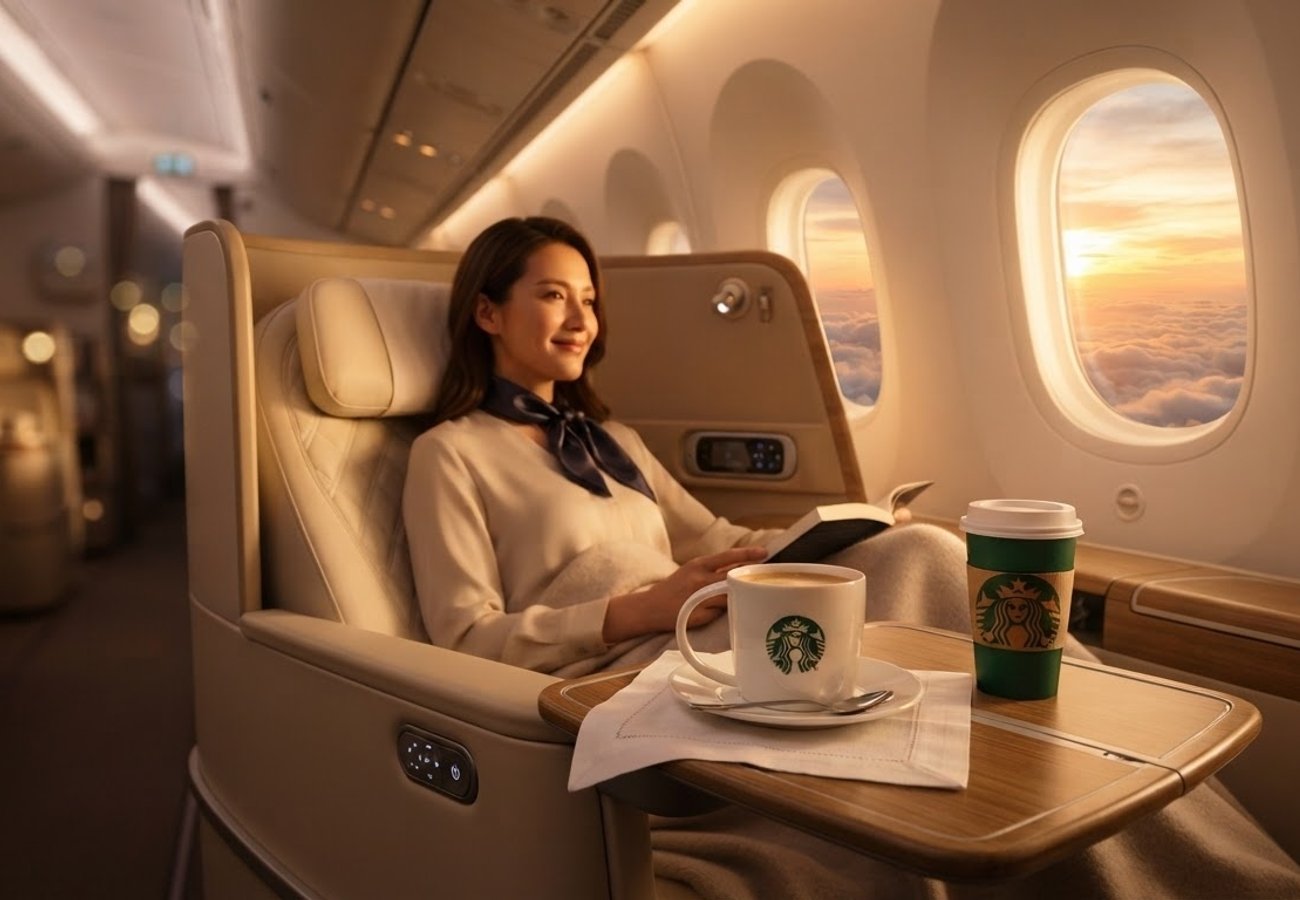
Image generated by AI
Flying China Eastern Airlines in first or business class now comes with a café-standard perk: freshly prepared Starbucks coffee served at cruising altitude. The rollout is the most visible step yet in an "aviation plus coffee" partnership with Starbucks and Nestle that has already generated tens of thousands of new airline loyalty members and more than one hundred thousand cups of coffee through joint campaigns.
China Eastern Airlines has formally introduced Starbucks coffee into its first and business class cabins, according to joint announcements from Starbucks, Nestle and the carrier. The service focuses on freshly prepared Arabica coffee and select customized beverages designed for consumption at cruising altitude, rather than relying solely on instant products.
The decision matters well beyond the drinks trolley. It signals how a major Chinese carrier intends to compete for high-yield travelers: through recognizable global brands layered onto a soft product that has been steadily rebuilt around dining, loyalty and lifestyle partnerships.
Freshly Brewed Arabica Replaces Instant in Premium Cabins
The Starbucks offering is being positioned as a standard fixture of the first and business class beverage selection, not a limited-time promotion. That framing tells passengers and competitors alike that China Eastern views branded coffee as a long-term differentiator in its onboard product.
Under the arrangement, Starbucks draws on its alliance with Nestle to supply product, branding and training support. China Eastern then integrates the coffee program into its existing premium inflight service framework, which has long included hot beverages but never before a named global coffee brand served to passengers.
Key details of the rollout:
- Cabins covered: first class and business class
- Product: freshly prepared Arabica coffee plus select customized beverages built for altitude
- Initial network: core trunk routes and long-haul services where the airline typically deploys widebody aircraft and concentrates premium seating
- Status: a permanent menu addition rather than a seasonal trial
A Partnership Brewing Since 2025
The inflight launch builds on a comprehensive cooperation between China Eastern and Starbucks China that has been developing since 2025. Company disclosures describe an "aviation plus coffee" ecosystem linking loyalty programs, airport experiences and inflight products to drive engagement across platforms.
The early results were measurable. The partnership has already delivered tens of thousands of new airline loyalty memberships, and joint campaigns have distributed over one hundred thousand cups of Starbucks coffee.
Those figures suggest coffee has become a central theme in China Eastern's customer-experience strategy rather than a peripheral marketing tie-in. Earlier phases concentrated on member benefits and airport interactions; placing the brand inside the cabin moves it to the core of the onboard experience.
For Starbucks, the arrangement extends its reach into yet another consumption scenario within China, complementing an extensive store network and licensed channels. For China Eastern, it secures a globally recognized brand that reinforces its positioning as a full-service carrier with an upgraded soft product.
Why Premium Cabins Get the First Pour
Anchoring the service in first and business class is a deliberate commercial choice. High-yield passengers are the most sensitive to onboard quality and brand recognition, and they are the travelers airlines fight hardest to retain.
The smaller cabin footprint also creates a controlled test environment. China Eastern can evaluate service consistency, crew workflows and passenger response at limited scale before committing to a wider deployment.
If satisfaction scores and operational metrics meet expectations, expansion becomes straightforward to justify. Premium economy is the obvious next candidate, given that demand for upgraded food and beverage in that cabin has been rising steadily across the industry.
Yunnan Beans, Solar Terms and a Global Counterpoint
The Starbucks addition lands amid a broader refresh of China Eastern's premium food and beverage program. The airline has been upgrading through seasonal menu design and partnerships with domestic and international suppliers.
Previous announcements highlighted menus aligned with Chinese culinary traditions, including concepts built around the 24 solar terms and regional ingredients. Starbucks-branded coffee now provides an international counterpoint, giving premium passengers a choice between globally familiar beverages and localized flavors.
There is also a regional coffee thread worth watching. The cooperation draws on earlier joint work around Yunnan coffee, in which China Eastern has promoted single-origin beans from the province both on the ground and in the air. Observers suggest the Starbucks partnership could eventually intersect with those initiatives, using the cabin environment to showcase Chinese coffee alongside a global brand.
Asia's Inflight Coffee Race Intensifies
China Eastern is not moving in isolation. Airlines across Asia and globally have partnered with specialty roasters or international chains in recent years to serve branded coffee at altitude, responding to passengers who increasingly expect café-standard drinks on long journeys.
Coffee quality has become a visible battleground, particularly in premium cabins where travelers compare everything from bedding and Wi-Fi to wine lists and barista-style beverages. Aligning with Starbucks places China Eastern alongside peers that treat recognizable coffee as part of the overall travel proposition, especially on long-haul and business-heavy routes.
The timing also reflects a maturing coffee culture within China, where urban consumers are fluent in specialty beans, brewing methods and brand stories. Bringing a familiar café brand onboard connects the inflight experience with passengers' daily habits on the ground, strengthening affinity for both the airline and Starbucks.
There is a commercial recovery angle as well. As international capacity in and out of China continues to rebuild, soft-product upgrades such as improved coffee service can help win back corporate contracts and high-spend leisure travelers who compare multiple carriers before booking.
Loyalty Integration and Ancillary Revenue Potential
The partnership already extends beyond the cabin. China Eastern and Starbucks have linked their respective loyalty programs in mainland China, allowing members to earn or exchange benefits across airline and coffee purchases. Company sustainability and ESG reporting indicates the tie-up has driven incremental membership growth and higher engagement for both brands.
Embedding Starbucks into the premium service flow creates fresh activation points:
- Limited-time beverage offers tied to elite status
- Co-branded packaging and targeted promotions for high-tier loyalty members
- Cross-platform campaigns connecting flights, airport visits and store purchases
Ancillary revenue could follow. Analysts see scope for the airline to sell branded inflight coffee kits, beans or vouchers for Starbucks stores, either onboard or through pre- and post-trip channels, though no detailed commercial roadmap has been publicly disclosed.
Key Takeaways
- China Eastern now serves freshly prepared Starbucks Arabica coffee and customized beverages in first and business class, positioned as a permanent menu fixture rather than a promotion.
- The rollout begins on core trunk routes and long-haul services where the airline deploys widebody aircraft.
- The "aviation plus coffee" partnership with Starbucks and Nestle dates to 2025 and has produced tens of thousands of new loyalty members plus over one hundred thousand distributed cups.
- Premium cabins serve as a testing ground, with premium economy a logical expansion target if metrics perform.
- Linked loyalty programs and potential retail products point to revenue opportunities beyond the cabin itself.
Frequently Asked Questions
Which China Eastern cabins serve Starbucks coffee? First and business class. The airline has concentrated the initial rollout in premium cabins on core trunk routes and long-haul services.
Is the Starbucks service a temporary promotion? No. The offerings are positioned as a standard part of the first and business class beverage selection, signaling a long-term commitment to branded coffee onboard.
What coffee is actually served onboard? Freshly prepared Arabica coffee and select customized beverages designed for consumption at cruising altitude, rather than a sole reliance on instant products.
Will economy or premium economy passengers get Starbucks coffee? Not initially. China Eastern is using premium cabins to gauge passenger response and operational performance first, though premium economy is viewed as a natural next step if satisfaction scores and metrics meet expectations.
What is the "aviation plus coffee" ecosystem? A comprehensive China Eastern and Starbucks cooperation running since 2025, supported by Nestle, that links loyalty programs, airport experiences and inflight products to drive engagement across both brands' platforms.
For China Eastern's premium passengers, the clearest sign of the airline's soft-product ambitions may now arrive in a coffee cup.
Related Travel Guides
Disclaimer
This article is for informational and educational purposes only. It does not constitute legal, financial, or professional advice. While we strive to provide accurate and up-to-date information, travel policies, regulations, and conditions change rapidly. Always verify information with official sources before making travel decisions. Nomad Lawyer makes no representations about the accuracy, reliability, completeness, or suitability of the information provided. Readers should consult qualified professionals for advice specific to their circumstances. The views expressed in this article are those of the author and do not necessarily reflect the views of Nomad Lawyer.
Preeti Gunjan
Contributor & Community Manager
A passionate traveller and community builder. Preeti helps grow the Nomad Lawyer community, fostering engagement and bringing the reader experience to life.
Learn more about our team →