
Severe Weather Sparks Over 600 Flight Delays and 130 Cancellations Across Canada
Severe thunderstorms in Ontario spark 601 delays and 131 cancellations across Toronto Pearson, Montreal, and Vancouver airport networks.

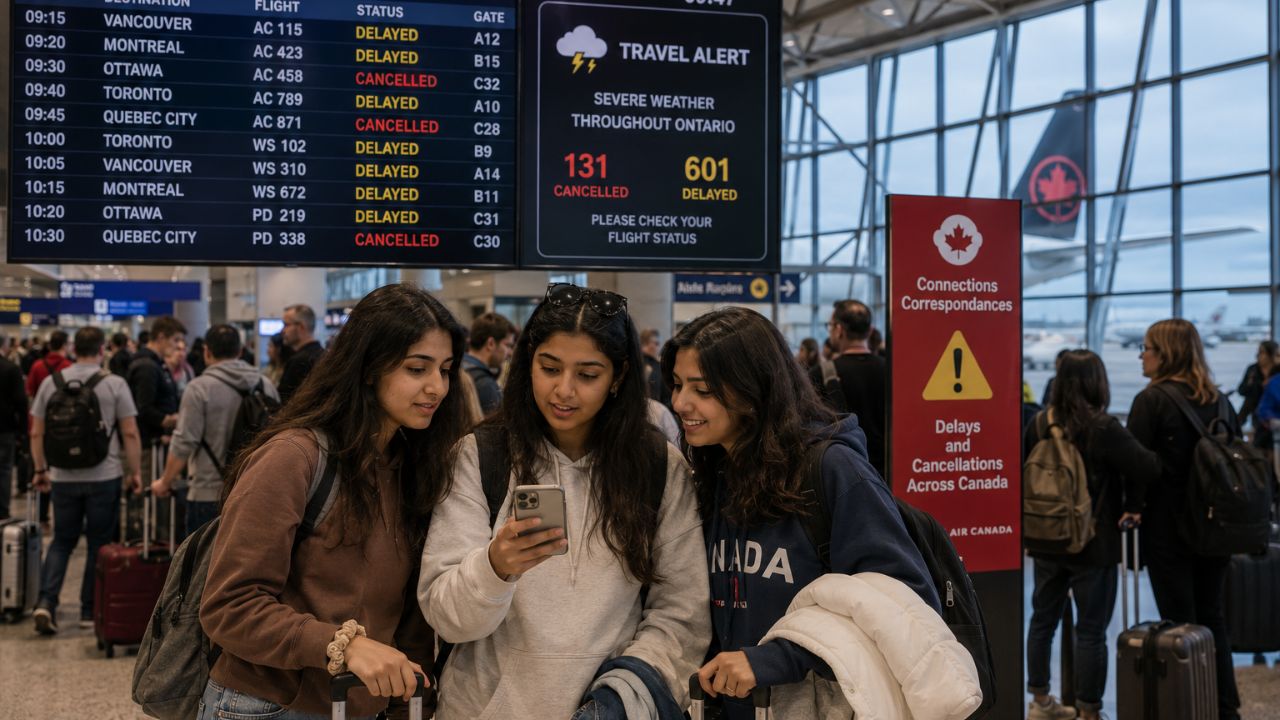
Image generated by AI
Canadian flight delays and cancellations have stranded passengers across the country's major aviation corridors. A severe thunderstorm system moving through Ontario has triggered 601 delays and 131 cancellations at key airport hubs.
Severe Weather Systems Paralyze Ontario Aviation Corridors
Environment Canada issued severe thunderstorm watches across the dense Ontario metropolitan region on July 4, 2026. The storm system brought wind gusts up to 100 km/h, heavy rain exceeding 30 mm, and large hail.
These atmospheric conditions forced air traffic controllers to implement ground holds and spacing adjustments for safety. The disruptions quickly spread from the Ontario corridor to impact hubs across Quebec and British Columbia.
Aviation monitors reported a cumulative total of 601 delays and 131 cancellations across the national air travel grid.
Major Canadian Airport Terminals Experience Schedule Backlogs
The terminal operations monitored at Toronto Pearson International Airport reveal that the facility was the primary epicentre of the disruption. Pearson recorded 275 delays and 46 cancellations, leading to significant terminal queues and passenger backlogs.
Billy Bishop Toronto City Airport registered 38 delays and 21 cancellations, impacting regional short-haul routes.
In Quebec, Montreal-Trudeau International Airport faced 119 delays and 40 cancellations, while Quebec City's Jean Lesage Airport reported 26 delays and 5 cancellations.
Downstream effects also hit Vancouver International Airport, which logged 102 delays and 10 cancellations due to aircraft repositioning constraints.
Canadian Carrier Schedule Instability and Disruptions
The tables below display the airport and airline disruption statistics.
Flight Cancellations and Delays by Canadian Airport Hub
| Airport Hub Name | Airport Code | Cancelled Flights | Delayed Flights | Hub Network Classification |
|---|---|---|---|---|
| Toronto Pearson | YYZ | 46 | 275 | Primary International Hub |
| Montreal-Trudeau | YUL | 40 | 119 | Transatlantic Hub |
| Vancouver International | YVR | 10 | 102 | Transpacific Gateway |
| Billy Bishop Toronto City | YTZ | 21 | 38 | Regional Commuter Hub |
| Ottawa Macdonald-Cartier | YOW | 9 | 41 | Capital Regional Hub |
| Québec Jean Lesage | YQB | 5 | 26 | Provincial Feeder Hub |
Flight Disruptions by Operating Canadian Carrier
| Airline Carrier Name | Cancelled Flights | Delayed Flights | Primary Operating Hubs |
|---|---|---|---|
| Air Canada | 26 | 125 | Toronto (YYZ), Montreal (YUL) |
| Jazz Aviation | 43 | 92 | Regional Feeder Network |
| Porter Airlines | 6 | 78 | Toronto City (YTZ) |
| Air Canada Rouge | 12 | 54 | Leisure Destinations |
| Air Inuit | 2 | 22 | Northern Communities |
Severe Weather Impact Factors in Aviation Safety
Aviation safety protocols require immediate adjustments when thunderstorm activity approaches airport boundaries. High wind gusts disrupt flight control during takeoff and landing, while heavy rain reduces runway visibility and braking performance.
Additionally, lightning activity forces ground crews to suspend ramp and refueling operations to prevent hazard.
These safety constraints delay aircraft turnarounds, causing scheduling backlogs that cascade throughout the airline's daily route rotations.
Why This Matters
Our analysis of the flight data indicates that the Canadian aviation network is highly centralized around the Toronto-Montreal corridor. Because Toronto Pearson handles the highest volume of domestic and international traffic, a ground stop in Ontario immediately halts aircraft repositioning to western gateways like Vancouver. This dependency explains why Vancouver registered over 100 delays despite being geographically clear of the storm system.
Furthermore, regional feeder services like Jazz Aviation experienced the highest volume of cancellations. Feeder airlines operate tight, back-to-back rotations with minimal turn times. When a mainline connection is delayed at a major hub, the regional flight must be cancelled to prevent crew and aircraft out-of-position errors.
Industry Outlook
Market trends suggest that Canadian carriers will need to build additional scheduling buffers into transcontinental routes to absorb seasonal storm delays. Airlines are also exploring digitized passenger self-service tools to automate rebooking during multi-hub ground stops.
Expect airport operators to upgrade lightning detection and warning systems to minimize the duration of ramp closures. The current scheduling irregularities are projected to persist until weather systems clear the Ontario corridor.
Key Takeaways
- Widespread Congestion: The Canadian air travel network recorded 601 delayed flights and 131 cancellations due to weather.
- Hub Closures: Toronto Pearson was the hardest hit facility, logging 275 delays and 46 cancellations.
- Regional Strands: Jazz Aviation experienced 43 cancellations, disrupting regional feeder links.
- Downstream Ripples: Vancouver Airport registered 102 delays due to delayed aircraft arrivals from eastern hubs.
- Safety Protocols: Lightning and high winds forced ground handlers to suspend refueling and ramp operations.
FAQ
How many flights were delayed and cancelled across Canada?
There were 601 delays and 131 cancellations recorded across major Canadian airports.
Which airline had the most flight cancellations?
Jazz Aviation, which operates regional feeder flights for Air Canada, recorded the highest number of cancellations with 43 flights.
Why did Vancouver Airport experience delays if the storm was in Ontario?
Airports are interconnected; delayed departures from Toronto and Montreal prevented aircraft from arriving in Vancouver on schedule, causing downstream delays.
What weather conditions caused the flight disruptions?
The delays were caused by severe thunderstorms, 100 km/h wind gusts, heavy rain, and lightning safety holds on airport ramps.
Related Travel Guides
Disclaimer
This article is for informational and educational purposes only. It does not constitute legal, financial, or professional advice. While we strive to provide accurate and up-to-date information, travel policies, regulations, and conditions change rapidly. Always verify information with official sources before making travel decisions. Nomad Lawyer makes no representations about the accuracy, reliability, completeness, or suitability of the information provided. Readers should consult qualified professionals for advice specific to their circumstances. The views expressed in this article are those of the author and do not necessarily reflect the views of Nomad Lawyer.
Kunal K Choudhary
Co-Founder & Contributor
A passionate traveller and tech enthusiast. Kunal contributes to the vision and growth of Nomad Lawyer, bringing fresh perspectives and driving the community forward.
Learn more about our team →