
Can You Travel While on Bail in Canada? Passport and Travel Restrictions Explained
Learn whether you can travel while on bail in Canada, how passport surrender and geographic restrictions work, and what to do before planning domestic or international travel.

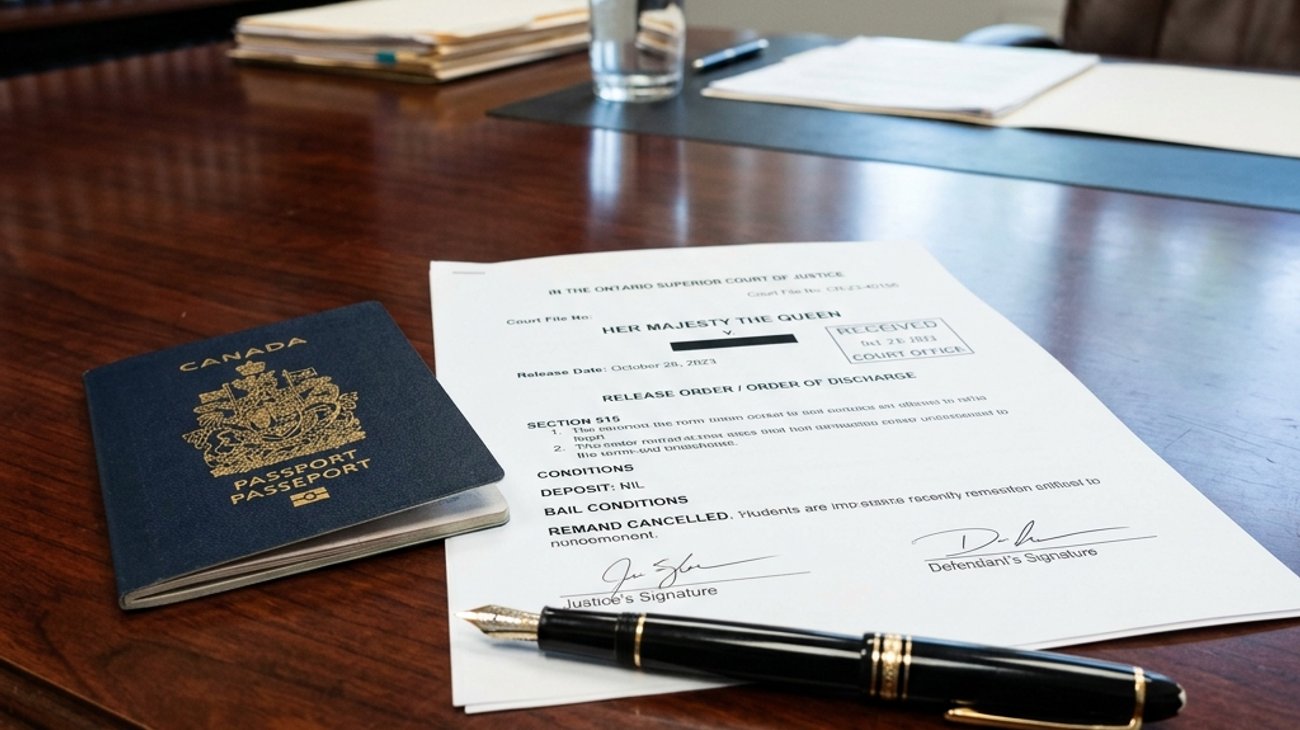
Image generated by AI
Being released on bail does not automatically answer whether you can travel. The real answer is found in the exact wording of the release order, undertaking, or recognizance that governs your case. Some accused persons are permitted to move around relatively freely, while others must remain within a specified area, stay at a particular residence, observe a strict curfew, or surrender their passport.
That is why travel should never be booked on assumption alone. A person may believe they are allowed to leave town because no one expressly said otherwise, or because a surety informally agreed, but the written conditions control. If the order restricts movement or requires the passport to be deposited, travelling anyway can create a new legal problem separate from the original charge.
This article provides general legal information only and is not a substitute for formal advice about an individual case.
Understanding Travel Rights and Release Orders in Canada
Can you travel while on bail in Canada? Possibly, but only if your release conditions allow it.
A person on bail must comply with every condition until the order is formally changed or the criminal matter ends. That means travel restrictions while on bail Canada courts impose remain binding even if the trip seems reasonable, temporary, or necessary.
If the order says the accused must remain within Ontario, the Greater Toronto Area, or another specified jurisdiction, leaving that area may amount to a criminal breach. If the order requires passport surrender bail conditions, international travel may be impossible unless the condition is varied first by a judge or Crown consent.
Informal permission is not enough. A friend, family member, or even a surety cannot override the written terms of a release order unless the order itself specifically gives that person authority in the situation. Verbal assumptions are especially dangerous in bail matters because a seemingly small misunderstanding can lead to immediate arrest or a failure-to-comply charge.
Common Bail Conditions That May Restrict Travel
Not everyone released on bail receives the same conditions. Canadian law requires conditions to relate to the specific circumstances of the case and the release decision, rather than being imposed mechanically in every file. Still, certain conditions commonly affect whether someone can travel.
Section 515(4) of the Criminal Code of Canada permits release conditions that can include staying away from a geographic area and depositing passports as specified in the order. Justice Canada's public guidance on the bail process also lists common release terms such as attending court, reporting to police, remaining within a particular territorial jurisdiction, and depositing travel documents.
In practice, travel may be limited by conditions such as:
- Remaining within Ontario or another specified territorial jurisdiction.
- Remaining at a particular approved residence.
- Reporting regularly in person to police or another authority.
- Obeying a curfew or house arrest requirement.
- Depositing all passports and international travel documents.
- Avoiding certain addresses, regions, or specified people.
- Complying with terms linked to a surety's supervision.
- Attending court whenever required by the registry.
A person asking "can you leave Ontario while on bail" needs to review more than one sentence in the order. Even if there is no direct "do not leave Ontario" term, a residence condition, reporting schedule, curfew, or upcoming court date may make travel unlawful or impractical.
What Does Surrendering a Passport Mean Legally?
A passport-surrender condition is one of the clearest indicators that travelling outside Canada while charged may not be permitted.
If the release order requires the accused to deposit a passport, that condition generally prevents international travel unless the order is varied or the passport is lawfully returned through the proper court process. A person should not try to work around the condition by applying for a replacement passport or using another travel document. The condition applies because of the court order itself, not simply because one physical booklet has been handed over.
Anyone subject to passport surrender bail conditions should confirm exactly where the passport was deposited and what legal steps would be required for its return. In some cases, the variation process can take time to resolve—which is one reason travel plans should never be made first and sorted out later.
The broader point is simple: surrendering a passport is not symbolic. It is a binding release term with real legal consequences if ignored.
Can You Travel Within Ontario or Elsewhere in Canada?
Domestic travel is sometimes possible, but it is not automatically permitted just because the trip stays within Canada. The written order must be read as a whole.
Some people on bail are allowed to move within the province freely as long as they continue attending court and complying with all other terms. Others are required to remain within a defined area such as Ontario, York Region, the GTA, or a particular municipality. Some must live at a specific address except for narrowly defined purposes such as work, school, medical appointments, or meetings with legal counsel.
Curfews and reporting requirements can also make a trip unrealistic even if there is no express intercity travel ban. A person may technically be allowed to visit another part of Ontario but still be unable to do so lawfully because they must report in person, remain home by a specific time, or stay with a surety whose supervision is part of the release structure.
Families often assume a surety can simply approve a trip. That is not necessarily correct. A surety's role is to help ensure compliance with the order, not to rewrite it. Unless the order expressly authorizes a surety to permit certain movements, the surety cannot give effective permission to travel contrary to the written terms.
Leaving Canada While Criminal Charges Are Pending
Pending charges do not create one universal rule against leaving Canada, but they do raise several separate legal issues at once.
First, the Canadian release conditions must permit departure. If the order limits geography, imposes house arrest, requires reporting, or includes passport surrender, the analysis stops there. Second, the destination country decides independently whether to admit the traveller. A person may be legally free to depart Canada and still be refused at the border of another country because of an unresolved charge or prior record.
International travel also creates practical legal risk. Court dates must still be attended. Defense counsel may need instructions quickly. Disclosure, resolution discussions, or unexpected scheduling changes can occur while the accused is away. Missing a required court appearance can trigger serious failure-to-appear warrants even if the trip itself was not the original problem.
Anyone considering travelling outside Canada while charged should obtain legal advice before attempting to cross a border. The issue is not just whether travel is convenient—it is whether it is lawful, realistic, and consistent with ongoing court obligations.
Can Bail Conditions Be Changed for Necessary Travel?
Sometimes, yes. But the existing order remains binding unless and until it is formally changed through the courts.
Necessary travel requests can arise for many reasons: employment obligations, medical treatment, family emergencies, previously booked travel, religious commitments, or compassionate circumstances. In some cases, the Crown prosecutor may consent to a variation. In others, a formal court application before a judge or Justice of the Peace may be required. The process depends on the case, the wording of the order, and the position taken by the prosecution.
Timing matters. Changing bail conditions in Ontario is rarely something to leave until a few days before departure. Supporting materials may need to be gathered, counsel may need to contact the Crown, and a court appearance may be necessary if consent is not available. Approval is never guaranteed, even where the reason for travel is understandable.
Anyone uncertain about the wording or potential modification of their release conditions should speak with an experienced bail hearing lawyer in Newmarket before making travel arrangements.
The key point is procedural: a reasonable purpose does not suspend the order. The accused must obtain an actual legal variation, not rely on the hope that the reason will excuse non-compliance after the fact.
Information That May Support a Travel Variation Request
Where a travel variation is being considered, the required evidence will depend on the individual case. Still, certain kinds of information commonly matter because they help the court or Crown assess whether the proposed travel is genuine, limited, and compatible with ongoing supervision.
Potentially relevant documents may include:
- Specific travel dates and a complete daily itinerary.
- A detailed explanation of the reason for travel.
- An employment letter verifying business necessity.
- Medical records or appointment confirmation.
- Proof of a family emergency.
- Return transportation details and confirmed flight numbers.
- The exact address where the person will stay.
- Supervision details while away from the jurisdiction.
- Written confirmation that no court dates will be missed.
- The surety's formal position, where a surety is involved.
This does not mean every request succeeds once paperwork is assembled. It means the request is more likely to be assessed seriously if it is concrete, documented, and brought forward well in advance. Vague proposals create difficulty, whereas specific plans supported by real documents allow the legal issue to be evaluated properly.
What Happens If Someone Travels in Breach of Bail?
Travelling contrary to release terms can lead to consequences that are much more serious than many people expect. A breach of bail conditions Canada courts impose is not a minor administrative oversight.
Possible consequences may include:
- A new criminal charge for failing to comply with a release order (Section 145 of the Criminal Code).
- Immediate arrest and detention in custody.
- Revocation of the original bail release.
- Stricter future release conditions if re-released.
- Greater difficulty obtaining bail in any future matters.
- Financial estreat consequences for a surety who signed a recognizance.
- Significant harm to the accused's credibility in the underlying criminal case.
A breach does not have to involve violence, concealment, or leaving the country permanently to become serious. A technical-looking violation, such as leaving a permitted geographic area or travelling while a passport remains deposited, can still affect how the court views future compliance. Once a person is seen as unreliable on release, the rest of the case becomes far harder to manage.
That is why breach of bail conditions concerns should never be treated casually. If the trip is important enough to take, it is important enough to clear legally first.
Practical Pre-Travel Checklist for Accused Persons
Before making any travel plans while on release, take these steps in order:
- Obtain a full copy of the release order, undertaking, or recognizance.
- Review every condition, not just the ones that seem obviously travel-related.
- Confirm whether any passport has been surrendered and where it is held.
- Check residence, reporting, and curfew terms carefully.
- Identify all upcoming court dates and scheduling deadlines.
- Discuss the proposed trip thoroughly with defense counsel.
- Apply for any required variation well before the intended travel date.
- Get written confirmation if a variation is formally approved.
- Review the destination country's entry requirements separately.
- Do not depart until legal authorization is clear in writing.
For anyone asking "can you travel while on bail in Canada," this checklist is usually more useful than a broad yes-or-no answer. Travel depends on the order, the facts, and whether the proper legal steps were taken before departure.
Frequently Asked Questions
Does being charged with a crime automatically prevent international travel?
No. The answer depends on your release conditions, whether your passport has been surrendered, upcoming court obligations, and the destination country's own entry admissibility rules. A person may be free to leave Canada under their release order yet still be refused entry elsewhere. In other cases, Canadian bail terms themselves make travel unlawful. The safest approach is to review written conditions first and address foreign entry issues separately.
Can a surety give permission to travel?
Not necessarily. A surety cannot override a court order simply because they agree with the trip. Any authority a surety has depends on the exact wording of the release conditions. In many cases, a surety's role is supervisory rather than discretionary. If the order limits movement, requires residence at a particular address, or imposes a curfew, those terms remain binding unless formally varied through the court.
Can an accused person travel for work purposes?
Possibly, but only if existing release conditions permit it or are formally varied first. Work travel can be a legitimate reason to request a variation, especially where employment would otherwise be affected, but there is no automatic exception. Geographic restrictions, reporting requirements, house arrest, or passport surrender can all interfere with business travel. The request should be raised early through counsel and supported with concrete documentation.
What if the trip was booked before the criminal charge?
A pre-booked trip does not override bail conditions. The fact that flights or accommodations were arranged earlier may be relevant to a request to vary the order, but approval is not automatic. Courts and Crown prosecutors will still evaluate the nature of the charge, the reasons for travel, supervision plans, court dates, and compliance history. The safest course is to address the issue through legal counsel as soon as the travel restriction becomes apparent.
Related Travel Guides
Disclaimer
This article is for informational and educational purposes only. It does not constitute legal, financial, or professional advice. While we strive to provide accurate and up-to-date information, travel policies, regulations, and conditions change rapidly. Always verify information with official sources before making travel decisions. Nomad Lawyer makes no representations about the accuracy, reliability, completeness, or suitability of the information provided. Readers should consult qualified professionals for advice specific to their circumstances. The views expressed in this article are those of the author and do not necessarily reflect the views of Nomad Lawyer.
Preeti Gunjan
Contributor & Community Manager
A passionate traveller and community builder. Preeti helps grow the Nomad Lawyer community, fostering engagement and bringing the reader experience to life.
Learn more about our team →