
Breaking Airline News: Severe Travel Chaos Engulfs Bucharest Henri Coandă Airport as 10 Flight Cancellations Paralyze the European Transit Network
Breaking airline news: Amidst a terrifying era of massive passenger congestion, Bucharest Henri Coandă Airport suffers a catastrophic operational collapse, trapping thousands of travelers in a 10-flight disruption nightmare.

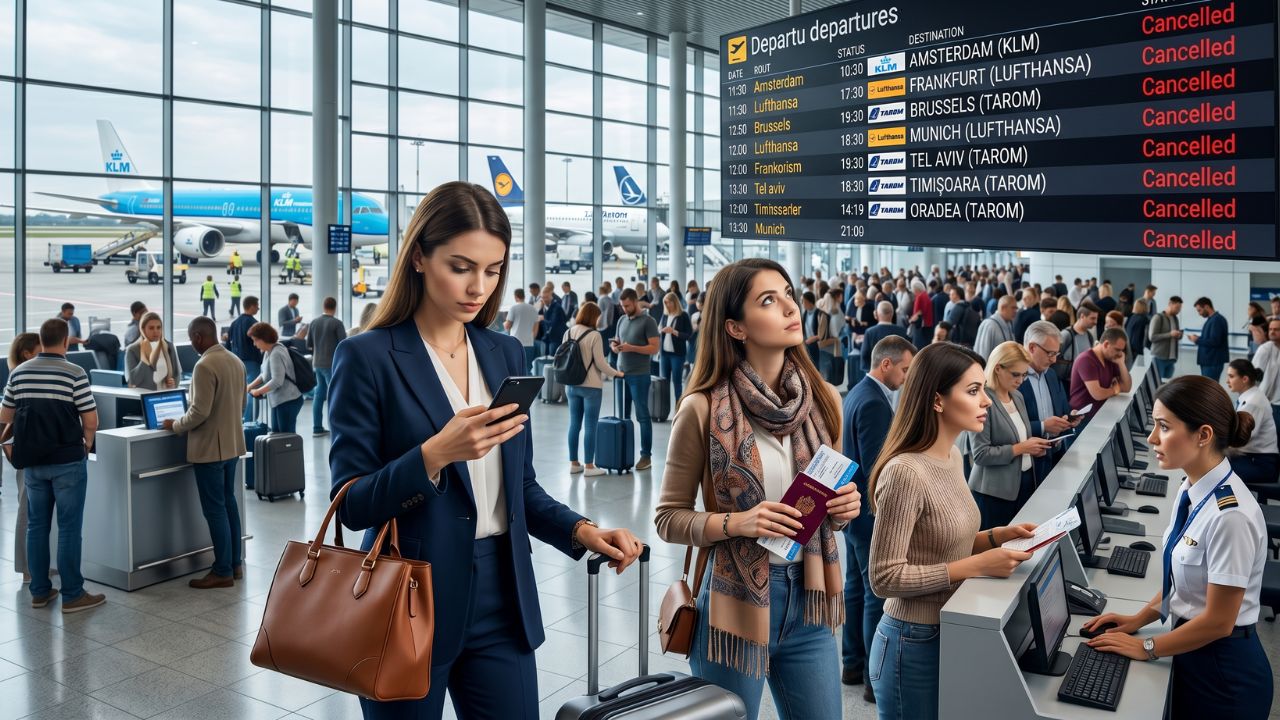
Image representing the intense strategic nightmare as global aviation authorities desperately attempt to contain severe flight cancellations and massive travel chaos following a catastrophic terminal gridlock in Romania.
Breaking Airline News: Severe Travel Chaos Engulfs Bucharest Henri Coandă Airport as 10 Flight Cancellations Paralyze the European Transit Network
As paralyzing airport disruptions, highly constrained operational bandwidth, and severe airspace friction violently sweep through the massive European aviation network, a catastrophic logistical collapse has completely severed Romania’s primary transit artery. In a devastating blow to regional connectivity and commercial flight schedules, Bucharest Henri Coandă International Airport (LROP) suffered a massive operational meltdown, recording an absolutely staggering 10 flight cancellations. This terrifying disruption event actively paralyzed multiple airlines, violently pulling down critical departures from national carrier TAROM, alongside European heavyweights Wizz Air, KLM, and Lufthansa. The sheer volume of terminated flights instantly triggered a massive emergency scenario, plunging thousands of desperate domestic and international travelers into an inescapable web of severe travel chaos. As major carriers frantically battle to reposition grounded fleets, the resulting terminal gridlock has severely disrupted vital travel corridors connecting Timişoara, Oradea, Amsterdam, Frankfurt, Brussels, Munich, and Ben Gurion.
In a harrowing display of modern aviation fragility, the sheer diversity of grounded aircraft currently overwhelming the Bucharest transit hub brutally exposes the terrifying cascading effects of systemic operational failure. Operating within a highly synchronized, hyper-connected European network, even the slightest deviation in aircraft availability can rapidly devolve into a high-stress, massive emergency scenario. Today’s operational data confirms that the crisis is not limited to a single aircraft variant or low-cost carrier; narrowbody workhorses spanning the Airbus and Boeing spectrum, including the B737, B738, A319, A320, A20N, and A21N, alongside regional AT72 turboprops, were violently grounded. This devastating fleet-wide disruption proves that airline dispatchers are not fighting an isolated technical glitch, but rather a terrifying systemic collapse—potentially triggered by compounding crew shortages, severe maintenance delays, and regional air traffic restrictions. With ground operations actively failing to rapidly deploy backup aircraft, furious passengers are left trapped inside overflowing, severely congested terminals.
Expanded Overview: The Massive Scale of the Contagion
The terrifying crisis currently gripping Bucharest Henri Coandă International Airport brutally exposes the incredibly fragile nature of the Eastern European transit grid. When a strategically vital regional mega-hub experiences a severe operational meltdown of this magnitude, the cascading effects on the secondary regional network are absolutely devastating. The grounded commercial aircraft actively paralyze both domestic inter-city flow and critical intercontinental connections, aggressively strangling corporate business travel and vital leisure itineraries. Because major carriers operate incredibly high-frequency routes connecting Bucharest with the broader European Union, today's severe cancellation wave immediately triggered massive shockwaves, proving that heavily loaded commercial passenger jets are entirely vulnerable to the cascading logistical failures currently plaguing the aviation industry.
Section-Wise Breakdown: The Operational Collapse
The Massive TAROM Domestic Contagion
The massive incident aggressively centered around the sudden logistical friction plaguing Romania’s national flag carrier. TAROM was heavily impacted by the operational shutdown, which aggressively severed critical domestic lifelines across the region. Repeated cancellations were forced upon flights targeting Timişoara Traian Vuia International, with an AT72 turboprop (ROT601) grounded on Thursday, preceded by massive B738 (ROT603) and AT72 (ROT603) cancellations on Wednesday and Tuesday respectively. Furthermore, a vital domestic link to Oradea International (ROT621) utilizing an AT72 was violently canceled on Wednesday morning. Beyond the domestic gridlock, TAROM was also forced to completely ground its international B738 service targeting Brussels (ROT373) on Tuesday afternoon.
Lufthansa's German Network Paralyzed
The terrifying operational shockwaves violently disrupted the massive German transit corridors. Lufthansa, a cornerstone of European connectivity, was forced to execute severe cancellations out of Bucharest. The carrier violently scrubbed highly critical narrowbody services to Frankfurt International, grounding an A20N (DLH1417) on Tuesday and an A319 (DLH1419) on Sunday. Additionally, Lufthansa’s crucial evening connection to Munich International (DLH1653) operated by an A320 was completely terminated on Sunday, stranding hundreds of corporate travelers and tourists attempting to connect to the broader global network via Germany.
Wizz Air and KLM Suffer Severe Friction
The cascading flight cancellations completely decimated transit corridors across other major European and Middle Eastern alliances. Hungarian ultra-low-cost giant Wizz Air was dragged into the travel chaos, suffering the outright cancellation of its massive A21N service (WMT3263) targeting Ben Gurion International Airport in Tel Aviv on Monday afternoon. Similarly, Dutch flag carrier KLM was unable to escape the regional contagion, violently executing the termination of its early evening B737 service (KLM1376) heading to Amsterdam Schiphol. This widespread, multi-carrier failure demonstrates severe, uncontrollable schedule pressure across the entire Bucharest network.
Aviation Incident & Operational Disruption Matrix
To fully comprehend the massive logistical and strategic fallout of this Bucharest Henri Coandă collapse, corporate travel managers and affected commercial passengers must review the exact incident metrics currently paralyzing the European network. The following matrix provides a granular breakdown of the specific, officially verified flight disruption data that triggered this severe travel chaos.
| Flight Number | Aircraft Type | Destination Airport | Departure Date & Time (EEST) |
|---|---|---|---|
| ROT601 | AT72 | Timişoara Traian Vuia Int’l (TSR / LRTR) | Thu 07:20AM |
| ROT603 | B738 | Timişoara Traian Vuia Int’l (TSR / LRTR) | Wed 12:40PM |
| ROT621 | AT72 | Oradea Int’l (OMR / LROD) | Wed 07:45AM |
| ROT603 | AT72 | Timişoara Traian Vuia Int’l (TSR / LRTR) | Tue 12:40PM |
| WMT3263 | A21N | Ben Gurion Int’l (TLV / LLBG) | Mon 01:10PM |
| KLM1376 | B737 | Amsterdam Schiphol (AMS / EHAM) | Sun 06:10PM |
| DLH1417 | A20N | Frankfurt Int’l (FRA / EDDF) | Tue 05:15PM |
| ROT373 | B738 | Brussels (BRU / EBBR) | Tue 04:35PM |
| DLH1653 | A320 | Munich Int’l (MUC / EDDM) | Sun 07:20PM |
| DLH1419 | A319 | Frankfurt Int’l (FRA / EDDF) | Sun 02:05PM |
Passenger Impact: Surviving the Terminal Nightmare
For the thousands of regional tourists and corporate commuters physically trapped inside heavily congested commercial terminals due to the sudden operational collapse, the human cost of this emergency is absolutely terrifying. The brutal reality of enduring a massive 10-flight cancellation event inflicts intense psychological stress and entirely destroys meticulously planned itineraries. The disruption caused immediate friction, resulting in severely missed international connections through mega-hubs like Frankfurt and Amsterdam, abandoned hotel reservations, massive financial losses, and entirely ruined business schedules as furious passengers battled to secure alternative flights out of the locked-down Romanian hub.
Survival Guide for Stranded Travelers
Travelers desperately navigating this chaos at Bucharest Henri Coandă Airport must immediately execute the following survival protocols:
- Do Not Panic, Deploy Digital Tools: Avoid aggressively swarming the physical airline customer service desks; immediately utilize your airline's official digital app to secure emergency rebookings before competing passengers exhaust available inventory.
- Demand EU261 Financial Compensation: Because these flights originated within the European Union, stranded passengers must aggressively demand hotel accommodations from carrier customer service and immediately file for massive financial compensation under EU261 passenger rights laws for sudden cancellations.
- Monitor Connection Cascades: Passengers utilizing Frankfurt, Munich, or Amsterdam as a transit point must assume their entire global itinerary is compromised and proactively request route alterations before allowing their baggage to be trapped in the disrupted sorting facility.
Industry Analysis: The Fragility of Systemic Operations
From a strategic aviation perspective, the travel turmoil currently decimating Bucharest highlights the terrifying vulnerability of managing highly dense flight schedules during peak operational stress. Industry analysts confirm that the simultaneous grounding of multiple fleet types—from domestic turboprops to international narrowbodies—indicates a severe systemic breakdown rather than a localized technical flaw. The massive commercial failure observed today proves that major airline networks remain incredibly vulnerable to the compounding pressures of crew scheduling, airspace restrictions, and intense maintenance backlogs. To prevent the complete destruction of Bucharest’s travel reputation, aviation authorities must aggressively overhaul contingency protocols to rapidly restore efficiency following severe disruption events.
Conclusion: A Strategic Retreat to Ensure Aviation Survival
As the situation across Bucharest Henri Coandă Airport remains highly volatile, the sudden collapse of these primary regional and international routes represents a massive warning to transit travelers. The staggering 10 cancellations prove that flight schedules remain terrifyingly fragile under unexpected operational lockdowns. Corporate travel buyers and everyday passengers attempting to navigate this highly unstable era of airport disruptions must maintain extreme flexibility. By acting aggressively to secure robust travel insurance and relentlessly monitoring real-time data, travelers can successfully survive this unprecedented operational meltdown and escape the severe travel chaos currently paralyzing the Eastern European region.
Key Takeaways
- Massive Airport Paralysis: Bucharest Henri Coandă International Airport suffered a catastrophic operational meltdown, recording 10 severe flight cancellations across the regional and international network.
- TAROM Severely Impacted: The national carrier executed multiple cancellations, completely severing domestic routes to Timişoara and Oradea, as well as an international service to Brussels.
- European Heavyweights Suffer Extreme Friction: Lufthansa, KLM, and Wizz Air were forced to violently cancel services to Frankfurt, Munich, Amsterdam, and Tel Aviv.
- Systemic Fleet Grounding: The cancellations devastated multiple aircraft types, violently grounding AT72s, B738s, B737s, A319s, A320s, A20Ns, and A21Ns.
- Traveler Advisory: Passengers trapped in the terminal gridlock must aggressively utilize mobile apps to secure rebookings and immediately demand financial compensation under strict EU261 regulations.
Related Travel Guides
- Sun PhuQuoc Airways Eradicates Regional Travel Chaos by Launching Direct Hong Kong Flights, Shielding Tourists From Transit Hub Airport Disruptions and Sudden Flight Cancellations: Latest Airline News and Aviation Updates
- Asia Flight Disruptions: Over 700 Cancellations and 10,000 Delays as Typhoons and Monsoons Batter Regional Hubs
- US Airlines Face Critical Fuel-Driven Financial Shakeout as Operating Costs Surge
Disclaimer
This article is for informational and educational purposes only. It does not constitute legal, financial, or professional advice. While we strive to provide accurate and up-to-date information, travel policies, regulations, and conditions change rapidly. Always verify information with official sources before making travel decisions. Nomad Lawyer makes no representations about the accuracy, reliability, completeness, or suitability of the information provided. Readers should consult qualified professionals for advice specific to their circumstances. The views expressed in this article are those of the author and do not necessarily reflect the views of Nomad Lawyer.
Kunal K Choudhary
Co-Founder & Contributor
A passionate traveller and tech enthusiast. Kunal contributes to the vision and growth of Nomad Lawyer, bringing fresh perspectives and driving the community forward.
Learn more about our team →