
Brazil Along With Chile and More See Argentina’s Solar Train Boost Sustainable Tourism Across UNESCO Andean Valley
Brazil Along With Chile and More See Argentina’s Solar Train Boost Sustainable Tourism Across UNESCO Andean Valley

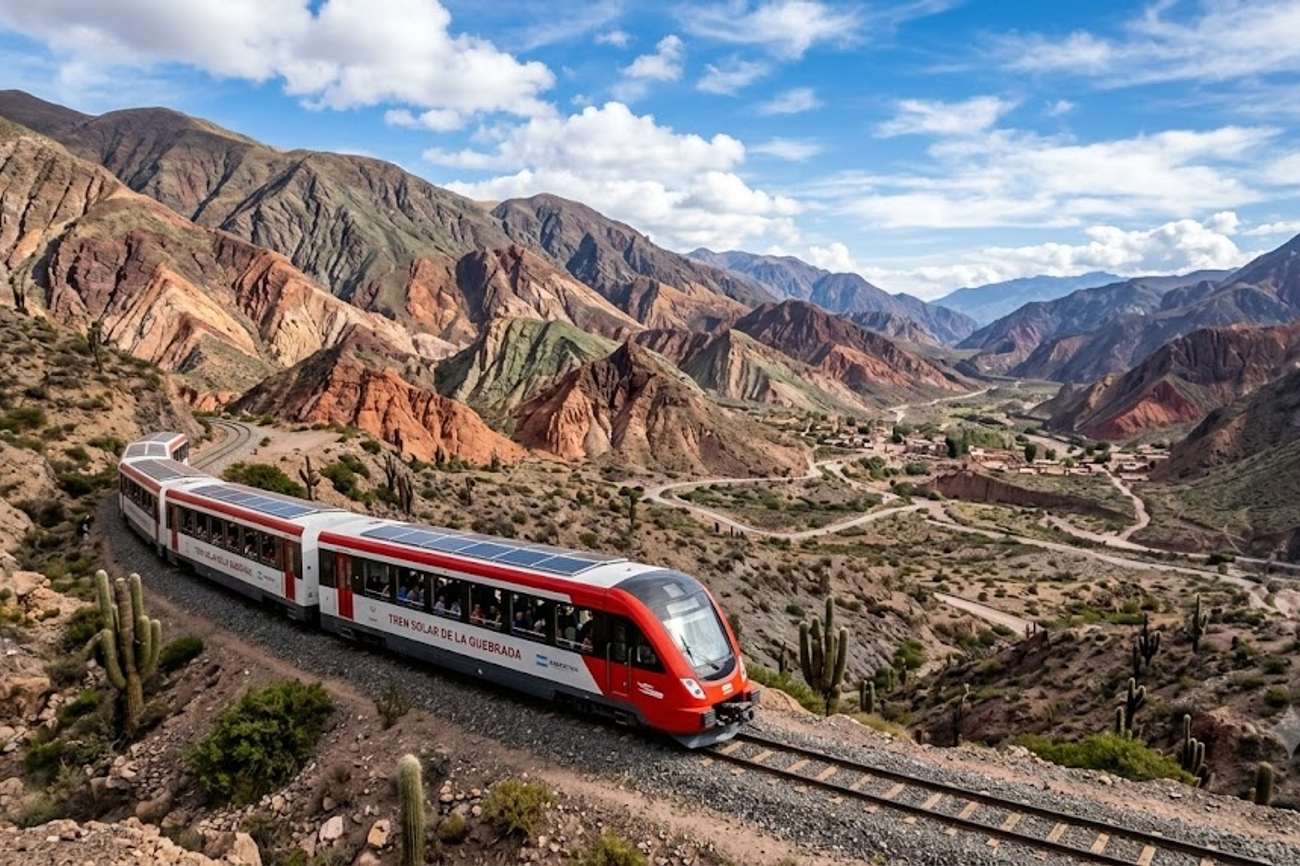
Image generated by AI
[Jujuy, Argentina] — Argentina has launched the Tren Solar de la Quebrada, a battery-electric railway powered by solar energy designed to provide carbon-neutral access to the UNESCO World Heritage site of Quebrada de Humahuaca.
The new rail service operates in the Jujuy province of northern Argentina, marking the return of passenger rail to the Andean valley after a hiatus of approximately 30 years. By utilizing lithium battery technology charged via local solar arrays, the project aims to decouple remote tourism from fossil fuel dependence while enhancing connectivity between six distinct communities along a 42-kilometre route.
The Shift to Renewable Rail
The immediate catalyst for this project is the need for sustainable infrastructure within the sensitive ecosystems of the Andes. Traditional rail electrification typically requires the installation of continuous overhead power lines, a process that is often cost-prohibitive and environmentally disruptive in rugged, mountainous terrain.
To bypass these infrastructure hurdles, the Government of Argentina has implemented a battery-electric model. The train operates as a two-car set powered by six lithium battery units. These batteries are charged using electricity generated from solar farms located within the Jujuy region, leveraging the area's high solar irradiance.
Furthermore, the system integrates regenerative braking technology. This mechanism captures kinetic energy during deceleration, converting it back into electricity and storing it within the onboard batteries to maximize operational efficiency and reduce energy waste.
Regional Impact and Market Reach
The Tren Solar de la Quebrada is positioned as a strategic asset to attract high-value, eco-conscious travelers from key South American markets. The project specifically targets visitors from Brazil, Chile, and Uruguay, who represent Argentina's most significant regional tourism demographics.
The operational specifics of the service are as follows:
| Metric | Detail |
|---|---|
| Route Length | Approximately 42 kilometres |
| Service Area | Quebrada de Humahuaca (UNESCO Site) |
| Power Source | Solar-generated electricity |
| Battery Capacity | 100–120 kilometre range |
| Infrastructure | No overhead lines required |
| Community Reach | 6 local communities connected |
By shifting the transit model, the UNESCO World Heritage Centre recognized valley can distribute tourist traffic more evenly. Rather than concentrating visitors in primary hubs, the solar train facilitates easier access to smaller, outlying heritage locations, providing increased economic visibility for rural communities along the 42-kilometre stretch.
Practical Traveler Advisory and Strategic Insights
For passengers booking trips to northern Argentina, this transition replaces traditional diesel-based transit or private vehicle rentals with a low-emission alternative.
Direct Passenger Impacts:
- Reduced Environmental Footprint: Travelers can now navigate the Andean valley without contributing to local carbon emissions or noise pollution.
- Expanded Access: The connection of six separate communities allows for more flexible itinerary planning and the ability to visit smaller cultural sites that were previously difficult to reach.
- Enhanced Sightseeing: The shift to a quiet, electric engine improves the auditory experience of the landscape, turning the transit itself into a primary tourist attraction.
- Reliability: With a battery range of 100 to 120 kilometres—more than double the current 42-kilometre route—the system provides a significant buffer for operational reliability.
The Future of Andean Transit
The success of the Tren Solar de la Quebrada serves as a scalable blueprint for other remote regions globally. The project proves that battery-electric rail is a viable alternative to diesel in areas where full grid electrification is impractical.
The introduction of solar-powered rail infrastructure in the Andean Valley aims to reduce the carbon footprint of regional travel while enhancing access to protected heritage sites. Travelers can coordinate these sustainable journeys with broader itineraries managed by the Argentina Tourism Board, ensuring a seamless integration of eco-friendly transport and cultural exploration.
As Argentina seeks to position itself as a preferred destination for natural and cultural tourism in South America, the integration of lithium-based transport—utilizing minerals often mined within the region—creates a circular economic narrative. The focus now shifts to whether this model will be expanded to other provinces or integrated into broader national transit strategies to meet international low-carbon travel trends.
The current operational capacity suggests that the infrastructure is ready for increased frequency as demand grows from the Brazilian and Chilean markets. Future phases may see the integration of more advanced energy storage systems to further extend the range and capacity of the fleet.
FAQ: Argentina Solar Train 2024
How does the train charge without overhead wires? The train uses six onboard lithium batteries that are charged at depots using electricity generated by local solar panels in the Jujuy province. It does not require a continuous electrical grid along the tracks.
Which areas are served by the Tren Solar de la Quebrada? The railway covers a 42-kilometre route through the Andes in Jujuy, connecting six different communities within the UNESCO-recognized Quebrada de Humahuaca valley.
Is the train's range sufficient for the route? Yes. The train has an operational range of 100 to 120 kilometres on a single charge, which is more than double the length of the current 42-kilometre service route.
Who is the primary target audience for this service? While open to all, the service is specifically designed to attract sustainable tourism from regional markets, particularly travelers from Brazil, Chile, and Uruguay.
A new era of Andean exploration begins where sunlight meets the rails.
Related Travel Guides
Disclaimer
This article is for informational and educational purposes only. It does not constitute legal, financial, or professional advice. While we strive to provide accurate and up-to-date information, travel policies, regulations, and conditions change rapidly. Always verify information with official sources before making travel decisions. Nomad Lawyer makes no representations about the accuracy, reliability, completeness, or suitability of the information provided. Readers should consult qualified professionals for advice specific to their circumstances. The views expressed in this article are those of the author and do not necessarily reflect the views of Nomad Lawyer.
Preeti Gunjan
Contributor & Community Manager
A passionate traveller and community builder. Preeti helps grow the Nomad Lawyer community, fostering engagement and bringing the reader experience to life.
Learn more about our team →