
The Contactless Tasman: How Australia and New Zealand Are Automating Border Clearance in 2026

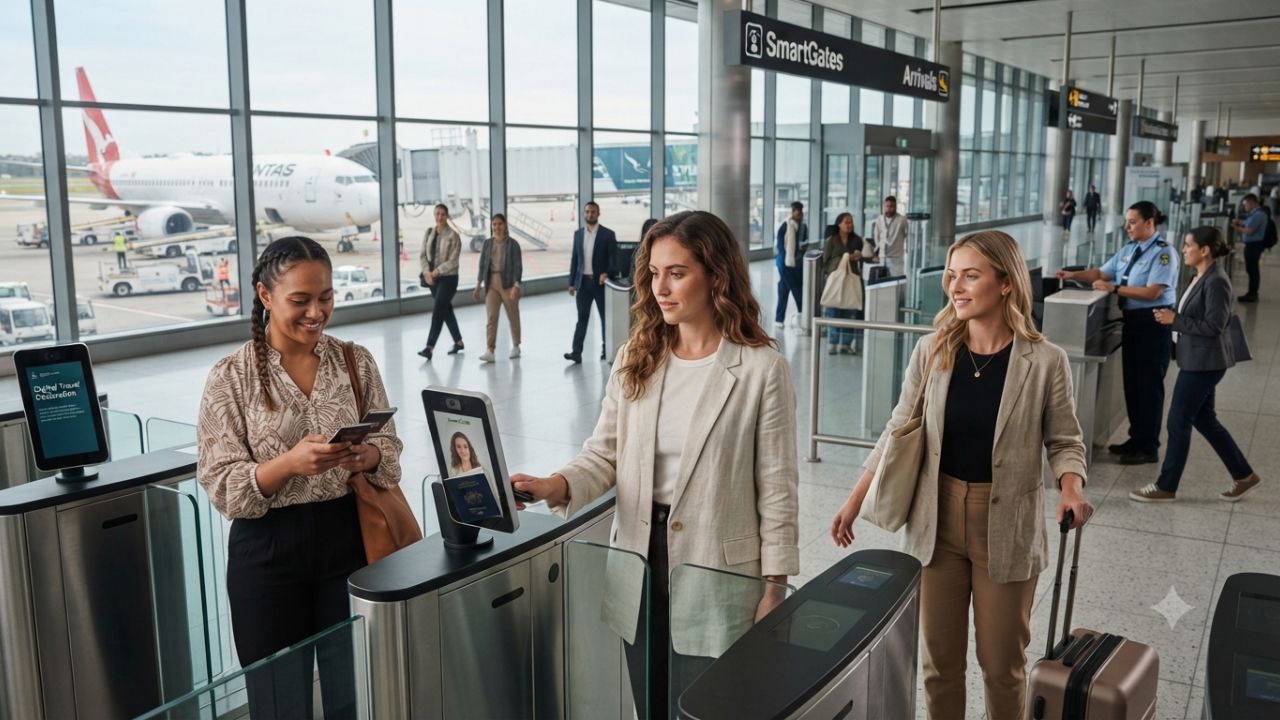
At Sydney Airport, the installation of eight upgraded SmartGate kiosks expanded passenger processing capacity by 640 travelers per hour, contributing to a 10% reduction in international queue times. The development is part of a coordinated push by the Trans-Tasman Seamless Travel Group to replace physical paper arrival cards with digital pre-declarations and biometric facial recognition across the South Pacific's busiest air corridor.
Rather than relying on manual document inspections at arrival counters, aviation gateways linking Sydney, Melbourne, Brisbane, Auckland, and Queenstown are deploying phased digital border systems. Under a pilot program expanded in May 2026, eligible Qantas passengers departing Auckland and Queenstown can complete the Australia Travel Declaration directly within the airline mobile application within 72 hours of departure, receiving a digital pass with a QR code that synchronizes with Australian Border Force screening systems upon arrival.
The Infrastructure Powering Contactless Trans-Tasman Crossings
The bilateral modernization strategy unites automated passport control gates with electronic declaration databases. In Australia, SmartGates scan the biometric chip in eligible electronic passports (ePassports) and match the traveler's live facial features against encrypted passport data.
Across the Tasman, New Zealand Customs operates biometric eGates at Auckland, Wellington, Christchurch, and Queenstown for eligible travelers aged 10 and older. Arrivals must submit the mandatory New Zealand Traveller Declaration (NZTD) before reaching border control. When the traveler taps their ePassport at the eGate, the automated system cross-references their passport identity against their pre-submitted biosecurity declarations in real time.
In September 2026, Auckland Airport commenced an extensive eGate replacement project alongside a terminal reconfiguration that reorganizes security screening and immigration control ahead of the planned integrated international-domestic passenger hub. These automated systems establish a scalable operational runway as Australia prepares for significant international visitor arrivals leading up to the Brisbane 2032 Olympic and Paralympic Games.
Performance Benchmarks Across Trans-Tasman Airport Hubs
The table below outlines the specific biometric infrastructure, processing capabilities, and digital initiatives deployed across major Australian and New Zealand gateways.
| Airport Gateway | Country | Biometric / Digital System | Operational Benchmark & Capacity | Key 2025–2026 Milestones |
|---|---|---|---|---|
| Sydney Airport (SYD) | Australia | SmartGate automated kiosks | Expanded capacity by 640 passengers / hour | Added 8 kiosks in May 2025; achieved 10% queue time drop in Q1 2025 |
| Melbourne Airport (MEL) | Australia | Australia Travel Declaration pilot | QR code pass integration with Qantas app | Joined pre-clearance trial in May 2026 on flights from AKL & ZQN |
| Brisbane Airport (BNE) | Australia | SmartGate & digital trial | Prototype testing hub for Trans-Tasman group | Served as initial launch ground for digital passenger declaration tests |
| Auckland Airport (AKL) | New Zealand | Biometric eGates & NZTD | Automated clearance for ePassports (ages 10+) | Launched eGate replacement program in Sept 2026 for integrated terminal |
| Queenstown Airport (ZQN) | New Zealand | eGates & App Pre-clearance | Alpine tourist portal for ski and adventure traffic | Integrated with Melbourne-bound Qantas digital declaration trials |
| Wellington & Christchurch | New Zealand | Customs eGates network | Regional automated entry for international flights | Continuous integration with real-time digital biosecurity screening |
Layered Security: Why Biometrics Complements Human Inspection
While digital declarations and facial recognition expedite terminal transit, immigration authorities emphasize that automation functions as a layered border filter rather than a total absence of scrutiny. Unsubstantiated commercial claims suggesting a 28% reduction in overall boarding friction remain unsupported by official government datasets.
Instead, verified improvements focus on throughput velocity and early risk assessment. By capturing travel intent, customs declarations, and customs risk profiles prior to flight departure, border agencies can direct low-risk travelers through automated kiosks in seconds. Travelers requiring biosecurity inspections, visa verification, or secondary reviews are routed to human officers without delaying general passenger flow.
Visitor Insider Tips for Crossing the Tasman
Navigating the digitized Australia-New Zealand corridor is straightforward with proper preparation.
- Complete Declarations Within the 72-Hour Window: Fill out the New Zealand Traveller Declaration (NZTD) or the Australia Travel Declaration online or through your airline application 24 to 72 hours before departure to ensure your QR pass is active upon landing.
- Verify ePassport Chip Eligibility for Children: Automated SmartGates and eGates in New Zealand accept children aged 10 and older holding valid ePassports, whereas Australian SmartGates generally require travelers to be 16 or older (or 10 to 15 when accompanied by an adult).
- Declare All Organic and Agricultural Items: Both nations enforce some of the strictest biosecurity regulations on earth. Even when using digital declaration apps, always declare hiking boots, wooden items, honey, fresh fruit, or outdoor sporting gear to avoid spot fines exceeding $400 AUD/NZD.
- Keep Offline Digital Passes on Your Mobile Device: Take a screenshot of your declaration QR code and store it in your smartphone wallet. International arrival corridors occasionally have mobile coverage dead zones before public Wi-Fi authentication.
Cultural and Biosecurity Context of Trans-Tasman Travel
The close relationship between Australia and New Zealand is anchored in shared historical ties and free movement under the Trans-Tasman Travel Arrangement. Millions of citizens cross the Tasman Sea annually for family visits, business meetings, and outdoor tourism exploring the natural heritage promoted by Tourism Australia and 100% Pure New Zealand.
However, preserving island biosecurity remains paramount. The unique flora and fauna of Australasia—from ancient kauri forests to the Great Barrier Reef—are vulnerable to invasive pests, foreign soils, and agricultural diseases. By shifting declarations from paper cards to digital databases, customs officers can analyze biosecurity risks before aircraft touch down, ensuring efficient passenger transit while maintaining rigorous protection over fragile native ecosystems.
FAQ: Trans-Tasman Travel Clearance in 2026
What is the Australia Travel Declaration pilot?
It is a digital pre-clearance initiative allowing eligible passengers flying Qantas from New Zealand to complete customs declarations on their mobile devices within 72 hours of departure.
Who can use the biometric eGates in New Zealand?
Travelers aged 10 and older holding an approved ePassport from eligible countries can use the automated eGates at Auckland, Wellington, Christchurch, and Queenstown.
Do I still need to carry a physical passport?
Yes. Biometric SmartGates and eGates require your physical ePassport to scan the biometric chip and match your live facial features.
Are physical incoming passenger cards completely gone?
Paper forms are being phased out in favor of the digital New Zealand Traveller Declaration and the Australian pilot program, though manual paper cards remain available as backups.
Automated technology across the Tasman proves that modern travel can move swiftly while keeping the world's most delicate natural sanctuaries securely protected.
Related Travel Guides
Disclaimer
This article is for informational and educational purposes only. It does not constitute legal, financial, or professional advice. While we strive to provide accurate and up-to-date information, travel policies, regulations, and conditions change rapidly. Always verify information with official sources before making travel decisions. Nomad Lawyer makes no representations about the accuracy, reliability, completeness, or suitability of the information provided. Readers should consult qualified professionals for advice specific to their circumstances. The views expressed in this article are those of the author and do not necessarily reflect the views of Nomad Lawyer.
Raushan Kumar
Founder & Lead Developer
Full-stack developer with 11+ years of experience and a passionate traveller. Raushan built Nomad Lawyer from the ground up with a vision to create the best travel and law experience on the web.
Learn more about our team →