
Australia Reinvents Airport Arrivals: Touchless Biometric Corridors, 12 Swing Gates, and Traveler Guide 2026

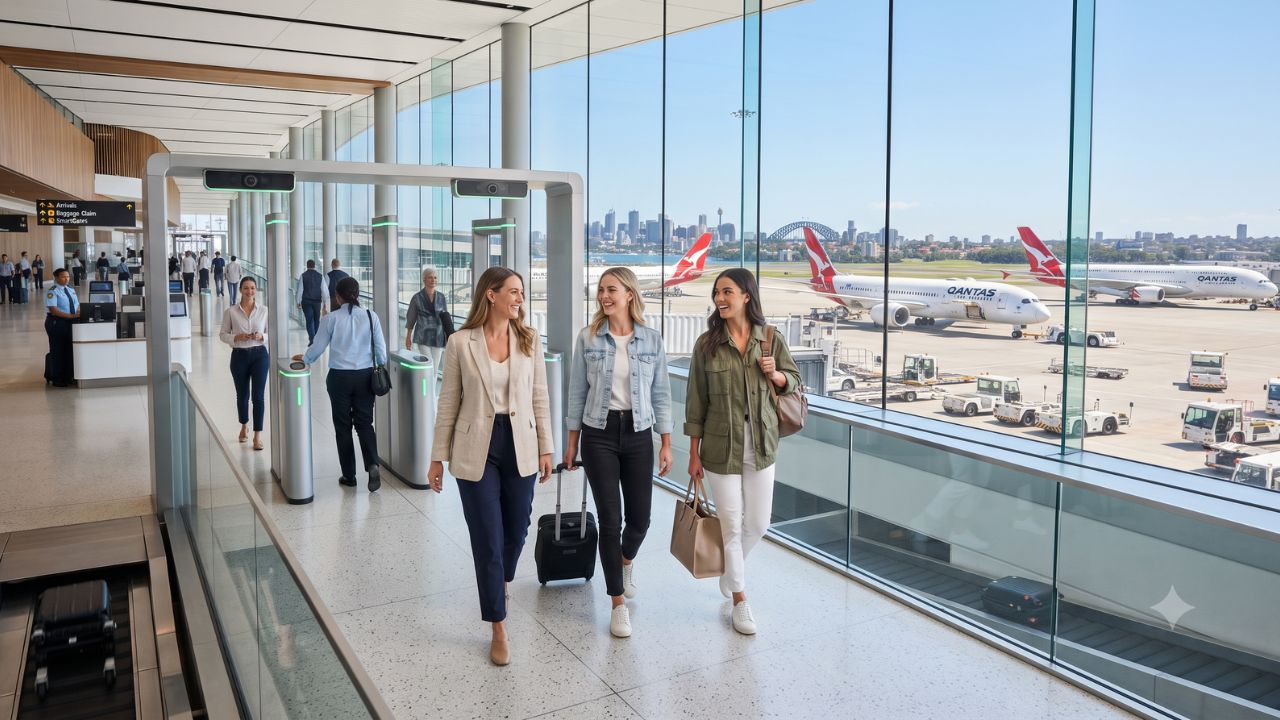
Paper incoming passenger cards and physical passport inserts are officially being retired across Australia in favor of high-speed facial recognition corridors that clear verified international travelers while they walk. Under the nationwide rollout of the Australia Travel Declaration (ATD) system managed by the Australian Border Force, arriving visitors submit health, customs, and biosecurity declarations securely via digital webforms or airline apps prior to departure. At major gateways, high-speed optical sensors match travelers' live facial geometry against stored digital passports and flight manifests in seconds, allowing machine-readable passport holders aged seven and older to stroll through automated portal barriers without stopping for ticket validation or manual document handling.
Multi-Billion-Dollar Gateway Transformations: Sydney and Melbourne
The modernization of border technology is matched by massive, privately funded capital expenditure programs reshaping Australia's primary international aviation gateways. At Sydney Airport, federal approvals granted by Infrastructure Minister Catherine King have set in motion the Eastern Expansion Program (EEP) Package 1. Developed collaboratively with Multiplex, Grimshaw Architects, and Mott MacDonald, the program resolves the historical physical divide between international Terminal 1 (T1) on the western airfield and domestic Terminals 2 and 3 (T2/T3) on the eastern apron.
The centerpiece of Sydney's reconfiguration is a series of 12 flexible "swing gates." Engineered with automated vertical passenger segregation, these gates seamlessly transition between domestic and international flights to match peak arrival banks. During early morning international arrivals from North America and Asia, the gates channel disembarking travelers directly into secure border corridors, before automatically reconfiguring to accommodate heavy domestic departure banks by midday.
In Victoria, Melbourne Airport is expanding its footprint as Australia’s largest 24-hour, curfew-free aviation hub under the leadership of Chief Executive Officer Lorie Argus. The completion of the multi-level T123 Transport Hub and elevated roadway system cleared the ground-level forecourt in front of Terminal 2, enabling direct terminal expansion into the vacated space without interrupting active operations.
Airside, Melbourne is adding five new international aircraft gates capable of accommodating either twin-aisle widebodies or narrowbody airliners along Pier D on a single concourse level. Below the departure floor, German logistics specialist Beumer Group is installing an automated tote-based Individual Carrier System (ICS) and an Early Bag Storage (EBS) facility. This technology allows long-haul travelers connecting from regional points to check bags up to 24 hours prior to departure, freeing departure halls from congestion while robotic cranes retrieve luggage for flight loading.
Regional Decentralization Across Queensland: Brisbane and Gold Coast
Capital works across Queensland are transforming northern gateways ahead of the Brisbane 2032 Olympic and Paralympic Games, enabling overseas travelers to bypass southern hubs entirely:
- Brisbane Airport (Future BNE): Under Chief Executive Officer Gert-Jan de Graaff, Brisbane Airport Corporation is executing the comprehensive Future BNE overhaul. Primary security screening and passport control checkpoints are moving to a naturally illuminated Level 4 mezzanine atrium. The expanded floorplate accommodates Computed Tomography (CT) 3D security scanners and Amadeus cloud-connected bag drops, eliminating the need to unpack liquids or laptops. In the baggage hall, Alstef is deploying an energy-efficient tote conveyor system that idles motors during off-peak periods.
- Gold Coast Airport (Southern Terminal Expansion): Managed by Queensland Airports Limited and project managed by RCP Australia, the three-level Southern Terminal Expansion doubled the airport’s physical footprint. Featuring flexible swing gates, glass aerobridges, and dedicated biosecurity processing halls, the gateway processes direct long-haul flights from Singapore, Japan, and New Zealand without intermediate stops.
What Sets Australia’s New Transit Experience Apart
Unlike legacy airports where travelers navigate separate queues for security, check-in, customs, and baggage claim, Australia's updated terminals are structured around frictionless, continuous flow. The integration of advance digital declarations with on-the-move biometric identification compresses arrival processing times from 45 minutes down to mere minutes.
Furthermore, airport expansions across Australia operate under strict commercial discipline and environmental standards. Major facilities are funded via private commercial loans and sustainability-linked financing rather than taxpayer subsidies. Terminals incorporate rooftop solar arrays, all-electric airside ground support fleets, low-carbon concrete mixes, and repurposed local stone terrazzo flooring, ensuring airport growth directly aligns with national net-zero benchmarks.
Visitor Insider Tips: Navigating Australian Gateways Like a Local
- Complete the Digital Australia Travel Declaration (ATD) Early: Complete your digital ATD form online or via your carrier app within 72 hours of departure. Submitting accurate customs declarations in advance generates a digital QR code that expedites border clearance upon arrival.
- Declare Strict Biosecurity Items Without Hesitation: Australia enforces the strictest biosecurity regulations in the world to protect its agricultural ecosystems. Always declare fresh fruit, meat products, seeds, wooden artifacts, or soiled outdoor hiking boots on your digital ATD. Declared items will be inspected quickly by biosecurity officers without penalties, whereas undeclared items risk heavy on-the-spot fines.
- Take the Direct Airport Train Lines into City Centers: Avoid rush-hour traffic jams on airport motorways. In Sydney, the Airport Link train delivers passengers from T1 International or T2/T3 Domestic to Central Station in under 15 minutes. In Brisbane, the Airtrain connects directly to South Bank and Fortitude Valley in 20 minutes.
- Use Contactless Credit Cards for All Ground Transit: You do not need to buy paper transit tickets. Public trains, ferries, and light rail in Sydney accept contactless credit cards, debit cards, and smartphone wallets (Opal system), while Melbourne’s SkyBus and metropolitan trams offer tap-and-go contactless payment.
- Utilize Early Bag Storage for Long Layovers: If you arrive in Melbourne or Brisbane several hours before an international flight, deposit your checked luggage at the automated self-bag-drop early. Take advantage of your free hours to explore nearby urban dining precincts unencumbered by baggage.
Cultural and Environmental Context: Biosecurity and Community Care
Preserving Australia’s fragile ecosystems and ancient indigenous heritage is central to modern border operations promoted by Tourism Australia. The continent’s strict biosecurity perimeter protects endemic wildlife, pristine coral reefs like the Great Barrier Reef, and vast agricultural heartlands from invasive pests and exotic diseases.
Airport redesigns increasingly celebrate First Nations cultural storytelling. Terminal concourses feature permanent art installations created by local Aboriginal and Torres Strait Islander artists, honoring traditional custodians of the land such as the Gadigal people of the Eora Nation in Sydney and the Wurundjeri people of the Kulin Nation in Melbourne. By utilizing public rail connections, respecting sacred natural sites, and adhering strictly to biosecurity inspection laws, travelers actively support Australia’s long-term conservation and community stewardship initiatives.
FAQ: Arriving in Australia 2026
What is the Australia Travel Declaration (ATD)?
The ATD is a secure digital declaration system replacing paper incoming passenger cards, allowing travelers to submit customs, health, and biosecurity information online before landing.
Who can use touchless biometric SmartGates at Australian airports?
Holders of machine-readable e-passports aged seven and older from eligible countries can clear automated facial biometric corridors without manual document inspection.
Do I still need an Electronic Travel Authority (ETA) or visa?
Yes. All international visitors (excluding Australian and New Zealand citizens) must obtain a valid visa or Electronic Travel Authority (ETA) prior to boarding their flight to Australia.
How do swing gates improve airport operations?
Swing gates alternate dynamically between domestic and international flights, optimizing terminal capacity and reducing boarding delays during morning and evening rush banks.
From seamless touchless arrivals to sustainable terminal architecture, Australia’s reimagined gateways open a fast, welcoming portal to the wonders of the southern continent.
Related Travel Guides
Disclaimer
This article is for informational and educational purposes only. It does not constitute legal, financial, or professional advice. While we strive to provide accurate and up-to-date information, travel policies, regulations, and conditions change rapidly. Always verify information with official sources before making travel decisions. Nomad Lawyer makes no representations about the accuracy, reliability, completeness, or suitability of the information provided. Readers should consult qualified professionals for advice specific to their circumstances. The views expressed in this article are those of the author and do not necessarily reflect the views of Nomad Lawyer.
Kunal K Choudhary
Co-Founder & Contributor
A passionate traveller and tech enthusiast. Kunal contributes to the vision and growth of Nomad Lawyer, bringing fresh perspectives and driving the community forward.
Learn more about our team →