
Five Dead After Amazon Prime Air Boeing 767 Overshoots Runway at Miami International Airport 2026
At least five people were killed and five others injured after a Boeing 767 cargo jet operating for Amazon overshot a runway at Miami International Airport, crashing into vehicles on Northwest 42nd Avenue.

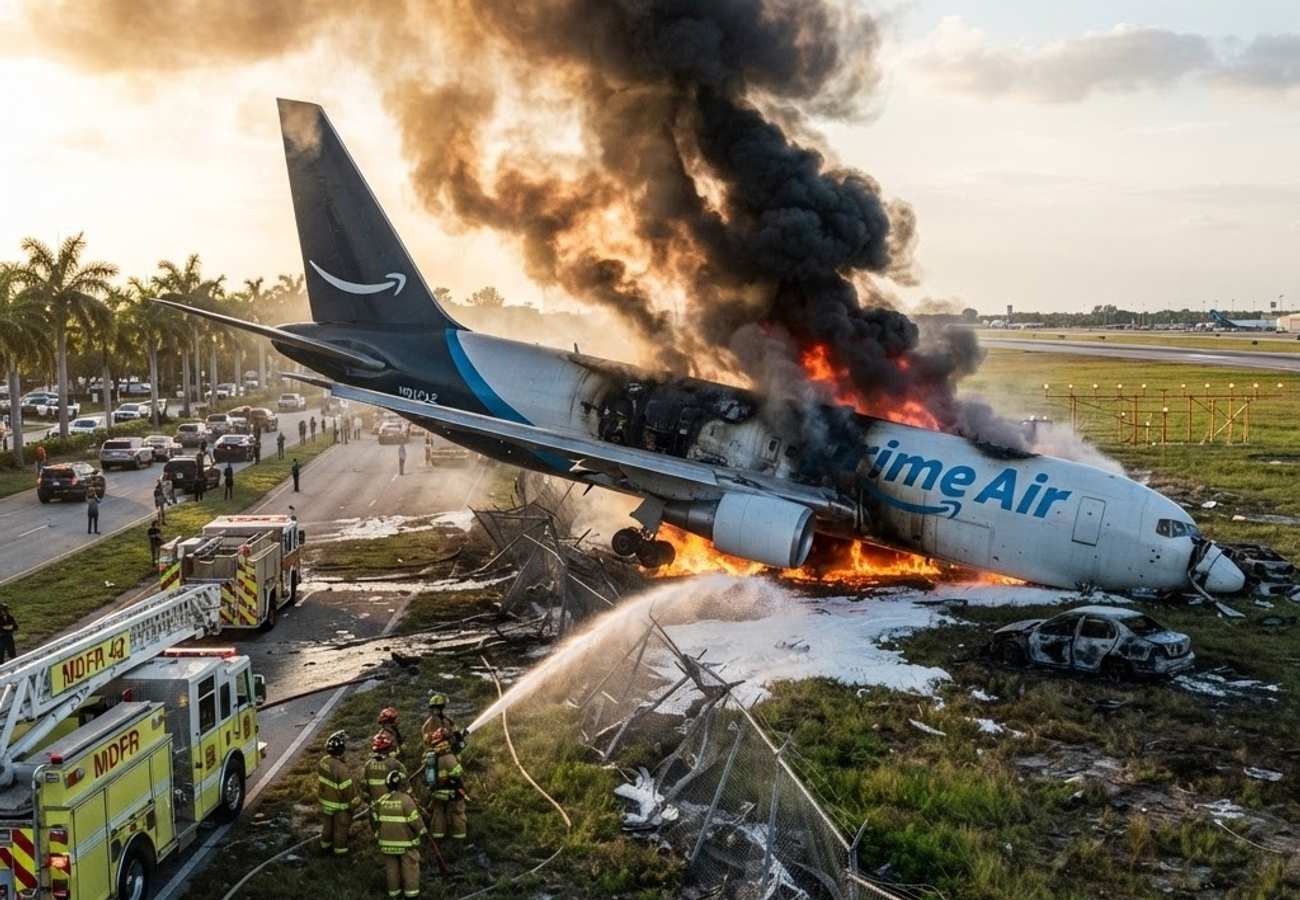
Image generated by AI
A catastrophic runway overrun at Miami International Airport has left at least five people dead and several others hospitalized after a heavy cargo jet plowed through airport boundaries and struck multiple vehicles.
The incident occurred on Sunday, September 6, 2026, when a widebody freighter failed to stop during its landing sequence, crossing a grassy perimeter and colliding with traffic on a public roadway before erupting in flames.
Cargo Flight from Puerto Rico Ends in Fiery Collision
The aircraft involved has been identified as a Boeing 767-300. It was operating as a Prime Air cargo service, arriving in Miami from San Juan, Puerto Rico. While the aircraft carried Amazon branding, it was being operated on behalf of the e-commerce giant by 21 Air, a North Carolina-based cargo carrier specializing in freighter services across the Americas.
The aircraft touched down shortly after 2 p.m. local time. However, it failed to decelerate within the usable length of the diagonal runway. The jet subsequently breached the airport's perimeter, crossing into the surrounding area where it struck vehicles and came to a halt tipped forward on its nose with the landing gear collapsed.
Witness reports and visual evidence show a scene of intense devastation, with thick black smoke rising over the airfield as fire crews battled blazes fueled by jet fuel. While the pilots survived the impact and were taken for medical evaluation, the majority of the casualties were ground-based.
Casualty Report and Emergency Response
The most severe impact occurred near the 2100 block of Northwest 42nd Avenue, a road running along the eastern boundary of Miami International Airport. This area is a high-traffic zone used by commercial vehicles, airport staff, and local businesses.
The human toll of the accident is significant:
- Fatalities: At least five people were killed upon impact.
- Critical Injuries: Three individuals were transported to trauma centers in critical condition.
- Minor Injuries: Two people were taken to local hospitals with less severe injuries.
Rescue teams utilized specialized extraction equipment to recover victims trapped within crushed vehicles. Images from the site confirm that at least one vehicle was pinned beneath the aircraft's structure, while others were incinerated alongside the fuselage.
Operational Chaos at Miami International Airport
As one of the primary gateways for the Americas, the disruption at Miami International Airport (MIA) had immediate ripple effects across both passenger and cargo networks.
The airport triggered its emergency response plan, leading to a temporary halt in aircraft movements. While other runways were gradually reopened, the specific diagonal runway involved in the crash remained closed for an extended period. This caused:
- Flight Disruptions: Widespread delays and scattered cancellations, particularly for widebody aircraft that require longer runways.
- Air Traffic Impact: Multiple flights were diverted or placed into holding patterns.
- Ground Gridlock: Sections of Northwest 42nd Avenue were shut down, forcing the rerouting of airport-bound traffic and adjustments to public transit stops.
Investigation into Braking and Landing Performance
Federal investigators and aviation safety experts are now focusing on the physics of the landing. A primary point of inquiry is the "touchdown point"—whether the Boeing 767 landed too far down the runway or maintained a speed too high for the available stopping distance.
This is particularly relevant given that the diagonal runway involved is shorter than the primary east-west strips at MIA. Investigators are analyzing several variables:
- Environmental Factors: While weather was typical for South Florida, experts are checking for runway contamination, such as rubber buildup or standing water.
- Technical Data: The flight data recorder (FDR) and cockpit voice recorder (CVR) are being analyzed to reconstruct the approach profile and verify the deployment of spoilers and thrust reversers.
- Maintenance History: The aircraft's braking systems are under scrutiny to determine if mechanical failure contributed to the overrun.
Safety Implications for Urban Airport Hubs
This accident highlights the inherent risks of "mixed-use" aviation hubs where high-volume cargo operations share infrastructure with passenger traffic. The rapid expansion of Prime Air to meet e-commerce demands has increased the frequency of heavy freighter movements on tight schedules.
Furthermore, the crash underscores the danger of encroaching urban development. As warehouses and roads move closer to runway ends, the "buffer zone" for emergencies shrinks. In this instance, the proximity of Northwest 42nd Avenue turned a technical landing failure into a mass-casualty event.
Incident Summary: Amazon Prime Air Overrun
| Detail | Specification |
|---|---|
| Date | September 6, 2026 |
| Time | Shortly after 2:00 PM local time |
| Aircraft Model | Boeing 767-300 |
| Operator | 21 Air (on behalf of Amazon Prime Air) |
| Route | San Juan, Puerto Rico $\rightarrow$ Miami, Florida |
| Location of Impact | NW 42nd Avenue (2100 block) |
| Confirmed Fatalities | 5 |
| Confirmed Injuries | 5 (3 Critical) |
Key Takeaways
- Ground Impact: The majority of the five deaths occurred among people in vehicles on the road, not on the aircraft.
- Infrastructure Risk: The crash occurred on a shorter diagonal runway, raising questions about safety margins for heavy freighters.
- Network Disruption: The incident caused significant delays at one of the US's busiest international hubs.
- Investigation Focus: Authorities are examining the touchdown point and braking efficiency of the Boeing 767.
FAQ
Who was operating the Amazon plane? The aircraft was operated by 21 Air, a North Carolina-based cargo carrier, under contract for Amazon's Prime Air service.
Were the pilots injured? The pilots survived the crash and were taken for medical evaluation.
Which part of the airport was affected? The crash occurred at the end of a diagonal runway, impacting the eastern side of the airport near Northwest 42nd Avenue.
The investigation continues as authorities work to match crew lists with medical examiner records.
Related Travel Guides
Disclaimer
This article is for informational and educational purposes only. It does not constitute legal, financial, or professional advice. While we strive to provide accurate and up-to-date information, travel policies, regulations, and conditions change rapidly. Always verify information with official sources before making travel decisions. Nomad Lawyer makes no representations about the accuracy, reliability, completeness, or suitability of the information provided. Readers should consult qualified professionals for advice specific to their circumstances. The views expressed in this article are those of the author and do not necessarily reflect the views of Nomad Lawyer.
Kunal K Choudhary
Co-Founder & Contributor
A passionate traveller and tech enthusiast. Kunal contributes to the vision and growth of Nomad Lawyer, bringing fresh perspectives and driving the community forward.
Learn more about our team →