
Over 4,900 Flights Delayed Across Asia: Transit Survival Guide for Taipei, New Delhi, and Shenzhen Hubs
Severe weather, regional flooding, and transfer bottlenecks trigger 4,900 flight delays and 354 cancellations across major Asian aviation hubs. Here is how travelers can protect their itineraries.

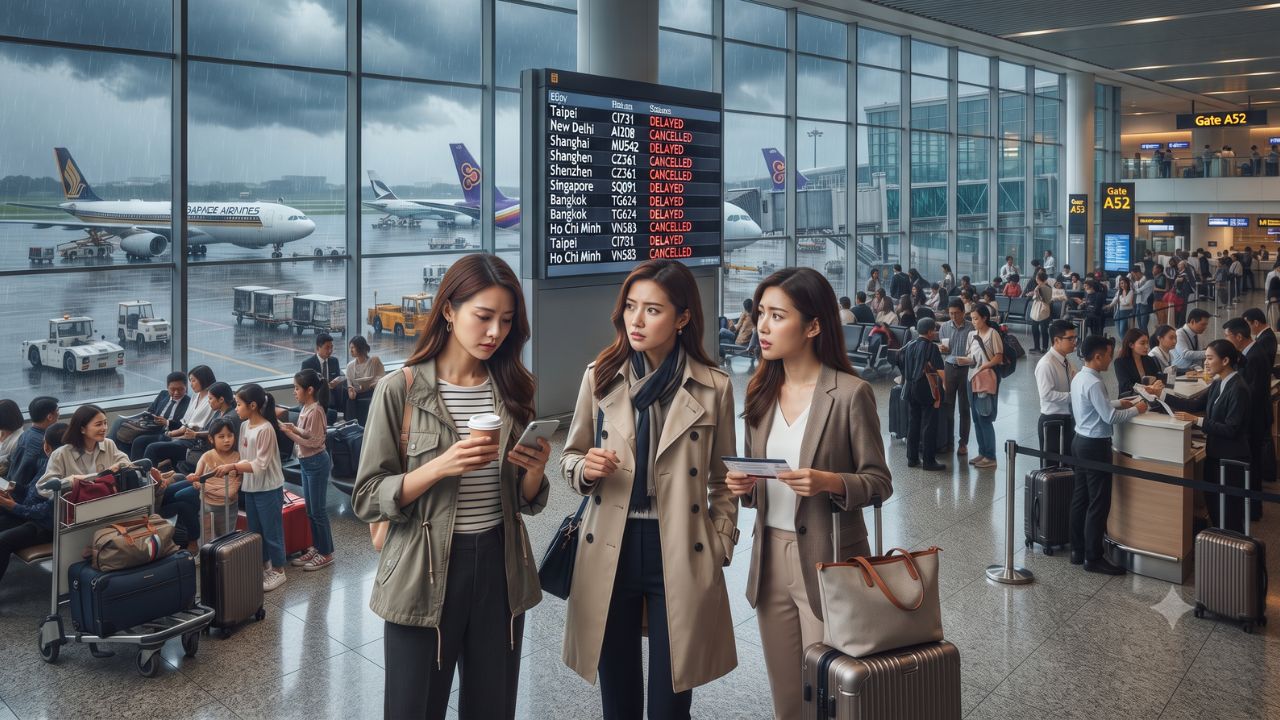
Philippines AirAsia recorded an extraordinary 67% operational delay rate while Taiwan Taoyuan logged 304 delayed flights in a single day, as severe monsoon storms, urban flooding around Ho Chi Minh City, and compound transfer bottlenecks triggered 4,900 flight delays and 354 cancellations across Asian airspace. From southern China to India and the Gulf, regional airlines and terminal operators are grappling with displaced flight crews, delayed aircraft rotations, and crowded transit lounges across primary East-West flight corridors.
Compounding Meteorology and Airspace Gridlock Across Key Hubs
The widespread disruption stems from three converging operational challenges across the Asia-Pacific region: concentrated convective weather fronts across the South China Sea, localized ground access disruptions in Vietnam, and cascading schedule friction across high-volume transit nodes.
In southern and eastern China, heavy rain and reduced runway visibility triggered massive delays. Shenzhen Bao'an International Airport topped all regional gateways with 386 flight delays and 5 cancellations. Shanghai Pudong International Airport recorded 337 delays and 7 cancellations, while Shanghai Hongqiao posted 154 delays alongside 17 cancellations. In western and central China, Kunming Changshui International logged 98 delays and 27 cancellations, Wuhan Tianhe posted 57 delays and 22 cancellations, and Xi'an Xianyang recorded 108 delays with 11 cancellations. Beijing's dual gateways absorbed significant friction, with Beijing Daxing recording 120 delays (6 cancellations) and Beijing Capital logging 76 delays (12 cancellations).
Across the Taiwan Strait, Taiwan Taoyuan International Airport absorbed 304 delayed flights and 3 cancellations, making it one of the most heavily backlogged island hubs in East Asia. In Vietnam, heavy surface runoff and regional flooding around Ho Chi Minh City slowed airport access routes and tarmac operations at Tan Son Nhat International Airport, resulting in 336 flight delays and 4 cancellations.
Southeast Asian transfer hubs saw extensive schedule slippage. Bangkok Suvarnabhumi recorded 254 delays and 6 cancellations, while Jakarta Soekarno-Hatta logged 264 delays and 17 cancellations. Regional gateway Singapore Changi Airport logged 184 flight delays and 2 cancellations as late-arriving aircraft from China and Vietnam forced gate reassignments and compressed turnaround times.
In South Asia, Indira Gandhi International Airport in New Delhi recorded 149 delays and 12 cancellations, while Mumbai Chhatrapati Shivaji Maharaj International logged 135 delays and 7 cancellations. Middle Eastern connecting hubs also felt the ripple effects: Dubai International recorded 189 delays and 26 cancellations, while Tel Aviv Ben Gurion posted 159 delays and 10 cancellations.
Airline Disruption Patterns and Fleet Impact
Carrier operational data reveals sharp differences between absolute disruption volume and proportional schedule degradation:
- China Eastern Airlines: Absorbed the largest absolute disruption volume across Asia, logging 395 delays (15% of total schedule) and 84 cancellations (3%).
- Shenzhen Airlines: Experienced 218 flight delays (28% of operations) and 10 cancellations (1%).
- Vietnam Airlines: Logged 162 delays, representing 41% of its scheduled domestic and international services, alongside 3 cancellations.
- Philippines AirAsia: Suffered the highest delay ratio in the entire region, with 46 delayed flights representing 67% of its total schedule, plus 2 cancellations.
- IndiGo: Logged 221 delays (10% of operations) and 3 cancellations, while SpiceJet recorded 22 delays (30% of operations) and 7 cancellations (9%).
- flydubai & Batik Air: flydubai recorded 79 delays (25%) and 11 cancellations (3%), while Batik Air logged 77 delays (25%) and 20 cancellations (6%).
Major Asian Airport Disruption Comparison
| Airport / Hub | IATA Code | Flight Delays | Flight Cancellations | Primary Disruption Factor |
|---|---|---|---|---|
| Shenzhen Bao'an | SZX | 386 | 5 | Thunderstorms and airspace flow control |
| Tan Son Nhat (Ho Chi Minh) | SGN | 336 | 4 | Severe surface flooding and runway holds |
| Shanghai Pudong | PVG | 337 | 7 | Low visibility and inbound slot delays |
| Taiwan Taoyuan | TPE | 304 | 3 | Regional weather fronts and airspace congestion |
| Jakarta Soekarno-Hatta | CGK | 264 | 17 | Severe convective activity and late crew arrivals |
| Bangkok Suvarnabhumi | BKK | 254 | 6 | Thunderstorm ground holds and gate congestion |
| Dubai International | DXB | 189 | 26 | Schedule realignments and network rotation delays |
| Singapore Changi | SIN | 184 | 2 | Late incoming long-haul and regional feeder flights |
| New Delhi Indira Gandhi | DEL | 149 | 12 | Northern airway congestion and weather holds |
| Mumbai CSMIA | BOM | 135 | 7 | Runway intersection holds and regional weather |
| Beijing Daxing | PKX | 120 | 6 | Flow management across northern domestic routes |
| Tokyo Narita | NRT | 111 | 3 | Cross-Pacific connecting rotation delays |
Visitor Insider Tips
- Managing Tight Connections in Changi and Bangkok: If connecting through Singapore Changi or Bangkok Suvarnabhumi during afternoon thunderstorm banks (2:00 PM to 6:00 PM), maintain a minimum connection window of 2.5 hours. For tight transfers under 75 minutes, approach your inbound flight attendants 30 minutes before descent to request priority deplaning access.
- Ho Chi Minh City Airport Access Strategy: When flying out of Tan Son Nhat during heavy rain periods, leave your hotel in District 1 or District 3 at least 4.5 hours before departure. Truong Son and Cong Hoa access roads frequently experience knee-deep surface flooding during tropical downpours, bringing road traffic to a complete standstill. Use the motorbike ride-hailing services or elevated pedestrian overpasses where available.
- Delhi Terminal Transfer Protocols: Indira Gandhi International Airport operates domestic and international services across separated terminals (T1, T2, and T3). Allow at least 45 minutes to transfer between T1 and T3 via the official shuttle bus service or Delhi Metro Airport Express, especially when flights are delayed into the evening rush.
- Active Rebooking via Airline Mobile Applications: Do not wait in customer service queues at crowded terminal desks when a flight is delayed past your connection departure. Open the operating carrier's mobile application directly over airport Wi-Fi to select alternate automated rebooking slots before seat inventory is exhausted by desk agents.
Cultural and Environmental Context
Rapidly urbanizing aviation hubs across Asia face mounting environmental challenges as intense seasonal monsoon cycles collide with concrete terminal expansion. In Ho Chi Minh City, rapid urban land development around Tan Son Nhat has reduced natural drainage basins, making perimeter roadways prone to flash flooding during intense rainfall events.
Simultaneously, Asian civil aviation authorities are implementing next-generation Collaborative Decision Making (A-CDM) systems to minimize tarmac engine idling. By holding aircraft at departure gates until takeoff slots are guaranteed rather than queuing on taxiways with running engines, airports across Singapore, Taipei, and Shenzhen are reducing aviation emissions and fuel burn during severe weather ground delays.
FAQ: Navigating Asian Airport Disruptions in 2026
What caused the widespread flight disruptions across Asian airports?
Severe convective thunderstorms across southern China and Southeast Asia, localized flooding around Tan Son Nhat Airport in Vietnam, and cascading crew and aircraft rotation delays across high-volume transit gateways.
Which airline experienced the highest percentage of flight delays?
Philippines AirAsia recorded the highest proportion of delays, with 67% of its total scheduled operations (46 flights) running behind schedule.
How can travelers avoid getting stranded during regional transit?
Book itineraries with generous transfer buffers (at least 2.5 hours), travel on early morning flights, and monitor real-time flight tracking applications before heading to the departure airport.
Are passengers entitled to hotel accommodations during weather delays in Asia?
Under most Asian regional aviation frameworks, weather-induced delays are classified as extraordinary circumstances, meaning airlines are not legally required to provide complimentary hotels, making comprehensive travel insurance essential.
Strategic layover planning and early morning departures remain the seasoned traveler's best defense against tropical weather delays.
Related Travel Guides
- Singapore Changi Airport Transit Guide: Terminal Transfers, Jewel, and Lounges
- Delhi Airport Navigation Playbook: Seamless Terminal Transfers and Metro Access
- Southeast Asia Rainy Season Travel Guide: Timing Itineraries and Monsoon Packing
- How to Handle Missed Flight Connections and Baggage Delays Across Asia
Disclaimer
This article is for informational and educational purposes only. It does not constitute legal, financial, or professional advice. While we strive to provide accurate and up-to-date information, travel policies, regulations, and conditions change rapidly. Always verify information with official sources before making travel decisions. Nomad Lawyer makes no representations about the accuracy, reliability, completeness, or suitability of the information provided. Readers should consult qualified professionals for advice specific to their circumstances. The views expressed in this article are those of the author and do not necessarily reflect the views of Nomad Lawyer.
Raushan Kumar
Founder & Lead Developer
Full-stack developer with 11+ years of experience and a passionate traveller. Raushan built Nomad Lawyer from the ground up with a vision to create the best travel and law experience on the web.
Learn more about our team →