
Asia Air Travel Disrupted with 4,160 Delays and 248 Cancellations Across Tokyo, Guangzhou, and Bengaluru

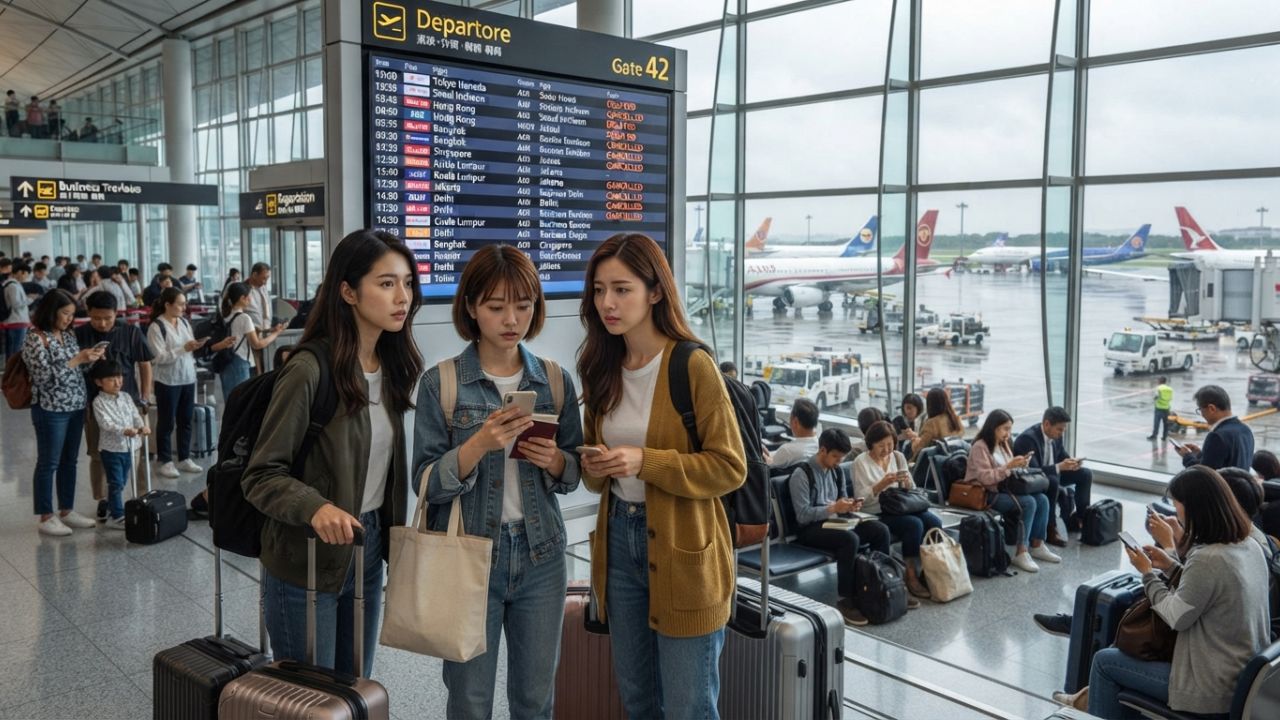
With Tokyo Haneda logging 495 delayed departures and Guangzhou Baiyun recording 450 schedule setbacks within hours, air traffic across the Asia-Pacific region encountered unprecedented pressure on 22–23 September 2026. Telemetry captured across major international hubs recorded a massive 4,160 flight delays and 248 cancellations, leaving thousands of business travelers, tourists, and connecting passengers stranded in crowded departure concourses.
A confluence of post-typhoon airspace restrictions, severe terminal congestion, aircraft rotation bottlenecks, and regional monsoon weather combined to strain major aviation corridors. While China Eastern absorbed 347 flight delays and Indonesian low-cost operator Batik Air recorded 21 cancellations, Indian regional carrier SpiceJet registered the highest overall delay rate in Asia at 46%. From East Asia's megalopolises to Southeast Asian island gateways and South Asian tech capitals, travelers faced protracted holding patterns and missed transfer windows.
The Epicenter of Disruption: Major Airport Breakdown
Aviation records compiled on 22 September 2026 at 3:31 pm ET (23 September 2026 at 2:31 am Indochina Time) reveal that schedule degradation hit major East and Southeast Asian transit centers hardest:
In Japan, Tokyo International Airport (Haneda) posted the highest delay total of any airport in the region, registering 495 delayed flights and four cancellations, while Tokyo Narita (NRT) recorded 169 delays and two cancellations, creating severe hurdles for long-haul transpacific connections monitored by the Japan National Tourism Organization.
Across mainland China, primary commercial hubs suffered heavy schedule disruptions. Guangzhou Baiyun International Airport (CAN) logged 450 delays and three cancellations. Shanghai Pudong (PVG) followed with 196 delays and 13 cancellations, while Beijing Capital (PEK) recorded 125 delays and 13 cancellations. Secondary and regional Chinese airports were also heavily impacted, including Chongqing Jiangbei with 123 delays and nine cancellations, Chengdu Tianfu with 109 delays and eight cancellations, Xi'an Xianyang with 95 delays and three cancellations, Kunming Changshui with 84 delays and nine cancellations, Xiamen Gaoqi with 76 delays and four cancellations, and Chengdu Shuangliu with 65 delays and nine cancellations.
Southeast Asian transit points absorbed widespread schedule shock. Tan Son Nhat International Airport in Ho Chi Minh City, Vietnam, documented 268 delays and four cancellations. In Malaysia, Kuala Lumpur International Airport (KUL) registered 197 delays and three cancellations. Hong Kong International Airport (HKG) recorded 145 delays and four cancellations. In Indonesia, Jakarta's Soekarno-Hatta International Airport (CGK) posted the highest single cancellation tally in Asia with 28 canceled flights and 147 delays, while Bali's Ngurah Rai Airport logged 62 delays and five cancellations, Juanda in Surabaya saw 36 delays and seven cancellations, and Sultan Hasanuddin in Makassar recorded 27 delays and nine cancellations.
In India, major commercial gateways handled significant schedule pressure overseen by the Directorate General of Civil Aviation (DGCA). Indira Gandhi International Airport in Delhi recorded 122 delays and 10 cancellations, Bengaluru Kempegowda International Airport (BLR) logged 59 delays and three cancellations, and Mumbai Chhatrapati Shivaji Maharaj International Airport (BOM) reported 42 delays and nine cancellations.
Airline Operations Under Pressure: Delays and Groundings
The ripple effect of aircraft rotation delays spread across full-service flag carriers and regional budget airlines alike:
China Eastern Airlines led all regional carriers in total delayed operations, recording 347 delayed flights (11% delay rate) and 21 cancellations. China Southern Airlines followed with 281 delays (12% delay rate) and two cancellations, while flag carrier Air China recorded 124 delays (6% rate) and 21 cancellations. Shenzhen Airlines logged 116 delays (15% rate) and six cancellations, with Sichuan Airlines adding 100 delays (13% rate) and eight cancellations.
Southeast Asian airlines reported elevated operational strain. Vietnam Airlines registered 106 delays (29% delay rate) and four cancellations. AirAsia recorded 70 delays (15% rate) and seven cancellations. In Indonesia, Batik Air logged 44 delays (14% rate) and 21 cancellations (6% cancellation rate), while Citilink documented 33 delays (12% rate) and 15 cancellations (5% cancellation rate). In the Philippines, PAL Express posted 39 delays (25% rate) and three cancellations.
In East Asia, Cathay Pacific recorded 74 delays (17% rate) and four cancellations, while Japanese regional operator ANA Wings registered 72 delays (20% rate) and three cancellations.
In India, SpiceJet registered an acute 46% delay rate across 29 flights alongside three cancellations. Middle Eastern carriers operating Asian sectors were also caught in the cascade, with Saudia recording 73 delays (13% rate) and nine cancellations, FlyDubai logging 29 delays (10% rate) and three cancellations, and Air Arabia noting 26 delays (11% rate) and four cancellations.
Visitor Insider Tips: Navigating Asia Transit Disruptions
- Build a Three-Hour Buffer for Mega-Hub Transfers: When booking connecting flights through sprawling hubs like Tokyo Haneda, Guangzhou Baiyun, Shanghai Pudong, or Delhi Indira Gandhi, ensure your scheduled layover is at least three hours to prevent missing international connections during gate holds.
- Monitor Aircraft Inbound Rotations via Live Tracking Apps: Use live flight tracking tools to trace the physical inbound aircraft assigned to your flight number. If the incoming plane is held in Guangzhou or Jakarta, you can anticipate gate delays hours before terminal departure screens update.
- Switch to High-Speed Rail for Domestic Transit: In Japan and mainland China, if domestic flights between major city pairs (such as Tokyo to Osaka on the Tokaido Shinkansen, or Shanghai to Beijing on the Fuxing bullet train) are delayed or grounded, book high-speed rail tickets immediately at station kiosks to reach your destination on schedule.
- Keep Digital and Physical Boarding Documentation Handy: In Indonesian and Indian airports, automated self-service kiosks may freeze during mass schedule updates. Keep saved offline PDF copies and printed boarding confirmations to present to airline duty supervisors for expedited manual rebooking.
- Inquire About Airline Refreshment Rights: Under regulatory guidelines in India, Japan, and Vietnam, airlines are required to provide passengers with complimentary refreshments, drinking water, and access to communication facilities during tarmac delays and airport holding periods exceeding two hours.
Cultural and Environmental Context
The Asia-Pacific region is experiencing the world's most rapid expansion of commercial air traffic, driven by rising middle-class consumer mobility and booming inter-regional business corridors. However, aviation infrastructure development is frequently outpaced by the volume of aircraft traversing congested skies.
Simultaneously, the region faces intense seasonal weather patterns, from late-summer Western Pacific typhoons to South Asian monsoon cloudbursts. When extreme weather restricts available flight paths over the South China Sea or Bay of Bengal, air traffic controllers must widen separation intervals between aircraft, creating immediate holding delays that cascade through airport hubs thousands of kilometers away. Strengthening airspace modernization and multilateral air traffic management remains imperative to ensuring sustainable, resilient connectivity across Asia.
FAQ: Navigating Asian Flight Disruptions 2026
Which Asian airport recorded the highest number of delays?
Tokyo Haneda Airport recorded the region's highest delay count with 495 delayed flights, followed closely by Guangzhou Baiyun Airport with 450 delays.
Which airline had the highest delay percentage in Asia?
SpiceJet in India registered the highest delay rate at 46%, while China Eastern recorded the highest raw volume with 347 delayed flights.
What should I do if my connecting flight in Asia is canceled?
Contact your operating airline immediately via their official mobile app or service desk to secure automatic rebooking on the next available flight or partner airline service.
Can I get a meal or hotel voucher during Asian flight delays?
Yes. Most Asian aviation authorities mandate that airlines provide meals, drinks, and hotel accommodations for long delays or overnight cancellations attributable to airline operations.
Patience, live flight tracking, and agile rebooking ensure that journeying across Asia's dynamic skies remains smooth even amid regional flight headwinds.
Related Travel Guides
Disclaimer
This article is for informational and educational purposes only. It does not constitute legal, financial, or professional advice. While we strive to provide accurate and up-to-date information, travel policies, regulations, and conditions change rapidly. Always verify information with official sources before making travel decisions. Nomad Lawyer makes no representations about the accuracy, reliability, completeness, or suitability of the information provided. Readers should consult qualified professionals for advice specific to their circumstances. The views expressed in this article are those of the author and do not necessarily reflect the views of Nomad Lawyer.
Raushan Kumar
Founder & Lead Developer
Full-stack developer with 11+ years of experience and a passionate traveller. Raushan built Nomad Lawyer from the ground up with a vision to create the best travel and law experience on the web.
Learn more about our team →