
Asia Travel Disruption: Over 4,600 Flight Delays and 270 Cancellations Restrict Regional Hubs
A major Asia travel disruption causes 4,639 delays and 276 cancellations across 37 regional airports, including Guangzhou, Shanghai, Delhi, and Tokyo.

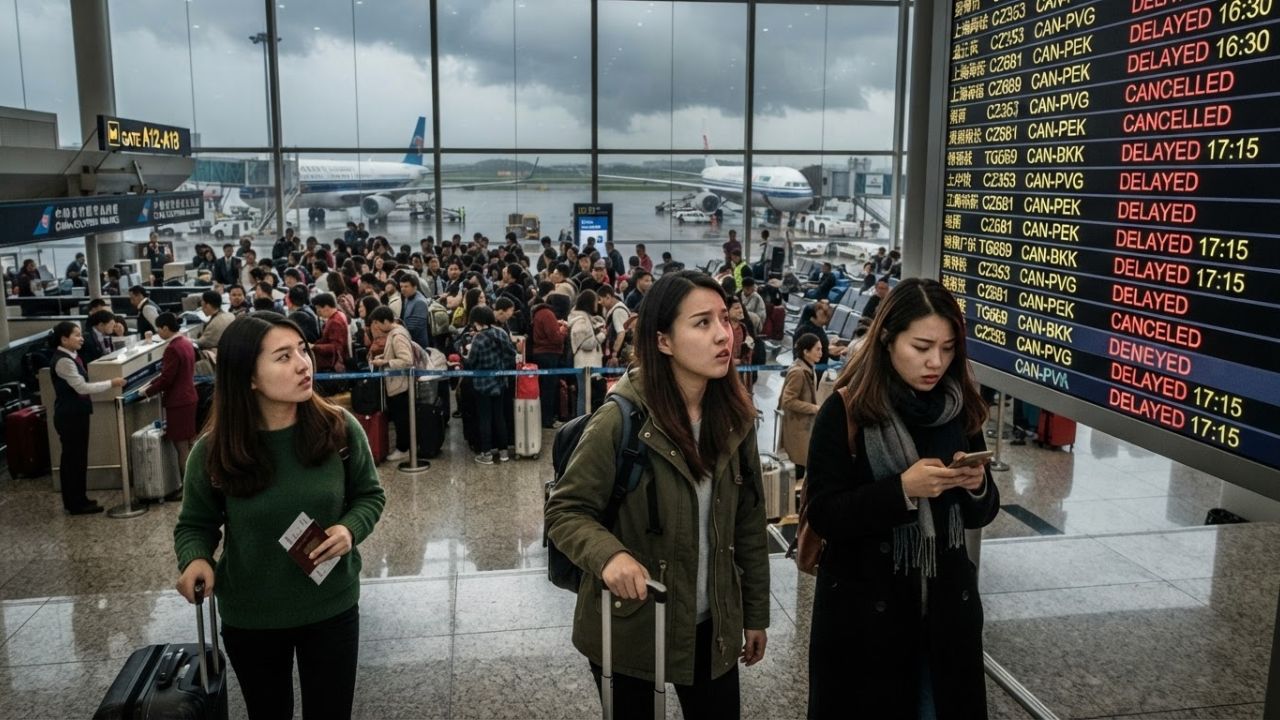
Image generated by AI
More than 4,600 flights are delayed and 276 cancellations are impacting Guangzhou and 36 other major airports across Asia as heavy seasonal weather and air congestion strain the regional aviation network.
Heavy Weather and Congestion Strain Chinese Aviation Hubs
Weather-related operational challenges and scheduling backlogs are creating significant congestion at major aviation hubs in China. Flight tracking data from FlightAware indicates that Guangzhou Baiyun International Airport (CAN) is experiencing the most severe disruption, logging 384 delays and 34 cancellations.
Other primary Chinese travel corridors are also experiencing high levels of operational pressure. Xi’an Xianyang International Airport (XIY) reports 324 delays and 7 cancellations, while Shanghai Pudong International Airport (PVG) has logged 296 delays and 3 cancellations. In western China, Chengdu Tianfu International Airport (TFU) has recorded 243 delays and 6 cancellations.
This disruption extends across additional major regional hubs in China. Shenzhen Bao’an International Airport reports 223 delays and 4 cancellations, Kunming Changshui International Airport has 175 delays and 2 cancellations, and Hangzhou Xiaoshan International Airport is managing 172 delays and 3 cancellations. Additionally, Xiamen Gaoqi International Airport recorded 151 delays and 14 cancellations, Beijing Capital International Airport logged 129 delays and 8 cancellations, Chongqing Jiangbei International Airport registered 122 delays and 5 cancellations, and Nanjing Lukou International Airport reported 109 delays and 5 cancellations.
Meteorological reports indicate that severe seasonal weather, including heavy monsoon downpours and low-visibility conditions, has significantly reduced slot capacity at major airports in Southern and Eastern China. The Civil Aviation Administration of China (CAAC) has implemented strict air traffic control flow management measures to ensure safety, which limits the number of takeoffs and landings per hour. Consequently, aircraft are held on the ground at departure airports, leading to an accumulation of delayed departures across the nation.
In addition, because Guangzhou Baiyun and Shanghai Pudong serve as major international gateways, the high concentration of wide-body aircraft scheduled for long-haul routes to Europe and North America creates secondary bottlenecks. When a single long-haul flight is delayed due to weather, it occupies gate space and prevents other arriving flights from deplaning, compounding the congestion.
Flight Delays Expand Across India, Japan, and Southeast Asia
The scheduling pressure is felt well beyond China's borders, impacting key connection points in neighboring countries. In India, Indira Gandhi International Airport in Delhi reports 174 delays and 8 cancellations, while Chhatrapati Shivaji Maharaj International Airport in Mumbai is managing 113 delays and 4 cancellations.
Indian carriers also faced operational challenges. IndiGo recorded 210 delays and 7 cancellations, making it one of the most affected airlines in Asia. Air India reported 69 delays and 4 cancellations, while SpiceJet recorded 55 delays and 3 cancellations. Akasa Air experienced 22 delays and 1 cancellation.
Japanese aviation infrastructure is also facing delays, with Tokyo Haneda International Airport recording 265 delays and 1 cancellation. All Nippon Airways (ANA) has logged 106 delays, and Japan Air Commuter reports 20 delays and 2 cancellations.
Southeast Asian air hubs are dealing with similar scheduling challenges. Jakarta-Soekarno-Hatta International Airport in Indonesia reports 291 delays and 11 cancellations. Meanwhile, Suvarnabhumi Bangkok International Airport in Thailand is experiencing 273 delays and 3 cancellations, creating connection challenges for international passengers.
In India, the Directorate General of Civil Aviation (DGCA) has issued advisories reminding airlines of passenger care requirements during extended delays. Indira Gandhi International Airport (DEL) in Delhi, which operates three active runways, faces severe runway congestion during peak morning and evening departures, making it highly sensitive to schedule alterations. When weather delays in other regions disrupt the arrival queue in Delhi, it creates a backlog that affects domestic routes connecting Mumbai, Bengaluru, and Kolkata.
Southeast Asian airports, such as Jakarta-Soekarno-Hatta (CGK), are dealing with localized convective weather patterns that are common during the mid-year monsoon season. The single-runway operations or taxiway bottlenecks at these regional hubs mean that even minor scheduling delays can escalate into significant flight backlogs. Bangkok's Suvarnabhumi Airport (BKK), operating as a primary transit point between Europe and Australia, is experiencing boarding delays as travelers miss connecting flights due to inbound delays from regional airports.
Regional Airlines Manage Scheduling and Aircraft Backlogs
Major airlines across Asia are struggling to restore flight schedules while managing crew availability and aircraft routing. China Eastern Airlines has logged 530 delays, the highest number among regional carriers. China Southern Airlines is also heavily impacted, reporting 351 delays and 31 cancellations.
Other Chinese operators, including Air China with 246 delays, Shenzhen Airlines with 236 delays, and XiamenAir with 156 delays and 17 cancellations, are working to clear backlogs. In the Middle East, Saudia has reported 53 cancellations, while Emirates has recorded 163 delays.
Low-cost and full-service carriers in India and Indonesia are facing similar pressures. India's IndiGo has logged 210 delays and 7 cancellations, while Air India reports 69 delays and 4 cancellations. SpiceJet is managing 55 delays and 3 cancellations, and Akasa Air has 22 delays and 1 cancellation. In Indonesia, Batik Air has reported 99 delays and 17 cancellations, Garuda Indonesia has 48 delays and 1 cancellation, and Citilink is managing 46 delays and 1 cancellation.
The high volume of delays has placed a heavy burden on airline crew scheduling systems. Aviation safety regulations mandate strict crew duty time limits to prevent pilot fatigue. When flights are delayed by several hours, crew members frequently exceed their legal working limits, forcing airlines to find reserve crews or cancel flights entirely. This explains the elevated cancellation figures reported by carriers like Saudia, which logged 53 cancellations, and China Southern, which recorded 31 cancellations.
Low-cost carriers, which operate on tight aircraft turnaround times of 30 minutes or less, are particularly vulnerable to these delays. A delay on the first flight of the morning for an IndiGo Airbus A320 or a Batik Air Boeing 737 will cascade through the entire daily schedule, causing the final flights of the day to operate several hours behind schedule. This is reflected in IndiGo's 210 delays and Batik Air's 99 delays.
Key Passenger Rights and Rebooking Advice
For passengers affected by these flight delays and cancellations, clear communication and proactive planning are necessary to minimize disruptions. Flight tracking data logs indicate that schedules can shift rapidly, making it vital to monitor updates on airline mobile applications and official airport portals before departing for the terminal.
Travellers should arrive at airports early to allow extra time for baggage check-in, security screening, and boarding processes. For those experiencing cancellations, contacting the airline immediately is the best way to secure rebooking options or initiate refund processes.
Passengers with connecting flights through major hubs, such as Shanghai, Guangzhou, Delhi, Bangkok, Jakarta, or Tokyo, should review their onward travel arrangements carefully. A delay on the first leg of a journey can create a cascading effect, causing passengers to miss subsequent connection windows.
Under regional consumer protection rules, passengers may be entitled to assistance depending on the duration of the delay. In China and India, airlines are required to provide meals, refreshments, and communication access for delays exceeding two to three hours. For overnight delays, carriers must arrange hotel accommodations and ground transportation, though implementation can vary during widespread disruptions when local hotels reach capacity.
Travellers should also verify their travel insurance policies. Many premium travel insurance plans cover meal and lodging expenses during delays exceeding six hours, provided the traveler secures an official written delay confirmation from the operating airline.
Why This Matters: Cascading Network Disruptions
For the traveler, this regional disruption highlights how modern hubs operate near peak capacity, where a localized delay in one city quickly spreads across international networks. Because airlines reuse aircraft throughout the day, a thunderstorm-induced delay in Guangzhou or high traffic in Jakarta can cause subsequent delays for flights departing hours later in Tokyo or Delhi.
From a logistical standpoint, the scale of these delays—totaling 4,639 delays and 276 cancellations—means that recovery times will likely extend over several days. Travel planners suggest that during periods of high demand, empty seats on alternative flights are scarce, meaning that passengers affected by cancellations may face long wait times before they can be rebooked on subsequent flights.
Additionally, the economic cost of these disruptions is substantial for both carriers and passengers. Airlines face increased fuel burn from holding patterns, landing fees at diversion airports, and passenger compensation costs, while travelers face missed hotel bookings, lost business meetings, and non-refundable tour costs.
Related Travel Guides
Disclaimer
This article is for informational and educational purposes only. It does not constitute legal, financial, or professional advice. While we strive to provide accurate and up-to-date information, travel policies, regulations, and conditions change rapidly. Always verify information with official sources before making travel decisions. Nomad Lawyer makes no representations about the accuracy, reliability, completeness, or suitability of the information provided. Readers should consult qualified professionals for advice specific to their circumstances. The views expressed in this article are those of the author and do not necessarily reflect the views of Nomad Lawyer.
Raushan Kumar
Founder & Lead Developer
Full-stack developer with 11+ years of experience and a passionate traveller. Raushan built Nomad Lawyer from the ground up with a vision to create the best travel and law experience on the web.
Learn more about our team →