
American and United Airlines Lead Global Busiest Airlines Rankings 2024-2026
American Airlines maintains its position as the world's busiest carrier, operating 2.18 million flights, while Asian carriers like IndiGo signal a major shift in global aviation frequency.

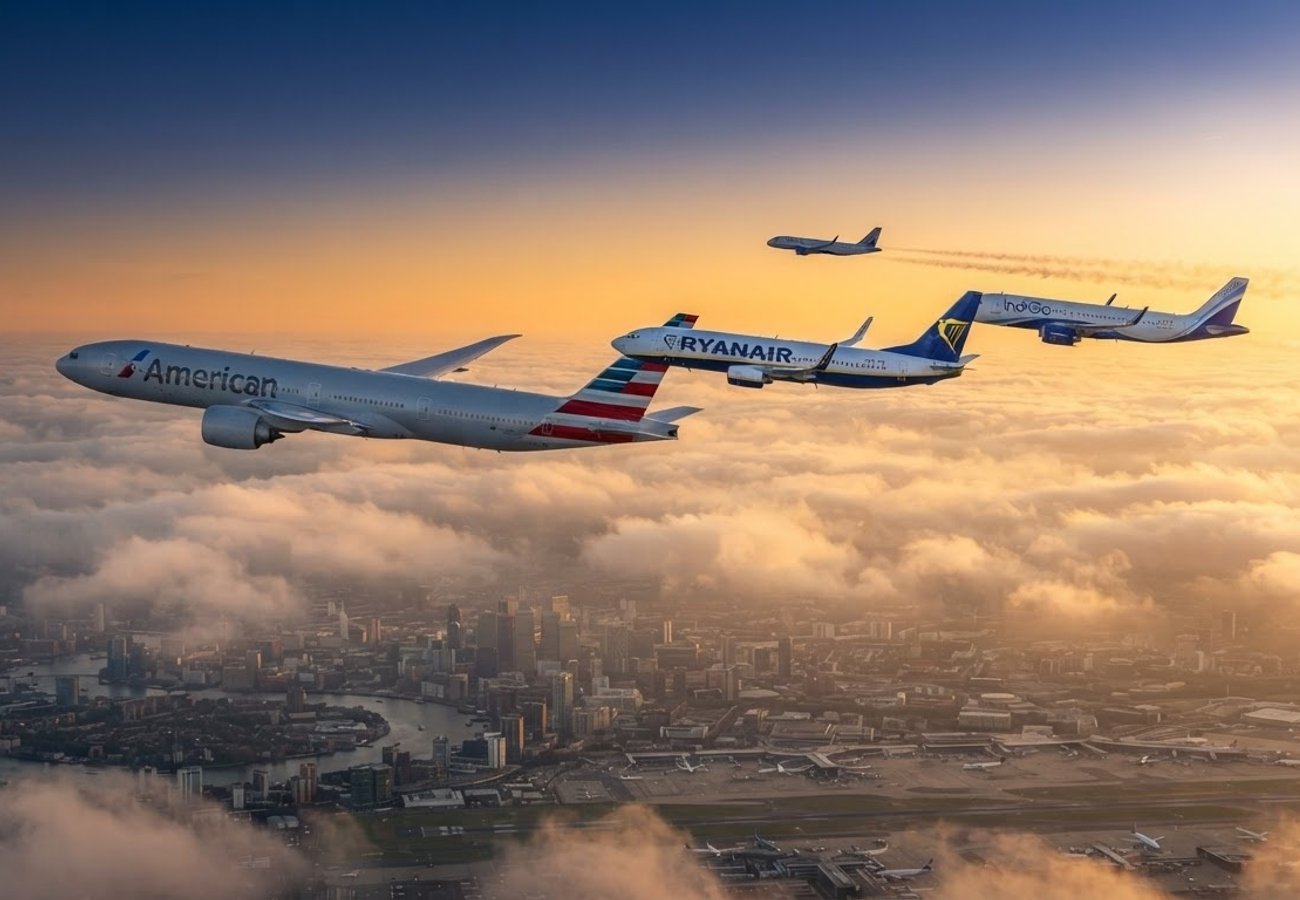
Image generated by AI
The US aviation market continues to dominate global flight frequency, with American Airlines operating 2.18 million scheduled flights to secure the top spot. However, the rise of low-cost carriers in Europe and rapid expansion in India are fundamentally altering the competitive map of the skies.
The global aviation hierarchy from 2024 through 2026 reveals a stark divide between traditional hub-and-spoke giants and the aggressive growth of low-cost carriers (LCCs). While the United States remains the primary engine of flight volume, the data indicates a strategic pivot toward emerging markets in Asia and high-utilization models in Europe.
US Market Dominance and the Hub-and-Spoke Advantage
American Airlines' position as the world's busiest carrier is not merely a result of fleet size, but a reflection of the massive scale of the US domestic market. According to the International Air Transport Association (IATA), the US handled 876 million passengers in 2024, cementing its status as the largest aviation market globally.
American Airlines leverages a sophisticated hub-and-spoke system centered on five key gateways:
- Dallas/Fort Worth
- Charlotte
- Miami
- Chicago
- Phoenix
This infrastructure, supplemented by the American Eagle regional network, allows the carrier to maintain high frequency by feeding passengers from smaller municipalities into major hubs. OAG data confirms that American Airlines led both in flight volume and seat capacity in 2024, proving that short-haul domestic frequency is the primary driver of global rankings.
The Low-Cost Disruption in Europe
While US carriers rely on domestic scale, Ireland’s Ryanair has utilized a different blueprint to secure the second position globally. Operating over 1.1 million scheduled flights in 2024, Ryanair has decoupled growth from traditional hub dependency.
The airline's success is built on three operational pillars:
- Secondary Airport Utilization: Avoiding congested primary hubs to lower costs and turnaround times.
- Fleet Standardization: Using a massive fleet of Boeing 737s to maximize maintenance efficiency.
- High Aircraft Utilization: Ensuring planes spend more time in the air than on the ground.
This model has captured the surging leisure travel demand in Europe, proving that high-frequency operations are no longer the exclusive domain of legacy flag carriers.
Asia's Ascent: The Rise of IndiGo and Chinese Giants
The most significant shift in the 2024-2026 window is the acceleration of Asian carriers. India’s IndiGo has emerged as a primary growth leader, driven by a burgeoning middle class and aggressive government investment in regional airport infrastructure.
IndiGo’s strategy centers on the Airbus A320neo family, providing the fuel efficiency and capacity needed to scale rapidly across the Indian subcontinent. Simultaneously, China's "Big Three"—China Eastern, China Southern, and Air China—continue to maintain massive volumes due to the sheer density of the Chinese domestic population.
While China has focused on rebuilding its international corridors, India is experiencing a more aggressive domestic growth trajectory, suggesting that the center of aviation gravity is shifting eastward.
Operational Shifts and Competitive Pressures (2024–2026)
The period between 2024 and 2026 highlighted that flight frequency is increasingly tied to supply chain resilience. Aircraft delivery delays from major manufacturers became a deciding factor in who could expand; airlines with existing fleet capacity or successful leasing strategies gained a competitive edge.
Passenger behavior has also evolved, with a sustained preference for affordable regional connectivity over premium long-haul travel for leisure purposes. This has directly benefited LCCs like Ryanair and IndiGo, who can scale frequency faster than legacy carriers burdened by complex legacy costs.
Global Flight Frequency Leaders
The following data illustrates the distribution of flight volumes and the carriers dominating the current era of aviation.
| Airline | Primary Market | Key Growth Driver | 2024 Flight Volume (Approx.) |
|---|---|---|---|
| American Airlines | USA | Hub-and-Spoke / Domestic Scale | 2.18 Million |
| Ryanair | Europe | Low-Cost / Secondary Airports | 1.1 Million+ |
| Delta Air Lines | USA | Domestic Network / Premium | High Frequency |
| United Airlines | USA | Global Footprint / Domestic | High Frequency |
| Southwest Airlines | USA | Point-to-Point Domestic | High Frequency |
| IndiGo | India | Middle Class Growth / A320neo | Rapid Expansion |
| China Eastern | China | Domestic Population Density | High Frequency |
| China Southern | China | Domestic Population Density | High Frequency |
| Air China | China | Domestic Population Density | High Frequency |
Key Takeaways
- US Dominance: American Airlines remains the global leader due to the unmatched scale of the US domestic market and its hub-and-spoke efficiency.
- LCC Power: Ryanair’s second-place ranking proves that the low-cost, high-utilization model is a viable alternative to traditional network carriers.
- Asian Pivot: IndiGo and Chinese carriers are leveraging domestic population growth to challenge Western dominance in flight frequency.
- Infrastructure Impact: Government investment in airports, particularly in India, is a direct catalyst for increased flight volumes.
Frequently Asked Questions
Why does American Airlines have more flights than international carriers? American focuses heavily on short-haul domestic routes. Because these flights are shorter, the airline can perform many more take-offs and landings per day compared to an airline focusing on long-haul international journeys.
How is IndiGo growing so quickly? IndiGo is capitalizing on India's expanding middle class and a government push for regional connectivity, supported by a standardized fleet of Airbus A320neo aircraft.
What is the "hub-and-spoke" model? It is a system where an airline funnels traffic from smaller "spoke" cities into a central "hub" airport, where passengers can then connect to other destinations.
The battle for aviation supremacy is moving from a contest of prestige to a race of operational efficiency and market penetration.
Related Travel Guides
Disclaimer
This article is for informational and educational purposes only. It does not constitute legal, financial, or professional advice. While we strive to provide accurate and up-to-date information, travel policies, regulations, and conditions change rapidly. Always verify information with official sources before making travel decisions. Nomad Lawyer makes no representations about the accuracy, reliability, completeness, or suitability of the information provided. Readers should consult qualified professionals for advice specific to their circumstances. The views expressed in this article are those of the author and do not necessarily reflect the views of Nomad Lawyer.
Preeti Gunjan
Contributor & Community Manager
A passionate traveller and community builder. Preeti helps grow the Nomad Lawyer community, fostering engagement and bringing the reader experience to life.
Learn more about our team →