
American Airlines Flight AA2524 Diverts to Grand Rapids Due to Chicago Ground Stop
American Airlines Flight AA2524 from Seattle to Chicago diverted to Gerald R. Ford International Airport in Grand Rapids due to severe Midwest weather.

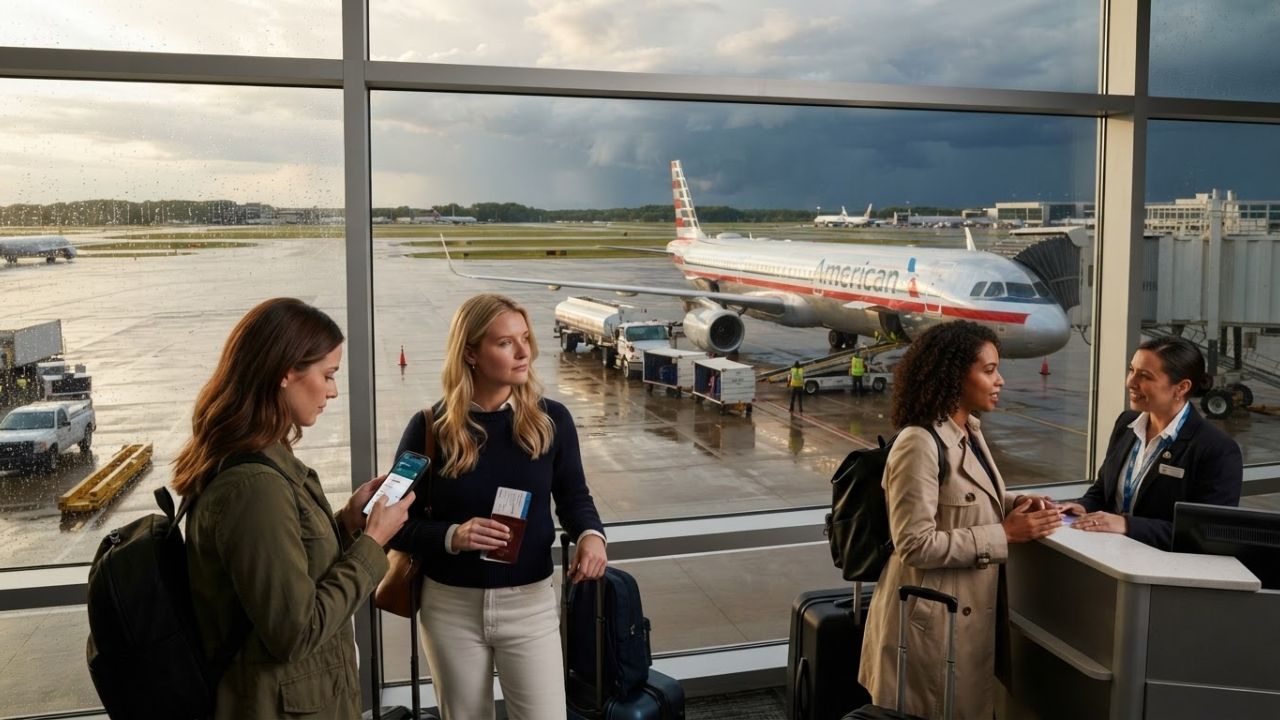
Image generated by AI
American Airlines Flight AA2524 from Seattle to Chicago Diverts to Grand Rapids Amid Severe Midwest Thunderstorms
American Airlines Flight AA2524, scheduled from Seattle to Chicago O’Hare, diverted to Gerald R. Ford International Airport in Grand Rapids due to severe weather. The Airbus A321-231 landed safely in Michigan on July 9, 2026, after holding due to a Chicago O'Hare ground stop.
The Disruption Details
Our analysis indicates that severe weather patterns in the Midwest frequently cause significant air traffic disruptions. On July 9, 2026, American Airlines Flight AA2524 departed Seattle-Tacoma International Airport (SEA) at 3:28 PM, bound for Chicago O'Hare International Airport (ORD). As the Airbus A321-231 aircraft (registration N573UW) approached the Great Lakes region, severe storm lines blocked the flight paths into Illinois.
Flight tracking systems show that the aircraft entered holding patterns as Chicago O'Hare went under a ground stop order due to lightning and wind shear. To maintain legal reserve fuel margins, the flight crew terminated the holding pattern and initiated a tactical diversion. The aircraft redirected to Gerald R. Ford International Airport (GRR) in Grand Rapids, Michigan, landing safely at 10:00 PM.
Flight & Airport Impact Breakdown
The weather-induced diversion affected travel schedules and required operational support from regional ground crews:
- Seattle to Chicago Route: A high-traffic transcontinental corridor affected by convective weather blocks across the Midwest.
- Chicago O'Hare Lockdowns: Severe lightning and storm cells triggered a ground stop, gridlocking incoming flight corridors.
- Grand Rapids Alternates: Gerald R. Ford International Airport served as the diversion site for refueling and ground handling.
- Baggage and Aircraft Repositioning: Luggage remained on the aircraft, allowing passengers to proceed on the same plane once O'Hare reopened.
Table: Flight AA2524 Operational Telemetry
| Parameter | Details | Source / Verification |
|---|---|---|
| Flight Number | AA2524 / AAL2524 | Active commercial schedule |
| Aircraft Model | Airbus A321-231 | FAA Aircraft Registry |
| Registration Number | N573UW | National Civil Registry |
| Departure Airport | Seattle-Tacoma International Airport (SEA) | Washington departure hub |
| Scheduled Destination | Chicago O'Hare International Airport (ORD) | Illinois arrival hub |
| Actual Landing Site | Gerald R. Ford International Airport (GRR) | Michigan diversion alternate |
| Departure Time | 3:28 PM local time (July 9, 2026) | Flight tracking logs |
| Actual Landing Time | 10:00 PM local time (July 9, 2026) | Regional airport arrivals log |
Passenger Rights & Advisory (Information Gain)
Passengers experiencing flight diversions within the United States should understand their protections under US Department of Transportation (DOT) guidelines. Because thunderstorms and air traffic restrictions are legally classified as weather-related, uncontrollable events, airlines are not required to pay cash compensation or provide hotel vouchers. However, carriers must still adhere to basic consumer duty of care requirements.
Under domestic tarmac delay regulations, airlines cannot keep passengers on the aircraft for more than three hours during a domestic delay without providing access to food, water, functioning restrooms, and medical attention. If the diversion is a refueling stop and the flight is not cancelled, checked baggage remains on the aircraft and cannot be retrieved until the plane reaches its final destination. Passengers should check their airline's mobile app for real-time boarding updates once weather conditions clear at the primary destination.
Industry Analyst View
Chicago O'Hare's vulnerability to convective summer storms requires close cooperation between airline dispatchers and regional airports. Utilizing secondary alternates like Grand Rapids (GRR) allows carriers to safely park and refuel narrowbody aircraft like the Airbus A321 without adding to the holding gridlock around Chicago. This operational planning minimizes network-wide delays by keeping aircraft and crews near their destination.
For flight crews, managing fuel margins during summer ground stops is a complex balancing act. Diverting to a nearby airport for fuel rather than continuing to hold prevents emergency declarations and ensures the aircraft is ready to complete the trip as soon as runways reopen. Keeping passengers onboard during refueling holds reduces terminal congestion at the alternate airport and accelerates transit times once flight paths clear.
Related Travel Guides
- United States International Air Travel Surges in Q1 2026 Driven by Global Flight Networks of Legacy Carriers
- American Airlines Adds Flights and Deploys Boeing 777-300ER to Rio de Janeiro for NFL Showdown in September 2026
- American Airlines Flight AA1811 Diverts to Harrisburg Due to Northeast Thunderstorms
Disclaimer
This article is for informational and educational purposes only. It does not constitute legal, financial, or professional advice. While we strive to provide accurate and up-to-date information, travel policies, regulations, and conditions change rapidly. Always verify information with official sources before making travel decisions. Nomad Lawyer makes no representations about the accuracy, reliability, completeness, or suitability of the information provided. Readers should consult qualified professionals for advice specific to their circumstances. The views expressed in this article are those of the author and do not necessarily reflect the views of Nomad Lawyer.
Kunal K Choudhary
Co-Founder & Contributor
A passionate traveller and tech enthusiast. Kunal contributes to the vision and growth of Nomad Lawyer, bringing fresh perspectives and driving the community forward.
Learn more about our team →