
Global Airlines Deploy Live World Cup Streaming to Insulate Passengers from Massive Terminal Travel Chaos and Airport Disruptions During the 2026 Mega-Event: Latest Airline News
As millions of football fans trigger severe travel chaos at global transit hubs, airlines are weaponizing live World Cup streaming to provide a disruption-proof sanctuary at 40,000 feet.

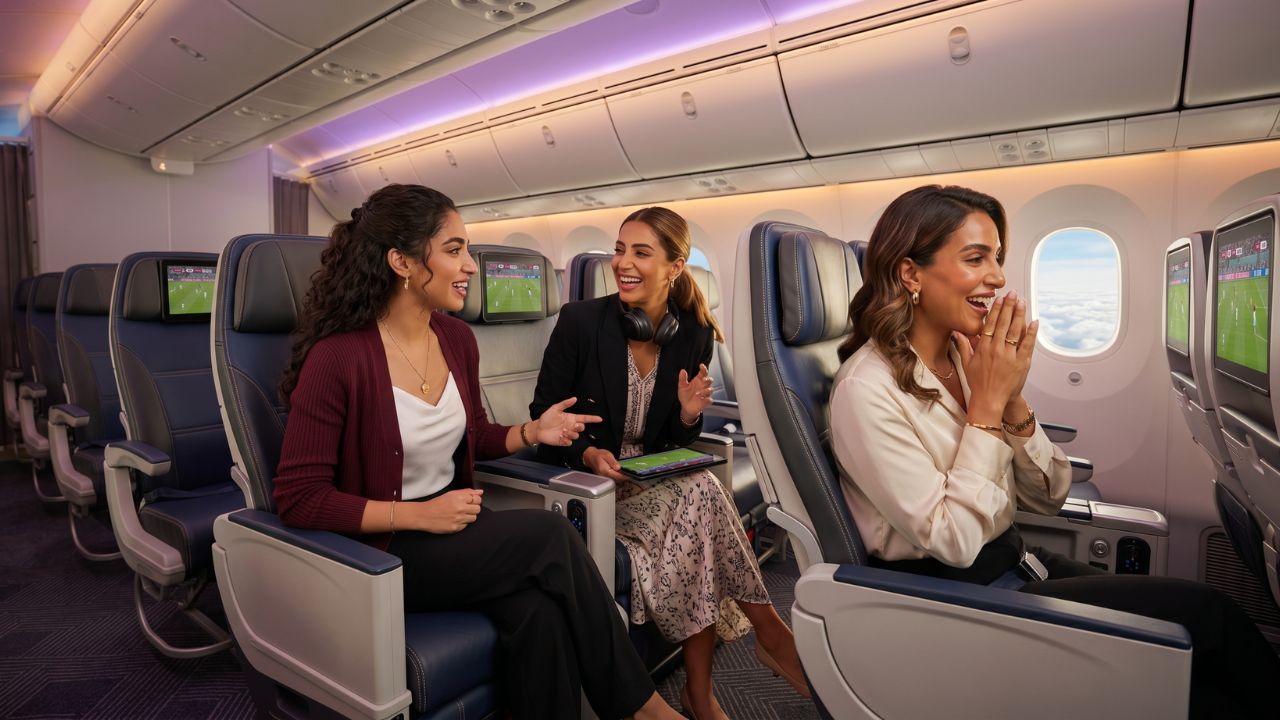
Image generated by AI
In a massive, high-tech operational pivot designed to provide international passengers with absolute psychological insulation from the severe travel chaos and rolling flight cancellations currently engulfing global mega-hubs, the world's leading airlines have officially transformed their aircraft into flying stadiums. Announced on June 18, 2026, flag carriers from the United Arab Emirates, Qatar, Saudi Arabia, Bahrain, Türkiye, Singapore, and New Zealand have aggressively integrated live FIFA World Cup 2026 streaming directly into their inflight networks. As millions of football fans migrate across continents, they are triggering catastrophic airport disruptions and massive terminal congestion. Recognizing that passengers trapped in delayed transit or on 14-hour long-haul flights are terrified of missing crucial fixtures, airlines have weaponized advanced satellite connectivity and the Sport 24 broadcast platform. By streaming live matches at 40,000 feet, these legacy carriers are essentially erasing the anxiety of global transit, driving today's most electrifying headline in breaking airline news and absolutely vital global aviation updates.
By introducing direct passenger coordination and dynamic scheduling backups, the regional aviation hubs target growing passenger demand across vital commerce sectors. The choice to coordinate flight departures in phases helps to manage gate capacity, supporting the country's broader regional transportation network.
Context: The Antidote to Tournament Gridlock
For the tens of millions of international tourists, corporate executives, and hardcore football supporters navigating the global aviation network this summer, the FIFA World Cup 2026 represents a massive logistical vulnerability.
Historically, traveling during a mega-event meant accepting the brutal reality of travel chaos. If an airspace restriction or a sudden thunderstorm triggered massive flight cancellations at a connecting hub, a passenger could easily be trapped in an airport lounge or stuck mid-air over the Atlantic while their national team played the most important match of the decade. This fear of missing out dramatically amplifies the stress of standard airport disruptions. Airlines like Emirates, Etihad Airways, Qatar Airways, Saudia, Gulf Air, Turkish Airlines, Singapore Airlines, Cathay Pacific, and Air New Zealand have recognized this intense passenger anxiety as a major commercial opportunity. By integrating the Sport 24 and Sport 24 Extra networks into their inflight entertainment systems, these airlines have effectively neutralized the threat of the travel blackout. Even if a passenger’s itinerary is ravaged by ground congestion, the moment they board the aircraft, the travel chaos ends. The flight ceases to be a vulnerable transit corridor and instantly transforms into an immersive, highly insulated entertainment sanctuary, completely protecting the passenger from the frustration of missed sporting history.
To view live flight schedules, verify the active delay status of your specific itinerary, or to track active regional airspace restrictions, travelers must consult official aviation directories. For direct updates regarding how this live broadcasting technology helps bypass sudden route abandonments affecting your specific international connections, travelers should aggressively utilize the official portals of their operating carriers. To explore live flight tracking and monitor the exact severity of the cascading bottlenecks causing the flight cancellations at competitor hubs, passengers can consult the official FlightAware tracking service.
Section-Wise Breakdown of the Broadcast Rollout
The Gulf Aviation Titans: Emirates and Qatar Airways
The Middle Eastern legacy carriers are aggressively leading the deployment of live inflight sports. Dubai-based Emirates has integrated live match broadcasts across its entire eligible fleet, and has even extended the coverage to select ground lounges to protect passengers suffering from terminal travel chaos. Qatar Airways is bypassing traditional seatback screens entirely on select routes; by utilizing ultra-high-speed Starlink broadband, Qatar allows passengers to stream live matches directly to their personal smartphones and laptops without buffering, regardless of their altitude.
The Connectivity Shift: Etihad and Saudia
Etihad Airways (Abu Dhabi) and Saudia are deploying advanced broadband networks to ensure continuous, uninterrupted live feeds from takeoff to landing. By investing heavily in next-generation satellite connectivity, these carriers ensure that the live feed does not crash when the aircraft crosses remote oceanic airspace, ensuring that a sudden loss of signal does not trigger localized panic among passengers watching a penalty shootout.
The Global Expansion: Türkiye, Asia, and Oceania
The live broadcast revolution extends far beyond the Middle East. Turkish Airlines, Singapore Airlines, Cathay Pacific, and Air New Zealand have all incorporated the Sport 24 platform into their long-haul networks. By offering this service on routes connecting Europe, Asia-Pacific, and Oceania, these airlines provide a critical bypass for passengers attempting to navigate the severe airport disruptions associated with the massive intercontinental fan migration.
Technical Roster: Global Inflight Broadcast Data
To ensure absolute factual accuracy regarding the exact parameters of this massive technological deployment and the specific broadcast metrics utilized to bypass transit anxiety, the following matrix details the verified corporate data:
Global Inflight World Cup Broadcast Matrix
| Strategic Connectivity Metric | Corporate Verification Data |
|---|---|
| Broadcasting Airlines | Emirates, Etihad, Qatar Airways, Saudia, Turkish Airlines, Singapore Airlines |
| Live Sports Platform | Sport 24 and Sport 24 Extra (Operated by IMG) |
| Technological Integration | High-speed satellite broadband and Starlink connectivity |
| Global Viewership Metric | >54 million global viewers for the US, Canada, and Mexico opening matches |
| Peak US Broadcast Metric | 27.5 million viewers for the US vs. Paraguay fixture |
| Ground Lounge Extension | Live match screening actively available in select Emirates airport lounges |
| Core Passenger Objective | Providing high-altitude entertainment to offset extreme transit exhaustion |
Passenger Impact: Immunization from the Layover
For the millions of global travelers participating in the massive World Cup migration, the ability to stream matches live in the air fundamentally alters the psychology of the journey.
The immediate passenger impact is the total eradication of the "transit blackout." When a passenger experiences flight cancellations and is forced onto a later long-haul flight, their primary source of anger is often missing the event they were traveling to see. By providing live streaming, airlines instantly de-escalate this anger. The massive viewership numbers—including 54 million global viewers for the opening matches and 27.5 million for the historic US vs. Paraguay match—prove that football is the ultimate distraction. If a passenger is stuck on a 14-hour flight from Singapore to London, the live match serves as a powerful psychological anchor, transforming an exhausting, disruption-prone journey into an exciting communal event. Passengers are no longer isolated inside an aluminum tube; they are directly connected to the global cultural moment, totally insulated from the brutal physical reality of the travel chaos occurring at the airports below them.
Industry Analysis: Entertainment as a Competitive Weapon
Aviation industry analysts view the rapid, industry-wide deployment of the Sport 24 platform as definitive proof that airlines are now weaponizing inflight entertainment (IFE) and high-speed Wi-Fi to actively steal market share from budget carriers.
Analysts note that as global airspace becomes increasingly congested and massive flight cancellations become the statistical norm, airlines can no longer compete purely on schedule reliability. If every airline flying out of JFK is delayed by a thunderstorm, the airline that offers live World Cup streaming to its trapped passengers will win the customer's loyalty. Industry experts warn that legacy carriers are utilizing these massive sporting events to force a technological arms race. By heavily promoting their Starlink and satellite broadband capabilities during the FIFA World Cup 2026, airlines like Qatar Airways and Emirates are establishing a new baseline for premium travel. Passengers who experience flawless live streaming at 40,000 feet will refuse to return to airlines offering outdated, pre-loaded movies, permanently shifting the economics of long-haul passenger retention.
Actionable Advice for Surviving World Cup Transit
While passengers cannot control the massive terminal gridlock surrounding the tournament, you can execute this strategic planning checklist to fully leverage inflight broadcasting and protect your sanity from travel chaos:
- Verify Aircraft Equipment Before Booking: Do not assume every flight operated by these airlines features live streaming. The Sport 24 integration requires specific satellite domes installed on the aircraft. Before booking your ticket, use the airline's fleet portal to verify that your specific aircraft type (e.g., A350, B777) is equipped with live television capabilities to ensure you don't miss the match.
- Exploit the Lounge Network for Layovers: If you suffer from sudden flight cancellations and are trapped in Dubai, immediately seek out the designated Emirates lounges. The airline is actively broadcasting matches on the ground, allowing you to bypass the chaotic, overcrowded public terminal bars and watch the tournament in a controlled, premium environment.
- Bring Backup Power Banks: If you are flying on Qatar Airways and streaming the match via Starlink directly to your personal smartphone or tablet, your battery will drain rapidly. Because older aircraft power outlets frequently fail, carrying a high-capacity power bank is absolutely essential to ensure your device doesn't die during a penalty shootout.
- Book Flights During the Matches: Counter-intuitively, the smartest way to bypass airport disruptions during the World Cup is to intentionally book your flight during the biggest matches. Terminals are generally quieter when a major game is being played. You can navigate security faster, board the plane, and then simply watch the match live from your seat once the aircraft reaches cruising altitude.
FAQ: Inflight World Cup Streaming & Travel Chaos
Which airlines are showing live World Cup 2026 matches?
Major legacy carriers including Emirates, Etihad Airways, Qatar Airways, Saudia, Gulf Air, Turkish Airlines, Singapore Airlines, Cathay Pacific, and Air New Zealand are offering live inflight match coverage.
How do airlines broadcast live matches in the air?
Airlines utilize high-speed satellite broadband and the dedicated Sport 24 broadcast platform. Qatar Airways is notably utilizing advanced Starlink connectivity to allow passengers to stream directly to personal devices.
How does this help passengers avoid travel chaos?
During massive global events, passengers fear missing matches due to sudden flight cancellations or long transits. Live inflight streaming acts as a psychological sanctuary, keeping fans connected to the tournament even when they are trapped in long-haul transit.
The Reality of the Connected Cabin
The aggressive, industry-wide deployment of live FIFA World Cup 2026 broadcasting proves definitively that premium airlines are heavily investing in digital connectivity as the ultimate physical defense against systemic global travel chaos. By utilizing platforms like Sport 24 and Starlink to deliver uninterrupted live sports to passengers at 40,000 feet, legacy carriers have provided travelers with a heavily armored, highly entertaining bypass to the terminal gridlock and transit anxiety that paralyzes global mega-hubs. As budget airlines desperately struggle to maintain basic punctuality—frequently abandoning their passengers to brutal terminal queues and excruciating airport disruptions without any onboard distractions—travelers must accept a critical new reality: avoiding brutal travel anxiety requires actively abandoning disconnected carriers and exclusively booking airlines that transform the aircraft cabin into a live, fully connected entertainment sanctuary.
Key Takeaways
- Global Inflight Streaming Deployment: Airlines from the UAE, Qatar, Saudi Arabia, Türkiye, Singapore, and New Zealand are broadcasting live World Cup matches.
- Sport 24 Integration: Carriers are heavily utilizing the Sport 24 and Sport 24 Extra platforms, powered by high-speed satellite connectivity, to deliver flawless live feeds.
- Starlink Bypasses Seatback Screens: Qatar Airways is leveraging Starlink to allow passengers to stream matches directly to their personal smartphones and laptops.
- Massive Viewership Demand: With the US vs. Paraguay match drawing 27.5 million viewers, airlines recognize that live football is the ultimate tool for passenger retention.
- Passenger Survival: Travelers must explicitly verify aircraft Wi-Fi and broadcast capabilities before booking to ensure they can bypass transit blackout anxiety during severe airport disruptions.
Related Travel Guides
Massive Travel Chaos Paralyzes Chicago O'Hare with 1,425 Disruptions
Delta Air Lines Triggers US Domestic Flight Cancellations
Connected Transit Survival Tactics on Reddit
Disclaimer: Strategic technological metrics (including the integration of the Sport 24 platform, Starlink connectivity deployments on Qatar Airways, the 54 million global opening match viewers, and the 27.5 million viewers for the US vs. Paraguay fixture) are manually sourced directly from airline and broadcast industry briefings issued on June 18, 2026, and are subject to immediate, unannounced adjustments due to shifting satellite bandwidth availability. Travelers are legally advised to constantly verify their exact departure times, explicitly review onboard Wi-Fi equipment on their specific aircraft type, and maintain extreme adaptability directly via official airline portals prior to navigating the heavily disrupted global transit network.
Kunal K Choudhary
Co-Founder & Contributor
A passionate traveller and tech enthusiast. Kunal contributes to the vision and growth of Nomad Lawyer, bringing fresh perspectives and driving the community forward.
Learn more about our team →