
Air Canada Gridlocked: 174 Flight Delays and 13 Cancellations Rattle Major Canadian Airports
As severe weather fronts stall transborder corridors, Air Canada travelers are facing massive disruptions across Toronto, Montreal, Vancouver, Ottawa, and Calgary.

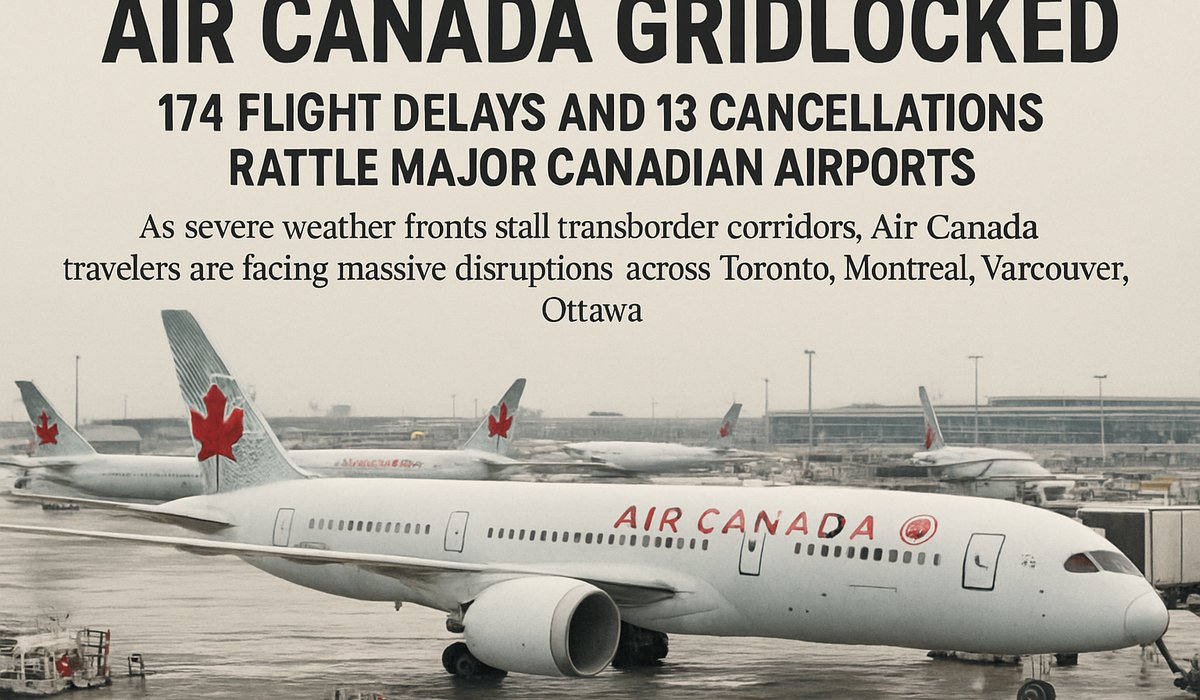
Image generated by AI
Transborder Friction Paralyzes the Flag Carrier
Demonstrating the extreme vulnerability of the deeply interconnected North American airspace, Air Canada has suffered a massive operational meltdown, recording 174 severe flight delays and 13 absolute cancellations within a single 24-hour cycle. Heavily triggered by violent storm systems moving across the US-Canada border, the disruption has effectively choked the nation’s primary aviation arteries—concentrating the absolute worst of the damage in Toronto (YYZ), Montreal (YUL), Vancouver (YVR), Ottawa (YOW), and Calgary (YYC).
When thousands of passengers are displaced by a flag carrier, the ripple effect is phenomenally violent. Air Canada, the largest carrier in the country, operates a massive "hub-and-spoke" model that relies on precision timing. Because major Canadian hubs like Toronto Pearson physically function as extensions of the US air traffic grid, a thunderstorm over Chicago or New York mathematically prevents Air Canada jets from reaching their Canadian gates. The result is a massive backlog of travelers stranded in terminal lounges, desperately attempting to re-negotiate their connecting international itineraries to Europe and Asia.
Analyzing the Hub Breakdown
The true pain of this disruption lies directly in the geographical bottlenecks of the Canadian network.
Toronto Pearson (YYZ) remains the absolute epicenter of the crisis, absorbing the highest volume of delays as a primary transborder crossing point. Simultaneously, Montreal and Calgary are experiencing "Secondary Failure," where the lack of arriving aircraft from the East has starved the regional networks of their next rotations. Travelers are findings themselves trapped in "the connection gap"—where their first flight arrives three hours late, mathematically ensuring they miss their once-daily trans-Pacific or trans-Atlantic departure.
Air Canada 2026 Hub Disruption Data
| Affected Canadian Hub | Flight Delays | Absolute Cancellations | Disruption Severity |
|---|---|---|---|
| Toronto (YYZ) | Major Surge | High | Absolute Gridlock |
| Montreal (YUL) | 45+ | Moderate | Connection Severs |
| Vancouver / Calgary | Cascading | Low | Tarmac holds |
What Guests Get
- Understanding transborder physics — realizing that "sunny weather in Toronto" means absolutely nothing if your airplane is currently held on the ground in the United States.
- The "hub-and-spoke" risk — recognizing that your international vacation depends entirely on the precision arrival of a domestic flight that is currently caught in a border-crossing bottleneck.
- Consumer protection frustration — grasping why Air Canada is legally not obligated to pay compensation for weather-related delays under existing Canadian law.
What This Means for Travelers
If you possess an Air Canada ticket this week: Reach a high-level digital status immediately. Download the official Air Canada mobile app and set up your biometric notifications. If the app displays a "Schedule Change" for your flight, do not travel to the airport. Generally, Air Canada provides a self-rebooking link inside the app that allows you to snag an alternative seat before the physical lines at the airport ticket counters even form.
The APPR Reality Check: Under the Air Passenger Protection Regulations (APPR), if your delay is officially classified as "Within the Airline's Control but Required for Safety" (like weather-related mechanical holds), Air Canada is legally permitted to deny cash compensation. However, they are still obligated to provide meal vouchers and "standards of treatment" if the delay exceeds two hours. Be aggressive in demanding these vouchers at the gate; do not expect the airline to proactively offer them to you.
FAQ: Surviving Air Canada Delays
Is it safe to transit through Toronto right now? The airport is physically safe and operational, but the sheer volume of delayed passengers is resulting in massive congestion at the Air Canada "Customer Service" desks inside the secure zone.
Why does a US storm stop a flight between Toronto and Montreal? Because the physical aircraft that flies between Toronto and Montreal likely just arrived from a US city like Chicago. If that aircraft is held in Chicago, the subsequent domestic flight to Montreal is mathematically canceled.
Can I get a refund if I cancel my delayed flight? Yes. If your Air Canada flight is delayed by more than three hours, you are entitled to cancel your trip and receive a full refund to your original form of payment, even if you purchased a "Non-Refundable" fare.
Related Travel Guides
The Survival Guide to Toronto Pearson: Quiet Zones and Lounges
Understanding Canada's APPR: Your Rights as an Air Canada Passenger
Disclaimer
This article is for informational and educational purposes only. It does not constitute legal, financial, or professional advice. While we strive to provide accurate and up-to-date information, travel policies, regulations, and conditions change rapidly. Always verify information with official sources before making travel decisions. Nomad Lawyer makes no representations about the accuracy, reliability, completeness, or suitability of the information provided. Readers should consult qualified professionals for advice specific to their circumstances. The views expressed in this article are those of the author and do not necessarily reflect the views of Nomad Lawyer.
Raushan Kumar
Founder & Lead Developer
Full-stack developer with 11+ years of experience and a passionate traveller. Raushan built Nomad Lawyer from the ground up with a vision to create the best travel and law experience on the web.
Learn more about our team →