
AI-Powered Borders, Biometric Travel & Real-Time Risk Intelligence Reshape Global Aviation Security in 2026
Europe, US, Asia-Pacific and Middle East deploy AI, facial recognition, digital identity systems and predictive analytics to create seamless, safer international travel. Here's what nomadic professionals need to know.

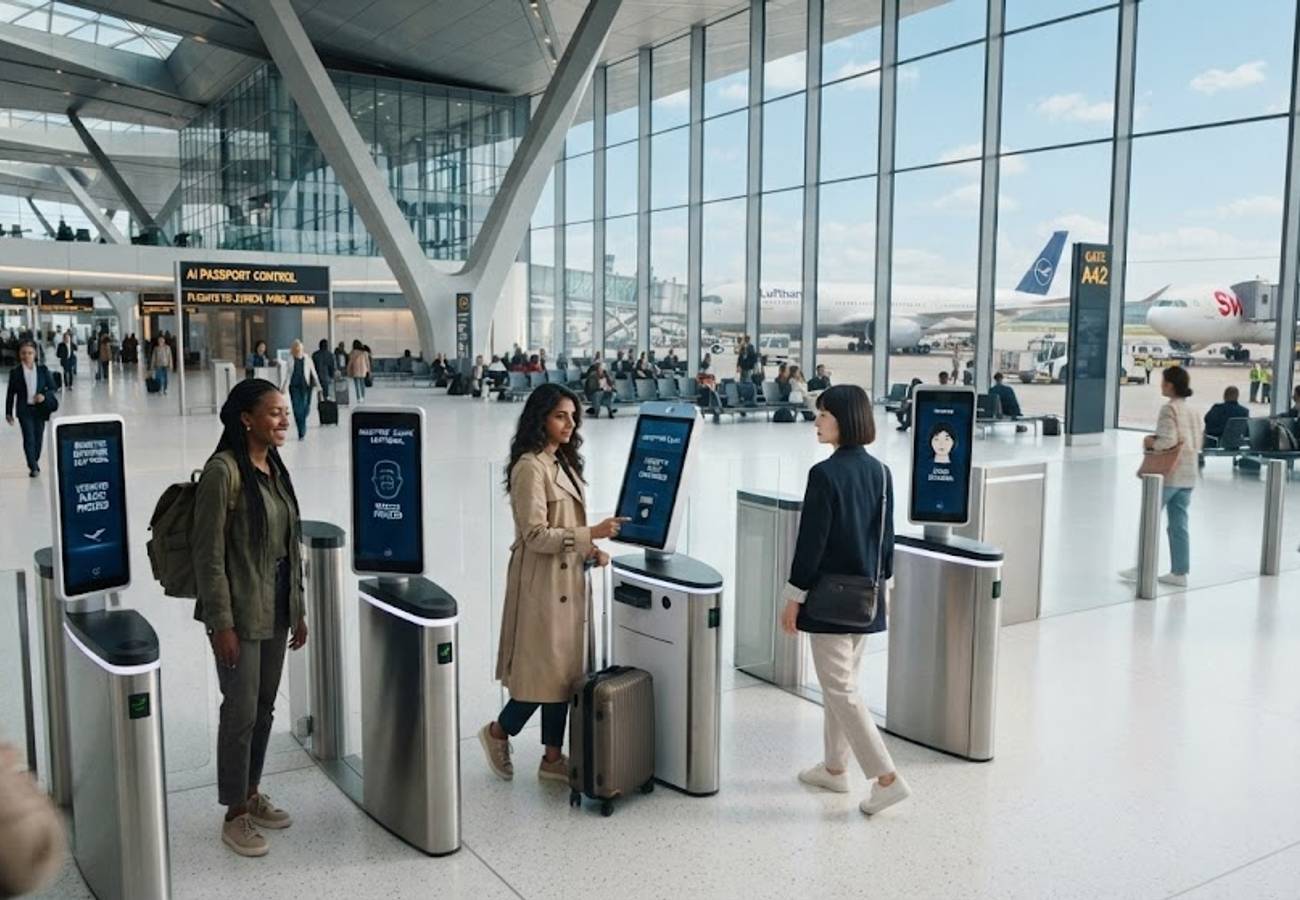
Image generated by AI
The global travel industry is experiencing a fundamental security overhaul. From facial recognition gates at European airports to AI-powered risk prediction in the United States, from digital identity wallets across Asia-Pacific to real-time threat intelligence in the Middle East—technology is fundamentally rewiring how millions of international travellers move across borders.
I've covered aviation security for years, but what's happening right now is different. This isn't incremental improvement. This is a complete reimagining of the relationship between traveller safety, operational efficiency, and personal convenience.
The Intelligence Revolution: AI Becomes the New Border Guard
Artificial intelligence is no longer a future concept in travel security—it's operational reality today. Modern airports and border agencies are deploying sophisticated AI platforms that process extraordinary volumes of data in real time: weather patterns, geopolitical developments, transport disruptions, historical incident data, and infrastructure performance metrics.
The difference between yesterday's security model and today's? Traditional systems asked the same questions of every single traveller. Modern AI-driven systems ask smarter questions of fewer people, allowing lower-risk passengers to move through checkpoints faster while allocating security resources where they're genuinely needed.
Reddit: "Went through Frankfurt's new biometric gates last month—took 8 seconds total. No document checks, no questioning. Just walk through." — r/digitalnomad
Predictive analytics now enables security agencies to identify emerging vulnerabilities before they become operational crises. Instead of responding to disruptions, airports and airlines are increasingly preventing them.
Biometrics: Your Face Is Your Passport
Facial recognition technology has evolved from surveillance concern to traveller convenience tool—and adoption is accelerating rapidly. Iris scanning, contactless fingerprint systems, and multi-factor biometric verification are reducing the friction that has plagued international travel for decades.
Here's what matters: travellers no longer need to repeatedly present documents at every checkpoint. A single biometric scan creates a verified identity record that follows you seamlessly from airport entrance to aircraft door. Speed increases measurably. Fraud detection improves dramatically.
The technology is particularly transformative for frequent international business travellers and digital nomads juggling multiple passports or visa conditions. Biometric systems don't care about document formatting—they verify the actual person in front of the scanner.
Digital Identity Wallets: Control Your Own Travel Data
Rather than clutching physical documents and hoping nothing gets lost, savvy travellers are increasingly storing verified credentials in secure digital wallets—encrypted storage systems on personal devices that grant selective access to authorized parties.
This shifts power dynamics fundamentally. You decide what information border agents see. You control what airlines access. You maintain privacy while proving identity. It's a remarkably elegant solution that simultaneously strengthens security and protects personal data.
The rollout varies by region. Europe is advancing rapidly through the EU Digital Identity Framework. The United States is piloting digital credential systems through trusted travel programs. Asia-Pacific governments are integrating digital identity into national mobility infrastructure.
Cybersecurity: The Invisible Threat Gets Visible
As travel becomes increasingly digitized—mobile boarding passes, cloud reservations, biometric verification, contactless payments—the attack surface for cybercriminals expands exponentially.
This is where the security evolution becomes genuinely serious. Advanced encryption, multi-factor authentication, behavioural monitoring, and AI-driven fraud detection now operate continuously across every transaction. Real-time monitoring systems identify suspicious activities—unusual logins, fraudulent bookings, account takeovers—within milliseconds.
For digital nomads and frequent business travellers particularly, this matters. Your travel accounts represent high-value targets because they connect to payment methods, passport information, and itineraries. Modern security systems are specifically engineered to protect exactly what criminals want to steal.
Real-Time Intelligence Networks: Global Awareness, Local Response
Modern travel risk management has evolved beyond airports and borders. Continuous intelligence networks now monitor global events—severe weather, civil unrest, transport strikes, disease outbreaks, infrastructure failures—and translate that information into actionable traveller guidance.
Corporate travel managers particularly benefit from these systems. When unexpected disruptions occur, organizations can instantly identify affected employees, communicate safety guidance, and coordinate alternative arrangements. The speed of response has compressed from hours to minutes.
Solo travellers also benefit through automated alerts about safety conditions in destinations they're approaching. Rather than discovering problems upon arrival, you receive guidance proactively.
Smart Airports: Where Technology Meets Operations
Modern airports are deploying interconnected ecosystems—smart sensors, automated security lanes, digital twins of terminal operations, integrated platforms that monitor passenger flows continuously—that simultaneously enhance security and improve efficiency.
Machine intelligence complements experienced security personnel by rapidly analysing operational information that would otherwise overwhelm human processing capacity. This isn't replacement. It's augmentation. The combination produces better decision-making than either humans or machines alone.
The result? Airports that adapt dynamically to changing conditions rather than operating on fixed protocols designed for average days. When congestion builds, the system responds. When risks elevate, resources redirect immediately.
Climate Resilience: A New Security Frontier
Travel risk management has expanded beyond traditional physical threats to encompass climate resilience and operational continuity. Heatwaves, flooding, wildfires, and severe storms now present cascading challenges for global transport networks.
Airlines and tourism organizations increasingly invest in advanced forecasting technologies that support proactive planning rather than reactive crisis management. Smart systems now predict infrastructure vulnerabilities from climate impacts weeks or months in advance, allowing operational changes before disruptions occur.
For travellers, this means smoother journeys during increasingly unpredictable weather conditions. For operators, it means dramatically improved resilience without requiring expensive physical infrastructure upgrades.
Privacy, Consent, and International Standards: The Governance Challenge
Technological capability and ethical governance don't always align. Digital security innovations raise legitimate concerns about surveillance, personal data ownership, and government overreach.
Progressive jurisdictions are embracing privacy-by-design principles that prioritize transparency and informed consent throughout the travel experience. You should understand exactly what data is collected, how it's used, who accesses it, and how long it's retained.
Long-term success of this security revolution depends upon stronger international collaboration. Greater interoperability across digital identity systems, unified security standards, and transparent information-sharing frameworks will create a genuinely connected ecosystem rather than fragmented regional systems.
Governments, airlines, airports, border agencies, and technology providers must embrace international cooperation. The alternative—incompatible systems requiring redundant verification processes—defeats the purpose of modernization.
What This Means for Nomadic Professionals
If you're a digital nomad, frequent business traveller, or location-independent professional, these changes directly affect your mobility:
Faster border crossings. Biometric systems eliminate document verification delays. Some travellers report sub-10-second processing times through modern automated gates.
Better data protection. Digital identity wallets give you control over personal information rather than surrendering documents to officials.
Smarter safety alerts. Real-time intelligence networks help you avoid destinations or regions experiencing unexpected disruptions.
Seamless rebooking. When disruptions occur, automated systems and continuous communication reduce stress and maintain travel continuity.
The travel security landscape is fundamentally different from five years ago. Technology has shifted the balance from convenience versus security toward achieving both simultaneously.
The future isn't about more checkpoints—it's about smarter checkpoints that respect both safety and privacy.
Related Travel Guides
Disclaimer
This article is for informational and educational purposes only. It does not constitute legal, financial, or professional advice. While we strive to provide accurate and up-to-date information, travel policies, regulations, and conditions change rapidly. Always verify information with official sources before making travel decisions. Nomad Lawyer makes no representations about the accuracy, reliability, completeness, or suitability of the information provided. Readers should consult qualified professionals for advice specific to their circumstances. The views expressed in this article are those of the author and do not necessarily reflect the views of Nomad Lawyer.
Raushan Kumar
Founder & Lead Developer
Full-stack developer with 11+ years of experience and a passionate traveller. Raushan built Nomad Lawyer from the ground up with a vision to create the best travel and law experience on the web.
Learn more about our team →