
Accessible Beach Infrastructure Transforms Wheelchair Travel in the US
US coastal destinations like Virginia Beach and Mission Beach are implementing sand access mats and adaptive equipment for wheelchair travel.

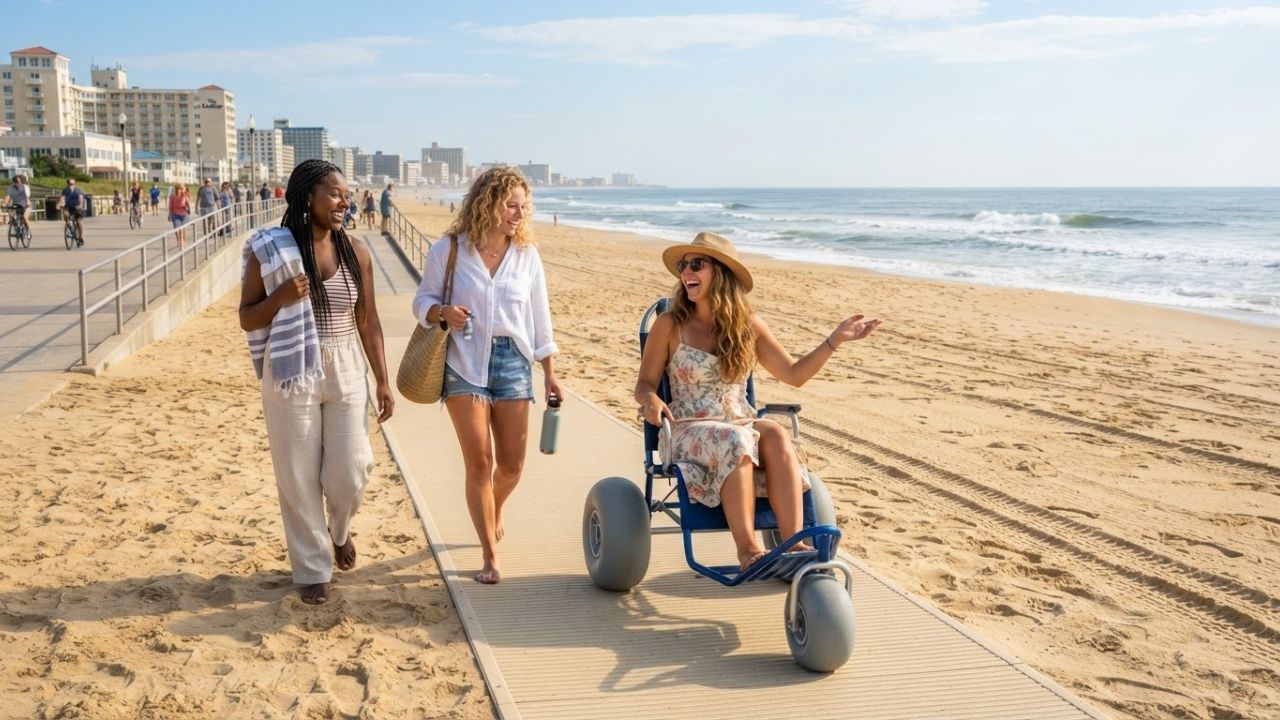
Image generated by AI
Coastal destinations across the United States are investing in barrier-free infrastructure to improve wheelchair travel and support visitors with mobility challenges. From sand access mats to public transit integrations, these adaptations are reshaping domestic beach tourism and expanding travel choices for millions.
Coastal Accessibility Deployments
Our analysis of municipal tourism budgets shows a growing focus on barrier-free oceanfront developments. Destinations are shifting from basic ramps to complete accessibility loops that link parking, hotels, and shoreline entry points. This transition enables elderly travelers and wheelchair users to navigate coastal areas independently verified by U.S. Access Board design metrics.
In Virginia Beach, the three-mile paved Oceanfront Boardwalk serves as the foundation for the city's accessibility network, featuring wooden extensions and free all-terrain beach wheelchairs with balloon tires at 17th and 24th Streets. In California, San Diego's Mission Beach uses non-slip Mobi-Mat pathways to extend wheelchair paths directly over loose sand, supported by MTS accessible trolley systems. Gulf Shores in Alabama, Pensacola Beach in Florida, and Myrtle Beach in South Carolina have deployed similar mat networks to connect parking bays with active surf zones.
Accessibility Infrastructure and Transit Matrix
The comparative table below summarizes the visitor statistics and primary mobility infrastructure deployed across leading U.S. coastal hubs:
| Destination | Main Mobility Feature | Primary Transit Support | 2023 Visitors | 2024 Visitors | 2025 Estimate |
|---|---|---|---|---|---|
| Virginia Beach, VA | Boardwalk ramps & balloon-tire chairs | Hampton Roads Transit (HRT) | 13.6 Million | 13.8 Million | ~14.0 Million |
| Mission Beach, CA | Mobi-Mats & powered sand wheelchairs | San Diego MTS Trolley | 30.5 Million | 31.2 Million | 31.8 Million |
| Gulf Shores, AL | AccessMat systems & roll-in showers | Baldwin Transit (BRATS) | 8.0 Million | 8.2 Million | 8.4 Million |
| Pensacola Beach, FL | Mobi-Mats & Casino Beach ramp setups | Escambia Transit (ECAT) | 2.4 Million | 2.5 Million | 2.6 Million |
| Myrtle Beach, SC | 40+ ramp entry zones & beach patrol chairs | Coast RTA Buses | 19.0 Million | 19.5 Million | 20.0 Million |
Passenger Rights & Advisory (Information Gain & Experience)
For travelers booking inclusive beach holidays, verifying local hardware availability is key:
- ADA Transit Accessibility Commitments: Under U.S. Department of Transportation (DOT) ADA rules, all municipal bus lines and beach shuttles must feature wheelchair lifts and securement bays. If a public shuttle is not accessible, the transit agency must provide equivalent paratransit support at no extra cost.
- Pre-Arrival Reservation Checks: While beach wheelchairs are generally free, some municipal programs operate on a first-come, first-served basis. Travelers should contact local lifeguard stations or beach patrols to confirm reservation policies before heading to the terminal.
- Hotel Access Verification: Travelers should verify step-free entrance clearances and roll-in shower layouts directly with hotel receptionists rather than relying on third-party booking sites.
Industry Analyst View
The deployment of sand access pathways and all-terrain equipment demonstrates the commercial value of inclusive travel design. Access services do not just support wheelchair users, but also assist families with strollers and elderly travelers, expanding the total destination market share.
Additionally, maintaining this transit infrastructure requires close cooperation between municipal managers and transit providers to keep boarding ramps clean. To support passenger recovery, beach patrols must conduct regular checks on balloon-tire frames and keep paths clear of debris. This coordination remains key to securing customer trust and driving regional coastal yields as tourism demand grows.
Related Travel Guides
Disclaimer
This article is for informational and educational purposes only. It does not constitute legal, financial, or professional advice. While we strive to provide accurate and up-to-date information, travel policies, regulations, and conditions change rapidly. Always verify information with official sources before making travel decisions. Nomad Lawyer makes no representations about the accuracy, reliability, completeness, or suitability of the information provided. Readers should consult qualified professionals for advice specific to their circumstances. The views expressed in this article are those of the author and do not necessarily reflect the views of Nomad Lawyer.
Kunal K Choudhary
Co-Founder & Contributor
A passionate traveller and tech enthusiast. Kunal contributes to the vision and growth of Nomad Lawyer, bringing fresh perspectives and driving the community forward.
Learn more about our team →